
Welcome to Modern Agriculture!

To understand integrated farming system, lets first have an understanding of farming system.
The term “Farming system” is used to describe an agricultural system that preserves land productivity, environmental quality, and maintains a desirable level of biological diversity and ecological stability. Rather than on the gross output, the emphasis is placed mainly on the system.
A farming system consists of a variety of farm enterprises, including: cropping systems, horticulture, livestock, fisheries, forestry, poultry and the means available to the farmer to raise them profitably.
As a result, it interacts with the environment appropriately without disrupting the ecological and socioeconomic balance on the one hand, while simultaneously achieving the national goal on the other. In its real sense, the farming system can help in many ways to lift the economy of agriculture and standard of living of the farmers in general.
Farming system is a mix of farm enterprises such as crop, livestock, aquaculture, agro forestry and fruit crops to which farm family allocates its resources in order to efficiently manage the existing environment for the attainment of the family goal. Pandey et al 1992
Farming system is a resource management strategy to achieve economic and sustained agricultural production to meet diverse requirements of farm livelihood while preserving resource base and maintaining a high level of environment quality. Lal and Miller 1990
In early farming system, the agricultural research focus was on how to increase specific crop yields.
It became increasingly apparent that reductionist, command-and-control approaches to agricultural research were unproductive, especially when it became evident that farms are far more heterogeneous than previously thought.
Farming system research was then consciously switched to “people-centred learning process” rather than the earlier “technological blueprint” approach.
Instead of just providing technology for greater yields, the scientists also started to work on how the inter-dependency of various elements of a farming system (such as crops, animal husbandry, manure, fishery, soil management etc) can be established and can be used for more sustainability and profit. Scientist also started working on how different aspects of a farming system can be intertwined in different eco systems and geographical locations.
The farming system research activities should be farmer-oriented, system-oriented, problem-solving, inter-disciplinary, complement the mainstream disciplinary research, test the technology in on-farm trials, and provide feedback to the farmers.
The “Farmer First and Last” (FFL) model is an alternative to the “Transfer of Technology” model (TOT), since it is based on the farmer’s perceptions and priorities rather than on the scientist’s professional preferences.
Agricultural practices such as the liberal use of inorganic pesticides and fertilizers during the twentieth century enhanced productivity significantly, but undesirable environmental degradation and increased operational costs in agriculture raised concerns about the economic feasibility and sustainability of agriculture.
Approximately 75% of the adversely affected households reside in rural areas of developing economies whose livelihood is directly or indirectly dependent on agriculture.
As in India, the average farm size is shrinking and there are financial constraints for higher investment in agriculture due to 80% of farm families belonging to the small and marginal farmer categories. Pollution from unsustainable farming threatens the livelihoods of millions of small farmers.
To increase income and food and nutrition security in developing countries, it is essential to strengthening agricultural production systems for greater sustainability and economic returns. Hence, the concept of integrated farming is introduced.
Integrated farming system(IFS) is subset of Farming system research(FSR). An integrated farming system is an eco-friendly approach that turns waste from one enterprise into nutrients for another, thereby maximizing the use of resources from the farm.
IFS is acomponent of Farming System Research (FSR), introduces a change in the farming techniques for maximum production in the cropping pattern and takes care of optimal utilization of resources.Dr. C Jayanthi – Integrated farming system: A path to sustainable agriculture. 2nd edition, 2006
It is the scientific integration of different interdependent and interacting farm enterprises for the efficient use of land, labour and other resources of a farm family which provide year-round income to farmers specially located in the handicapped zone.
integration is made in such a way that the product i.e. output of one enterprise / component should be the input for the other enterprises with high degree of complementarity effects.Panke et al. ,2010
The rationale of IFS is to minimize the wastes from the various sub systems on the farm and thus it improves employment opportunities, nutritional security and income of the rural people.
The farm wastes are better recycled for productive purposes in integrated farming system.
“there is no waste”, and “waste is only a misplaced resource which can become a valuable material for another product”FAO – Food and Agriculture Organization of the United Nations,1977
The activities in an integrated farming system are mutually supportive and interdependent. Whereas, mixed farming systems consist of components such as crops and livestock that coexist independently.
The purpose of combining crops and livestock in mixed farming is primarily to minimize risks, not to recycle resources. While in an integrated farming system, crops and livestock cooperate to create a synergy, with recycling allowing the maximum use of available resources.
Crop residues can be used for animal feed, while livestock and livestock byproduct production and processing can enhance agricultural productivity by intensifying nutrients that improve soil fertility, reducing the use of chemical fertilizers.
the distinction between the integrated farming system and the commercial farming system is not absolute, but is rather a matter of the degree of integration of resources in the farm system.Tipraqsa ,2006
The components of integrated farming system can be divided into four major categories.
(A) – CROP
Cereals, Pulses, Oilseeds, Fruits, Vegetables, Spices, Plantation crops, Flowers, Fodder/forage crop, Agro-forestry, Sugarcane, Fibre crops
(B) – Livestock & Poultry
Cattle, Buffalo, Pig, Goat, Sheep, Chicken, Duck
(C) – Fishery
Composite fish, culture, Fingerling production,Paddy cum fish culture
(D) – Secondary Agriculture
Bee keeping, Mushroom cultivation, Food processing, Vermicomposting, Biogas production, Azolla cultivation, Sericulture, Moriculture
It is possible to develop an integrated farming system by integrating the four above components (A+B, A+C, B+C, A+D, B+D, C+D, A+B+C, A+B+D, A+C+D, B+C+D, A+B+C+D).
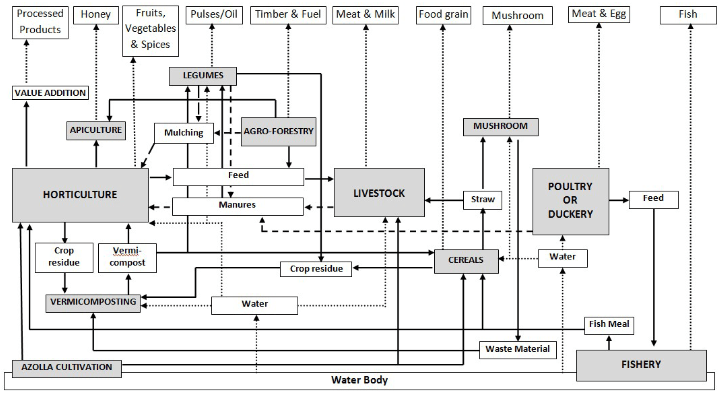
Crops, livestock, fisheries, and secondary agricultural activities are chosen according to farmer preferences, agroclimatic conditions, technology, and marketing facilities.
Depending on the ecosystem, integrated farming system can be broadly categorized in four classes:
(i) Irrigated upland integrated farming system
Because of the controlled irrigation system, a wide range of crops and varieties can be grown. A better control and management of available resources paves the way for the integration of two or more components with cropping. As compared to lowlands and rainfed lands, irrigated uplands have a larger variety of components options.
The components of an irrigated upland farm, such as dairy, poultry, goats, sheep, pigs, mushrooms, apiaries, pigeons, and rabbits, can be easily integrated. In addition to perennial trees such as coconuts and other fodder trees, multi-purpose farm forestry trees can be grown along the boundaries of the fields and the farm.
Irrigated Upland integrated farming system examples
(ii) Irrigated Lowland integrated farming system
Rice is the main crop in our lowlands. In this ecosystem, bananas, sugarcane, and coconuts are also grown. Fish, poultry, duck, and mushrooms can all be part of an integrated farming system in the lowlands. Because of the abundance of available water, it is considered less risky to grow food on low land (wetlands). Additionally, lowland soils are generally heavy-textured and relatively fertile.
Irrigated Lowland integrated farming system examples
(iii) Rainfed and Dryland integrated farming system
The dryland ecosystem has Inadequate and uneven distribution of rainfall, Poor and marginal soils, Low cropping intensity, Limited crop diversification, Low value crop.
People are without jobs for the remainder of the year because the cropping season is limited to 4-5 months. Through diversification of cropping by integrating components like livestock (Sheep/Goat rearing), silviculture, horticulture tree crops, and pastures, dryland farmers can improve their standard of living and employment opportunities.
Rainfed and Dryland integrated farming system examples
(iv) Hilly Regions integrated farming system
Generally, this system is practised in hilly regions at high altitudes, where it is not possible to build terraces or irrigation channels across the slope. This system integrates forest, agriculture, livestock, and fisheries with a solid foundation for soil and water conservation.
Rainwater is collected in a pond with seepage control from protected hilltop slopes. There are several points where sediment retention tanks are constructed before runoff water enters the pond. The cultivation is wholly dependent on the amount of water in the pond.
Hilly Regions integrated farming system examples
(v) Island integrated farming system
Models of integrated farming systems have been developed for the Andaman and Nicobar Islands
Island integrated farming system examples
| Farming system | Land used for different enterprises (hectares) | Area (hectares) | Description |
|---|---|---|---|
| Broiler chicken- Crop- Fish- Duck- Horticulture- Nitrogen fixing hedge row | Pond - 0.15 Pond dyke - 0.03 Duck shed - 0.016 Broiler shed - 0.006 Field crop - 0.75 | 1.06 | In upland area, ragi (0.18 ha), maize (0.30 ha) and rice bean (0.12 ha) followed by ginger and turmeric. In lowland area: Paddy (0.65 ha) and mustard 0.30 ha were cultivated. During rabi season potato, tomato, cabage, knol khol and radish were cultivated. Nitrogen fixing shrubs were planted on contour bunds, fodder grasses and fruit trees were raised on pond dykes and farm boundaries. Ducks were reared (72 Nos) on pond dykes. Composite fish culture was practiced and 900 fingerlings were stocked. |
| Crop- Fish- Poultry- Multipurpose trees | Pond - 0.12 Pond dyke - 0.04 Poultry shed - 0.01 Field crop - 0.80 | 0.97 | In upland area, Paddy (0.45 ha) and rice bean (0.05 ha) during Kharif and buckwheat (0.50 ha) in rabi season was cultivated. In lowland area: Paddy (0.30 ha) in Kharif and potato (0.25 ha) and french bean (0.05 ha) were cultivated. Fodder grasses and fruit trees were raised on pond dyke and farm boundaries. Layer bird (52 nos.) were raised on pond dykes. Composite fish culture was practiced and 720 fingerlings were stocked. |
| Crop- Fish- Goat- Multipurpose trees- Hedge rows | Pond - 0.10 Pond dyke - 0.035 Goat shed - 0.008 Field crop - 0.80 Hedge row - 0.10 | 1.04 | In upland area, Paddy (0.30 ha), ginger (0.30 ha), turmeric (0.20 ha) during kharif and mustard (0.30), tomato (0.40 ha) and radish (0.10 ha) during rabi season were grown. Fodder grasses, MPTs and fruit trees were cultivated on pond dike and farm boundary. Goats (6 nos) were reared on pond dyke. Composite fish culture was practiced and 600 fingerlings were stocked. |
| Crop- Fish- Pig- Bamboo- Multipurpose trees- Fruit- trees- Hedge rows | Pond - 0.12 Pond dyke - 0.035 Pig shed - 0.001 Field crop - 0.80 Hedge row - 0.09 | 1.05 | In upland area, Paddy (0.30 ha), colocasia (0.10 ga) and maize (0.40 ha) during kharif and brinjal (0.10 ha), radish (0.05 ha), potato (0.30 ha) and buck wheat (0.15 ha) during rabi season were cultivated. MPTs and fruit trees were raised on pond dykes and farm boundaries. Edible bamboo species were also cultivated on farm boundary. Hedge row rows were planted on contour bunds. Vermicompost was prepared in two units each of 12’ x 6’ x 2’ size. Pigs (2 Nos) on pond dykes. Composite fish culture was practiced and 720 fingerlings were stocked. |
| Crop- Fish- Dairy- Multipurpose trees- Fruit- trees- Hedge rows- Vermiculture- Liquid manure- Broom | Pond - 0.12 Pond dyke - 0.06 Dairy shed - 0.016 Field crop - 0.80 Hedge row - 0.17 | 1.17 | In upland area paddy (0.60 ha) was cultivated. Broom grass (0.10 ha) and job’s tear (0.10 ha) were cultivated along the water channels. MPTs and fruit trees with fodder grasses were raised on pond dyke and farm boundary. Cattle ( 2 milch cows and 2 calves) was reared. Oyster mushroom was cultivated in 8 m x 3 m x 2.5 m size unit. Liquid manure was prepared in 3 units 3’ x 3’ x 2.5’ capacity. Vermi- composting was done in 6 units of 1 m x 1 m x 0.75 m. Composite fish culture was practiced in the ponds. Composite fish culture was practiced and 720 fingerlings were stocked. |
| Upland crops, and fish farming without integration (control) | Pond - 0.10 Pond dyke - 0.05 Crop area - 0.80 | 0.95 | In upland area, paddy (0.40 ha) and maize (0.40 ha) during khraif season and buck wheat (0.20 ha) and frenchbean (0.30 ha) were grown. Fruit trees were grown on pond dyke. Composite fish culture was practiced and 600 fingerlings were stocked. |
With 2.2% of the global geographical area, India is home to more than 15% of the total world population, with 70% of them dependent on agriculture. Out of 328.73 million ha of geographical area, approximately 18% is under forest; only 13.5 per cent is not suitable for cultivation.
Total problem areas constitute 173.65 million ha which incorporates areas subject to wind and water erosion (145 million ha), water-logged areas (8.53 million ha), alkali soils (3.58 million ha), saline and coastal sandy areas (5.50 million ha), ravines and gullies (3.97 million ha), shifting cultivation (4.91 million ha) and reverie torrents (2.73 million ha).
It appears that integrated farming systems are the answer to the problem of increasing food production, increasing income, and improving nutrition for small scale farmers with limited assets, without negatively impacting agro Eco-system.
Even though integrated farming has now been proven to be highly profitable, its practice remains limited in scope. It is due to the fact that farmers are unable to access information and technology about methods of diversification. There needs to be a link between the farmers and information sources in order to tackle this problem. There is a need for a multidisciplinary approach that includes technological, economic, social, and political components. However, such an approach must be relevant to economic, social, and environmental conditions as well as to the needs of the farmers.

