Despite impressive gains in food production, the green revolution failed to consider sustainability. The continued use of chemical fertilizers has brought in its own side effects such as disturbance in soil reaction, nutrient imbalance in plants, reduction in legume root nodulation and plant mycorrhizal association, increased susceptibility to diseases and pests in plants, disturbs the ecology of the soil biota, decrease in all varieties soil life and environmental hazards such as shrinking of soil humus and water pollution.
To reduce the dependence on highly productive yet harmful chemical fertilizers, globally the governments are trying to promote and incentivize techniques like crop diversification, integrated farming, polyhouses and use of bio fertilizers.
What is biofertilizer
Bio fertilizer or biological fertilizer is a biologically active and efficient strain of a specific microorganism (bacteria, fungi and algae) or a combination of microorganisms, which when utilised as a surface application of seeds, plant parts, soil or composting area, improves the soil fertility because of its capability of fixing atmospheric nitrogen.
The nitrogen fixation of a bio fertilizer can be symbiotic of asymbiotic. It converts soil nutrients like zinc, phosphorus, copper, sulfur, iron etc from non-usable (fixed) to usable. Bio fertilizer biologically decomposes organic waste in the soil and releases the nutrients in the form which is easily absorbed by plants.
Microorganisms are often not as efficient in natural environments as one would expect, which is why artificially multiplied cultures of efficient microorganisms play a crucial role in accelerating soil microbial processes.
Classification of bio fertilizers
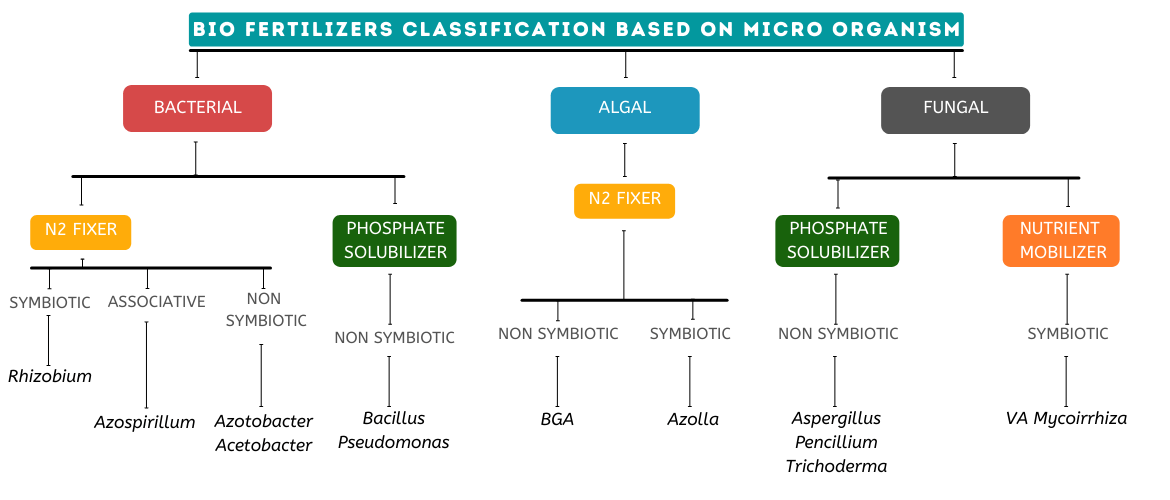
Bio fertilizers can be classified in two classifications (i) Classification based on microorganisms in bio fertilizer (ii) Classification based on function of bio fertilizer.
Classification based on micro organism used in bio fertilizer
Classification based on function of bio fertilizer
Types of Bio fertilizer
Nitragin, a laboratory culture of Rhizobia produced by Nobbe and Hiltner in 1895, was the first commercially available biofertilizer. Azotobacter, green algae, and a host of other microorganisms followed. Recent discoveries include Azospirillum and Vesicular- Arbuscular Micorrhizae (VAM).
In 1956, N.V.Joshi conducted the first study on legume Rhizobium symbiosis in India. With the establishment of the National Project on Development and Use of Biofertilizers (NPDB), the Ministry of Agriculture under the Ninth Plan made a real effort to popularize and promote the input.
Grouping of bio fertilizers
As shown in the above Flowchart 2 (Based on the function), bio fertilizers can be grouped in the following classes:
Some of the bio fertilizer examples and theirs uses are listed below:
Nitrogen Fixing Bio fertilizers bacteria
Rhizobia : In plants, nitrogen serves as a sole source of metabolism as it is a primary component of all cell biomolecules (amino acids, proteins, enzymes). The majority of leguminous plants need a high amount due to their protein requirements, but cannot fix atmospheric N2 due to their high energy expenditure.
As a result, legume plants have root nodules where bacteria belonging to the genera Rhizobium, Bradyrhizobium, Sinorhizobium, Azorhizobium, and Mesorhizobium fix atmospheric nitrogen. These bacterias are collectively termed as rhizobia and they belong to α-Proteobacteria. Rhizobium can fix 15-20 N/ha and increase pulse crop yield by 20%.
Azorhizobium : These are symbionts that nodulate and fix nitrogen in stem nodules. These microorganisms produce large quantities of IAA, which is essential for good plant growth.
Bradyrhizobium : Bradyrhizobium fixes nitrogen well. Mucuna seeds inoculated with Bradyrhizobium strains enhance soil total organic carbon, N2, phosphorus, and potassium. Additionally, it increases plant growth and, consequently, plant biomass. By reducing weed populations and increasing soil microbial populations, it contributes to soil improvement.
Azotobacteracae (e.g. Azotobacter) : It is a diazotroph, non-symbiotic, photoautotrophic (organisms that carry out photosynthesis), aerobic, free-living bacteria. A variety of substances are released from them including vitamins, gibberellins, naphthalene, acetic acid etc which inhibit certain root pathogens and allow roots to increase their growth and absorb nutrients.
The bacteria is found in the roots of Paspalumnotatum (tropical grasses) and other species. On the roots of Paspalumnotatum, it adds 15-93 kg N per hectare per year. Azotobacter indicum lives in acidic soil in the roots of sugarcane plants. It can be applied to millets, vegetables, fruits, flowers and cereals via seed, seedlings soil treatment.
Acetobacterdiazotrophicus : Acetobacterdiazotrophicus is a diazotroph that occurs in the roots, stems, and leaves of sugarcane and sugar beet crops to fix nitrogen. Additionally, it produces growth-promoting chemicals, such as. IAA. It helps with nutrient uptake, seed germination, and root growth. By fixing nitrogen, this bacterium increases the yield of crops by 0.5 – 1% and fixes up to 15kg of nitrogen per hectare / year.
Azolla – Anabaena symbiosis : It is a free-floating aquatic fern with cyanobacterial symbionts in its leaves. As it grows, it fixes atmospheric nitrogen in paddy fields and excretes organic nitrogen in water. It also releases nitrogen in water as soon as it is trampled.
Azolla contributes nitrogen, phosphorus (15-20 kg/ha/month), potassium (20-25 kg/ha/month), and organic carbon etc., increasing yields of paddy crops by 10-20% and suppresses weed growth. Azolla can also absorb potassium from irrigation water and be used as green manure before planting rice. As Azolla species are metal-tolerant, they can be applied near heavily polluted areas.
Cyanobacteria (Blue green algae – BGA) : Prokaryotic organisms such as Nostoc, Anabaena, Oscillatoria, Aulosira, Lyngbya, etc. are phototropic in nature. As well as fixing atmospheric nitrogen, they provide vitamin B complex and growth promoting substances that make the plant grow faster. If applied at 10 kg/ha, cyanobacteria fix 20-30 kg/N/ha and increase crop yields by 10-15%. Rice cultivation in India utilizes both free-living and symbiotic cyanobacteria (blue green algae).
Spirillaceae (e.g. Azospirillum and Herbaspirillum) : These are easy to cultivate, free-living, associative symbiotic and non-nodule-forming, aerobic bacteria. Roots of dicots and monocots, such as corn, sorghum, and wheat, contain these bacteria. Azospirillum increases yield of cereal crops by 10-15% and fixes N2 at a rate of 20-40% kg/ha. Various A. brasiliense strains inoculated into wheat seeds increase seed germination, plant growth, plumule size, and radicle length.
Roots, stems and leaves of sugarcane and rice contain Herbaspirillum species. They produce growth promoters (IAA, Gibberillins, Cytokinins) as well as enhance root development along with uptake of nutrients like nitrogen, potassium and phosphorus from the soil.
2. Phosphate SolubilisingBio fertilizers
Phosphate Solubilising Bacteria : Bacteria belonging to the genus Pseudomonas, Bacillus, Acrobacter, Nitrobacter, Escherichia, and Serratia species are very efficient in solubilization of inorganic tricalcium and rock phosphate. Specifically, Pseudomonas striata and Bacillus polymyxa have great phosphate solubilising capabilities.
‘Phosphobacterin‘ are bacterial fertilizers containing Bacillus megatherium var. phosphaticum cells, first developed in the USSR. They increased crop yield by about 10 to 20 percent and also released hormones that promote plant growth and assist in phosphate solubilization in the soil.
Phosphate Solubilizing Fungi : Some fungi are also capable of dissolving phosphate, e.g. Aspergillus niger, Aspergillus awamori, Penicillium digitatum etc. The microbes all produce organic acids that dissolve phosphate.
3. Phosphate absorbersBio fertilizers
VAM (Vesicular arbuscular mycorrhiza) fungi or Endomycorrhiza : Plant roots and fungi form mutually beneficial (symbiotic) relationships known as mycorrhizae. The VAM fungus invades and spreads inside the root system. They have special structures called vesicles and arbuscules. The symbiotic relationship occurs in a way where the plant root provides root exudates to the funcus and in return the VAM fungus aids the plant in absorbing phosphate and other nutrients and water via the plant roots.
Furthermore, VAM enhances the growth of black pepper and protects it from Phytophthora capsici, Radopholus similis, and Melvidogyne incognita. VAM fungi improves water uptake in plants and also allow them to tolerate heavy metals
Plant growth-promoting substances are also produced by the mycorrhizal fungus, which increases crop yields by 30-40%.
4. Bio-fertilizers for Micro nutrients
Silicate Solubilizing Bacteria : Microorganisms can also degrade silicates and aluminum silicates. Bacteria produce several organic acids that play a dual role in silicate weathering. By supplying H+ ions to the medium, they promote hydrolysis. Also, Citric acids, oxalic acids, keto acids, and hydroxy carbolic acids from complexes with cations, promote the removal and retention in the medium of these cations in a dissolved state. A lot of Bacillus species found in various types of soils can commonly used to dissolve silicate.
Zinc solubilizers : Some of the microorganisms that can solubilize zinc are B. subtilis, T. thioxidans and Saccharomyces spp. These microbes prove to be very useful in aiding the plant in absorbing zinc as very less percentage (1-4%) of zinc which is manually applied to the plant is absorbed.
5. Plant Growth Promoting Rhizobacteria (PGPR)
Plant growth promoting rhizobacteria (PGPR) are bacteria that colonize roots or rhizosphere soil (the soil zone surrounding the plant roots) and are beneficial to plants. They are also known as microbial pesticides e.g. Bacillus spp. and Pseudomonas fluorescence. Serratia spp. and Ochrobactrum spp. boost the growth of plants.
PGPR inoculants currently available commercially seem to promote growth by either suppressing plant disease (termed Bio-protectants), or improving nutrient uptake (termed Bio-fertilizers), or stimulating phytohormones (termed Bio-stimulants). Phyto-hormones and growth regulators produced by Pseudomonas and Bacillus increase the root surface area (more fine roots) of plant roots for absorption of water and nutrients. They are called Bio-stimulants, and the phytohormones they produce are indole-acetic acid, cytokinins, gibberellins, and inhibitors of ethylene production.
It was observed that a combination of the arbuscular mycorrhizal fungi Glomus aggregatum, the PGPR Bacillus polymyxa and Azospirillum brasilense maximized biomass and P content of the aromatic grass palmarosa (Cymbopogon martinii) when grown with an insoluble inorganic phosphate. PGPR are classified into iPGPR and ePGPR.
Production of bio fertilizers On industrial level
The following chart depicts the steps involved in the production of bio fertilizers in low or high quantity in industries.
The mass production of bio fertilizer is divided into three stages.
Stage 1 : Culturing of microorganisms
Stage-2 : Processing of carrier material
Stage-3 : Mixing the carrier and the broth culture and packing
In biofertilizers, the microorganism is encapsulated in a carrier medium that contains an efficient strain of nitrogen fixing or phosphate dissolving microbes, and is mass produced in a fermenter with adequate conditions for temperature, oxygen, and growth.
Typically, bio-fertilizers are formulated as carrier-based inoculants. Inoculants prepared with organic carrier materials are more effective. As carrier materials, peat soil, lignite, vermiculite, charcoal, press mud, farmyard manure, and soil mixture can be used. Neutralized peat soil/lignite are considered better carrier materials for biofertilizer production due to their affordability, availability, inertness and high organic and WHC contents.
Biological culture from the fermentor is transferred to sterilized carriers and well mixed by hand (while wearing sterile gloves) or by mechanical mixer before being sealed in polythene bags at room temperature.
The packet is stored in a temperature controlled cold room with a temperature of 25 degrees Celsius away from the heat or direct sunlight.
At the 15-day interval, an inoculant sample can be analyzed to determine the population within. At the time of preparation, the inoculant should contain at least 109 cells per gram.
After the final post culture inspection, the bags are stored in a temperature controlled room at a temperature of 4 degree celcius before its shipped to the farmer.
Application of bio fertilizers
Seed treatment : In the slurry of inoculants, the seeds are uniformly mixed, and then they are dried under the shade for 30 minutes. Within 24 hours, the dried seeds should be sown. Ten kilograms of seeds can be treated with one packet of the inoculant (200 g).
Seedling root dip : Transplanted crops are grown using this method. In 40 litres of water, two packets of the inoculant are mixed. The roots of the seedlings are dipped in the mixture for 5 to 10 minutes and then transplanted.
Foliar application : A liquid bio fertilizer can be applied by fertigation or foliar application to a crop. Alternatively, it can be applied through seed treatment or root dipping.
Main field application : A mixture of four packets of the inoculant and 20 kg of dried and powdered farmyard manure is broadcast in the main field just before transplanting.
Set treatment : Sugarcane sets, potato pieces, and banana suckers are usually treated with this method. Culture suspension is made by mixing 1 kg (5 packets) of bio fertilizer in 40-50 litres of water and keeping cut pieces of planting material in the suspension for 30 minutes. Before planting, the cut pieces are dried in the shade for some time. A ratio of approximately 1:50 of bio fertilizer to water is used in set treatment.
Better water relation and drought tolerance : The mycorrhizal fungi play an important role in the water economy of plants. Their presence increases the hydraulic conductivity of the root at lower soil water potentials, and this is a factor in the better uptake of water by plants.
Improved nutrient uptake (macro and micronutrients) : The most recognized beneficial effect of mycorrhizas is the enhancement of phosphorus nutrition for plants. AM (mycorrhizal) fungi are also reported to enhance potassium uptake and efficiency of micronutrients like zinc, copper, iron, etc. The fungi release enzymes and organic acid which leads to mobilization of fixed macro and micronutrients and makes them available to plants for absorption.
Crop protection (interaction with soil pathogens) : Mycorrhizal fungi inoculation significantly increases production and activity of both phenolic and phytoalexin compounds, as a result of which the plant’s defense mechanism becomes stronger, thereby imparting resistance to pathogens and pests.
Improved Soil structure (A physical quality) : Mycorrhizal fungi contribute to maintaining and improving soil structure through the growth of external hyphae into the soil to create a skeletal structure holding soil particles together. It also assists in creating conditions conducive to the formation of microaggregates and integration of microaggregates into macroaggregates.
Whereas the role of mycorrhizal associations in enhancing nutrient uptake will mainly be relevant in lower input agroecosystems, the mycorrhizal role in maintaining soil structure is important in all ecosystems. Ryan and Graham, 2002
Enhanced phytohormone activity : In plants inoculated with AM, phytohormones like cytokinin and indole acetic acid (IAA) are significantly more active. Higher hormone production results in better growth and development of the plant.
SUMMARY OF BIO FERTILIZER APPLICATION METHODS
Method
Crops
Dose/Packet/Acre
Water
BF:Water ratio
Soil
Seed Application
All crops, fruits and vegetables sown through seeds
200g bio fertilizer
400 ml
1:2
-NA-
Set Treatment
Base of Banana, Sets of Sugarcane
1 or 2 Kg bio fertilizer
50 or 100 liters
1:50
-NA-
Seedling Method
Rice, tomato, chilly, cabbage, cauliflower and flower crops
1 Kg bio fertilizer
10 liters
1:10
-NA-
Soil Application
All crops
2 Kg bio fertilizer
for wetting
-NA-
40-50 Kg
Source : ICAR Research Complex for Goa, HR PRABHUDESAI (Training Associate)
BIO FERTILIZER EXAMPLES FOR CROPS
Microorganism / Bio fertilizer
Nutrient fixed
(Kg/ha/year)
Host Crops
Actinorrhizae
(Frankia spp.)
150 kg N/ha
For certain non-legumes mainly trees & Shrubs
Algae
25 kg N/ha
Rice
Azolla
900 kg N/ha
Rice
Azospirillum
50 to 300 kg N/ ha
Non-legumes like maize, barley, oats, sorghum, millets sugarcane, rice etc
Rhizobium
0.026 to 20 kg N / ha
Legumes like pulses, peas, Groundnut, soybean, beans, and clover
Azotobacter
10-20 kg N /ha
Cereals, millets, cotton, vegetables
Mycorrhizae (VAM)
Solubilize food phosphorus (60%)
Many tree species, wheat, sorghum, ornamentals
Phosphate solubilizing Bacteria and fungi
Solubilize about 50-60% of fixed phosphorus in the soil
Soil application for all crops
Sources: Mall et al., (2013)
Advantages of bio fertilizers
Using biofertilizers is an eco-friendly and sustainable way to manage soil fertility, soil health, plant growth, and the environment as these are natural products containing living microorganisms and they reduce nitrogen depletion in soils and provide sustainable farming methods. It also results in increased yield 3 – 39 %.
Unlike chemical fertilizers, they are cheaper and simpler to use, and their preparation takes less time and energy. Thus, small and marginal farmers can produce, maintain, use, and recycle bio-fertilizers such as Azolla, BGA, and other organic wastes as needed.
Bio-fertilizers are available for a wide range of crops. The benefits are that they are pollution free, based on renewable energy, economical, have a high cost-benefit ratio without risk, and enhance the effectiveness of chemical fertilizers.
They complement fertilizer supplies for meeting the nutrient needs of crops. As reported by various researchers, the nitrogen equivalents of important bio-fertilizers are as follows:
Rhizobium inoculation fixes 19 to 22 kg of nitrogen per hectare, Azotobacter and Azospirillum each fix 20 to 30 kg N ha-1, Biogenic Glycerol may fix 20 to 30 kg N ha-1 and Azolla may supply 3 to 4 kg N ha-1 for one ton of Azolla inoculation.
It would therefore be very cost-effective to use them.
Additionally to their direct impact on standing crops, they also have a positive residual effect on soil fertility when used.
As they excrete growth-promoting substances, vitamins, and hormones, they assist in providing better nutrition to crop, maintaining soil fertility, and increasing tolerance to drought and moisture stress.
They inhibit weed growth, reduce pathogen incidence, and control diseases by secreting antibiotics, antibacterial, and antifungal compounds.
The inoculation of bio fertilizers increases microbial activity and population, availability of micronutrients, and the reduction of environmental pollution by detoxifying heavy metals from the soil.
In conjunction with chemical fertilizers, organic manure and crop residues, biofertilizers improve soil and crop productivity as well as nutrient utilization efficiency.
Under semi-arid conditions, biofertilizers have been shown to be effective.
Decomposition of organic matter and mineralization of soil are two benefits of bio fertilizers.
Constraints and Disadvantages of Bio fertilizers
Significantly lower nutrient density – required in large amounts for most crops.
Has to be applied with a different type of machine than chemical fertilizers.
In some areas, it is difficult to find.
Because biofertilizers are alive, long-term storage of them requires special care.
Proper care must be taken to use bio fertilizers before the expiry date which adds to the stress of planning and crop management.
By selling poor quality bio-fertilizers through corrupt marketing practices, farmers lose faith in the product, and it is difficult and challenging to regain that faith once lost.
During fermentation, bio fertilizers often mutate, raising the cost of production and quality control. The need for extensive research on this issue is urgent in order to eliminate such undesirable changes.
Using the incorrect strain of microorganisms or contaminating the carrier medium can result in less effectiveness of the bio fertilizer.
Both production and distribution of bio-fertilizers take place only during few months of the year, as such production units, especially private sectors, are unsure of the right time of the demand and assurance of sale of bio fertilizers.
Bio fertilizer needs optimum level of nutrients in the soil to function as intended.
Even with considerable efforts in recent years, majority of farmers in India are unaware of bio-fertilizers, their usefulness in increasing crop yields sustainably.
When the soil is too hot or dry, bio fertilizers lose their effectiveness.
Acidic or alkaline soils also inhibit the growth of beneficial microorganisms.
Technical problems cannot be addressed due to inadequate staff and staff who are not technically qualified. Farmers are not properly instructed about the application process.
Bio fertilizers fail to function if the soil contains excess of Antagonistic microbiological enemies.
Bio-fertilizer production units require very little investment. As a result of the short shelf life and no guarantee that awareness and demand of bio-fertilizers will increase, the resource generation is very limited.
Certain bio fertilizers are less available due to shortages of microorganisms or shortage of preferred growing medium.
Bio fertilizers cannot totally replace conventional fertilizers.
The majority of marketing sales personnel do not know how to properly inoculate. The handling, transportation, and storage of bio fertilizers are all critical because they are living organisms.
Tips to use bio fertilizers
Adequate amounts of organic manure (as per the recommendations for each crop) and biofertilizer should be used to ensure greater survival, growth and activity of microbial inoculums in acidic soils.
If the soil pH is below 6.0, liming is essential. Adding lime @ 250 kg/ha along with bio-fertilizer treatment is recommended for moderately acidic soils.
During summer months, irrigation is essential after applying bio-fertilizers to ensure the survival of the introduced microbes.
Since N bio-fertilizers can only supplement part of the nitrogen requirement of the inoculated plant, full doses of phosphorus and potassium may be applied as recommended. To ensure better plant growth and yield, this is essential. Likewise, full doses of nitrogen and potassium should be applied to P bio-fertilizers. However, there should be at least one week between the application of bio-fertilizer and chemical fertilizer.
Only bio-fertilizers that have been manufactured according to the quality parameters prescribed by the Bureau of Indian Standards should be used. Bacterial bio-fertilizers are required to have a population of at least 10 million per gram of the carrier material, and there must be no contamination with other microorganisms when examined at 1:100000 dilutions. Additionally, it should have at least six-month of shelf life.
Bio-fertilizers available for purchase should be used only before their expiration dates.
Applying topdressings of 25 kg/ha superphosphate 10 days after inoculation of BGA will enhance its growth under field conditions.
As green algae in rice fields can affect the normal growth and proliferation of BGA, Copper sulphate @ 4 g/ha should be applied initially to control the population of green algae.
When applied to moderately acidic soils of pH around 6.5, fine powdered calcium carbonate can improve root nodulation by Rhizobium and Bradyrhizoium.
In phosphorus-deficient soils, it is recommended to apply P2O5 @ 1kg/ha once every 4 days to guarantee good growth of Azolla. Azolla develops a reddish purple colour when it is deficient in Phosphorus.
It is essential to incorporate Azolla into the soil before transplanting rice seedlings because a floating population of Azolla can release its bound nutrients only during decay.