
Welcome to Modern Agriculture!

Picture a farm or garden, and you're likely to imagine crops planted in rows. Run water between the rows and you have furrow irrigation, one of humanity's oldest methods used to grow food.
It's still commonly used today around the world and in the United States, where more than a third of all irrigated fields, constituting 56 million acres, use furrow irrigation. In areas of the American South, furrow irrigation constitutes around 80% of all irrigation.
But unless furrow irrigation is managed properly, it's not a very efficient use of water. It's difficult to get water distributed evenly to an entire field. Yet because furrow irrigation is relatively inexpensive compared to mechanical sprinklers or drip irrigation, it is bound to continue to be used worldwide.
Finding ways to improve its efficiency is important in a world where water scarcity driven by climate change threatens both the viability of ecosystems and the food security of billions of people.
Furrow (or ridged-furrow) irrigation works by the simple use of gravity. With ridges and furrows, water runs down sloping channels between rows of hilled-up crops. Furrow systems work best on relatively level land that can be graded to allow for the ideal flow of water through the furrow. It's not a practice that's recommended for rolling fields or steep slopes. Elevating crops on ridges keeps the water in its channels and away from plant stems and leaves, reducing the likelihood of rot or disease.
Rows crops like corn, sunflower, sugarcane, and soybean are well-suited for furrow irrigation, as are fruit trees like citrus and grapes, and crops that would be damaged by standing water such as tomatoes, vegetables, potatoes, and beans.
Globally, agriculture uses an estimated 70% of the world's freshwater—more than is sustainable, as more than half of the world's groundwater is being depleted. In the United States, 4.5 billion gallons of water are wasted every day due to inefficient irrigation. Worldwide, furrow irrigation is on average only 60% efficient, compared to a center-pivot sprinkler (95%) and drip irrigation (97%) systems.
Whether through evaporation, runoff, or seepage into the ground below the root level, 40% of the water distributed never finds its intended target. Water not taken up by crops can leach fertilizer, herbicides, pesticides, and even antibiotics, into groundwater, or wash them into waterways. Together with the frequent problem of erosion, water wastage can pollute drinking water or create dead zones and algal blooms in lakes and oceans.
Yet furrow irrigation can be made more efficient, depending on how the furrows are set up and managed. One estimate is that if irrigation achieved 100% efficiency, the global demand for groundwater would be halved. Furrow irrigation has also been demonstrated to reduce greenhouse gas emissions, especially those of nitrogen oxides.
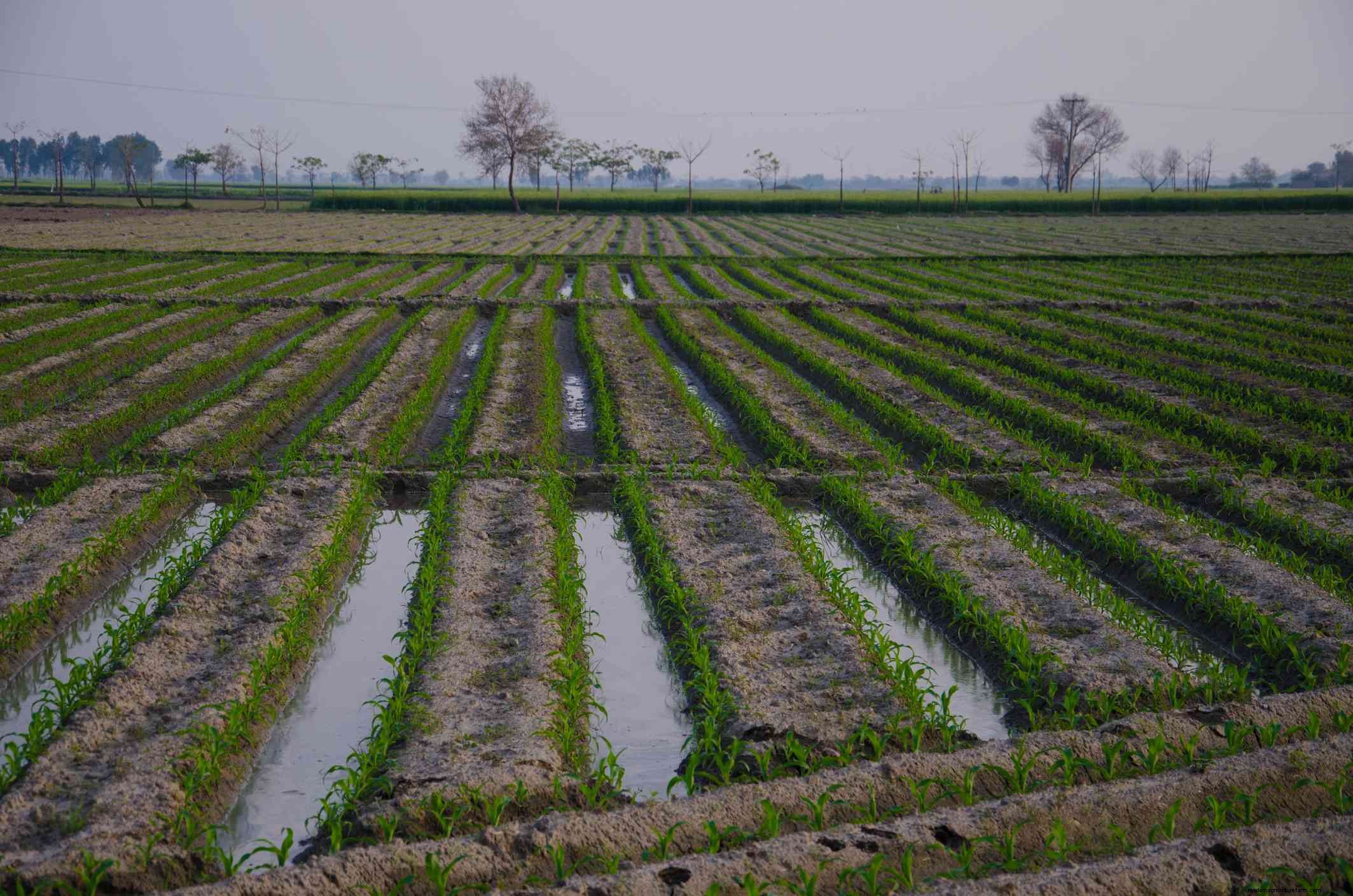
Water wastage can come in three forms: evaporation from standing water, runoff at the end of rows, and uneven water infiltration, where more water percolates into the ground than is necessary for crop growth. Managing that wastage can take a number of forms.
Depending on the type of soil, different grades of slopes are needed to create an ideal water flow. In short, the faster draining the soil (its infiltration rate), the steeper the slope.
Fast-draining sandy soil has an optimum slope of a 0.5% grade, while the ideal slope for less porous clayey soil is a 0.1% grade. Since clay soil is less penetrable, a wider, shallower, and longer furrow means more soil comes in contact with water, absorption is slower, and less water runs off at the end of the row. In sandy soil, by contrast, deeper, narrower, and shorter furrows assure that water is distributed more evenly throughout the entire length of the row, reducing the amount of water needed to water the entire row.
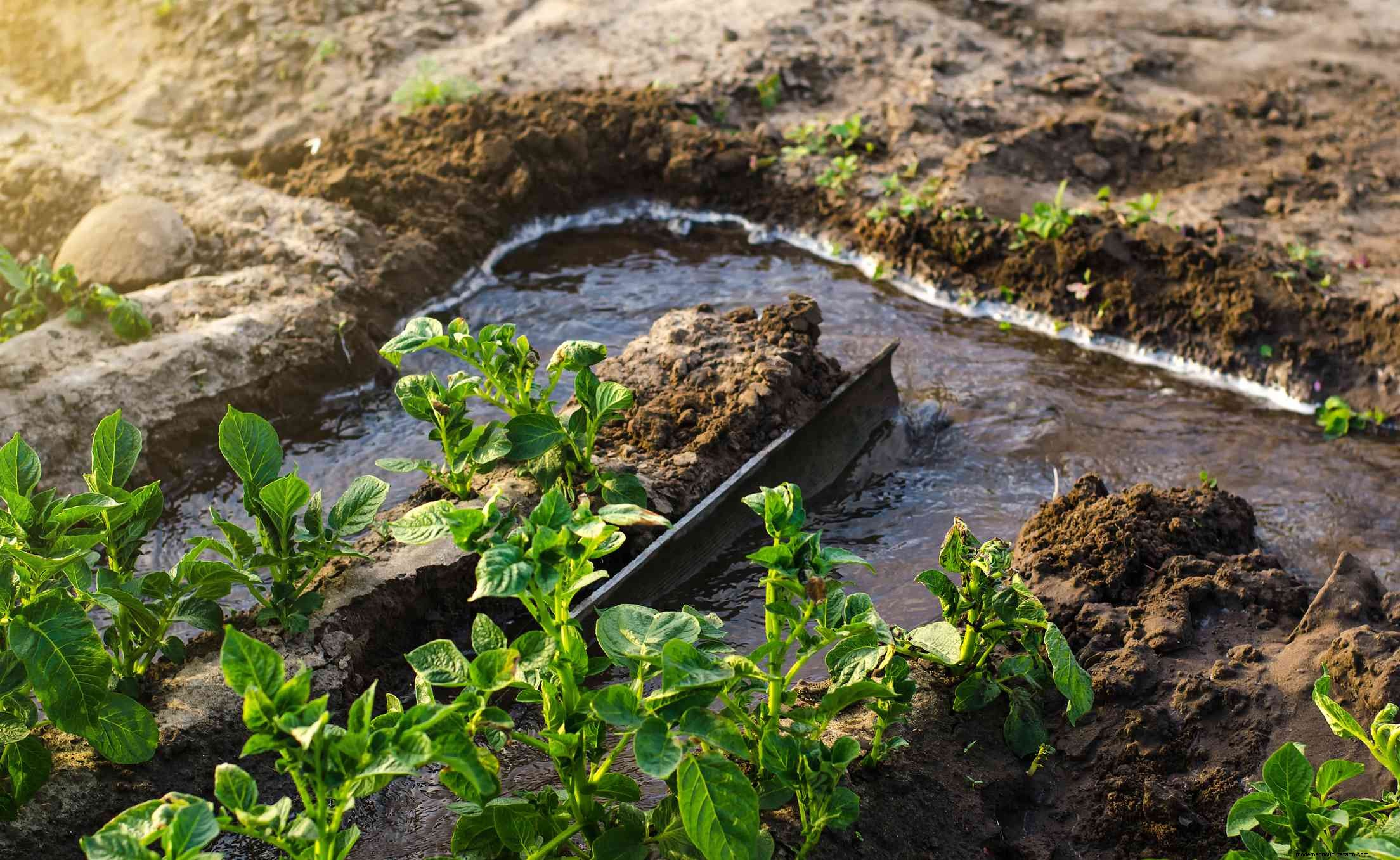
According to the U.S. EPA, agricultural runoff is the leading cause of water quality impairment. Along with regenerative agriculture and soil conservation practices, reducing and reusing runoff from furrow irrigation can lead to an improvement in water quality and reduction in both water use and fertilizer use. Runoff at the end of a furrow can be redirected into collecting pools, then reused. Reusing runoff can reduce water use by up to 25%.
In fields where excess water is not reused, blocking or diking the lower end of a row is a common practice, especially on slopes with low grades. This, however, can lead to uneven water distribution at either end of the field, as well as the leaching of nutrients at the bottom end of the row.
Reducing or eliminating tillage has many benefits, including sequestering carbon and decreasing the emission of greenhouse gases that warm the planet. Saving water is not always not mentioned among them.
Reducing tillage can have the effect of reducing water use while increasing crop yields. By not turning over the soil in a furrow, ground cover crops remain in place, slowing down the flow of water through the furrow, increasing the infiltration rate by up to 50%, and reducing runoff by up to 93%.
Surge flow irrigation involves alternating the flow of water, as in one-hour on, one-hour off. As irrigated furrows dry, the top layer of soil consolidates and seals the surface, allowing the next round of irrigation to be more evenly distributed through the entirety of the row. This can lower water usage up to 24% in one study and up to 51% in another.
In the 19th century, the economist William Stanley Jevons discovered that increases in efficiency did not necessarily lead to a decrease in the use of a natural resource, but rather to its increase. He observed that as coal-burning became more efficient, its use became more frequent as its use expanded to a wider range of industries.
The same paradox happened with the wider adoption of more efficient drip-irrigation systems in California during an extended drought in the 1980s and 1990s, leading to a greater depletion of the state's already scarce groundwater supplies. As governments around the world adopt water conservation measures which include improving the efficiency of crop irrigation, poorly crafted programs can have the unintended consequence of worsening the global water crisis rather than helping solve it.
Both furrow and flood irrigation are surface irrigation methods in which water is distributed across an area by gravity. The difference between them is that flood irrigation entails flooding a whole field, and as a result distributing water evenly, whereas furrow irrigation entails flooding only the trenched rows between plants.
The most water-efficient way to irrigate crops is believed to be through drip irrigation. This "micro-irrigation" method slowly drips water directly onto the roots of plants via a thin tube that's either buried or hovering just above the soil.
An estimated 40% of water is wasted when furrow irrigation systems are used, as opposed to the 3% that's wasted by drip irrigation systems.
