
Welcome to Modern Agriculture!

What is furrow irrigation?
Furrow irrigation method is among the oldest types of controlled irrigation.
Furrows are narrow, uniformly spaced shallow channels that run down a field’s slope, parallel to the crop rows to be irrigated.
Furrow irrigation is the practice of creating parallel channels along the field length in the direction of the slope of the field.
In order to apply water to the furrows, a gated pipe, siphon and head ditch, or bankless system is used.
Small doses of water are applied to the furrows, allowing water to infiltrate the field in a controlled manner as it runs down the furrow.
Slope, surface roughness, water quantity applied, furrow shape, and soil infiltration rate are among the factors that determine the speed at which water moves down the field.
The furrow irrigation method can therefore be considered to be a partial surface flooding irrigation system.
There is generally 2 to 7 feet of distance between each furrow, depending on the crop being grown. Crops are sown on the ridge between each furrow.
A furrow irrigation system is usually used with clean-tilled crops. Broad-acre row crops and the horticultural industries are well suited to this type of irrigation.
Is furrow irrigation water efficient?
If properly managed, the furrow irrigation method can be quite efficient, but if improperly managed, it can be quite inefficient.
Ideally, for furrow irrigation to work best, fields should have a mild slope.
Also, the inflow discharge must not be so fast as to produce excessive runoff losses, nor too slow as to cause excessive infiltration in the upper part of the field.
A traditional irrigation method involves short, blocked furrows with manually controlled watering.
However, long and precisely leveled furrows with automated or semi-automatic controls are gaining popularity.
1 . Crop Suitability
What is furrow irrigation best for?
Generally, furrow irrigation is used to irrigate widely spaced row crops such as potatoes, maize, vegetables, and trees.
2. Soil and Topography
Furrow irrigation is best suited to loam soils.
Excessive infiltration can occur at the top of the furrow in sandy soils.
Clay soils may need extra standing water for effective water infiltration in the soil.
It is necessary to establish furrow irrigation on steeper land having mildly sloping topography of 0.5–2%.
Furrow irrigation method is not appropriate for topography that is undulated or zigzagged.
This method is generally not suitable for soil with high salt concentration.
3. Water Quantity
The stream of water discharged in the furrow should be as large as possible so that the water can move through the field quickly. However, the stream should not be so big that it starts causing soil erosion.
4. Labor and Energy Requirement
Initial digging of a furrow requires labour. After the furrows are constructed, this irrigation method requires the least amount of labour when compared to other surface irrigation methods.
Automated systems reduce labor requirements further to a minimum.
5. Efficiency
Furrow irrigation efficiency can be as high as 90% when properly designed row slopes, row lengths, set times, and stream sizes are used.
6. Irrigation application
For small amounts of water to be applied per application, e.g., on sandy soils or with a shallow-rooted crop, furrow irrigation would be most effective
If the sand is very coarse, however, i.e., if the infiltration rate is over 30 mm/h, none of the surface irrigation methods can be used.
7. Level of Technology
Except for short, level furrows, furrow irrigation requires accurate field grading. Filed grading is often done with the help of machines.
Maintenance such as plowing and furrowing is usually done by machines.
The farmer is also required to have an understanding of the required amount of water and water infiltration rate for the crop he is growing.
Hence, a decent level of skill and knowledge is required to practice furrow irrigation.
8. Cost and Economics
Major part of the cost of furrow irrigation is the number of furrows to be dug, volume of soil to be displaced, labour charges, instrument charges and fuel charges.
After the furrows are dug, the cost is reduced significantly and only comprises of fuel charges (in case of using automated systems) and general maintenance.
| Type of furrow system | Feature | Suitability |
|---|---|---|
| Flat land furrows | Slopes less than 0.1 per cent and essentially straight | Best suited for row crops |
| Corrugation type furrows | Moderate to steep slopes small U-shaped or V-shaped closely spaced grooves | Suitable to irrigate close growing crops in areas where the topography is steep and uneven. |
| Contour furrows | Follows contours on steep lands and hill sides | Suitable to irrigate steep and uneven slopes. Hazardous in high rainfall areas |
| Furrows of miscellaneous shapes | Special cross-section like V-shaped or broad base | Adapted for special soil slope and crop production problems. |
| Furrows of miscellaneous arrangements | Circuitous or straight | Used in orchards for wetting the soil. Also used for vegetable crops |
| Source : Murty, 1998 |
There are four types of furrow irrigation methods:
1 . Level furrows
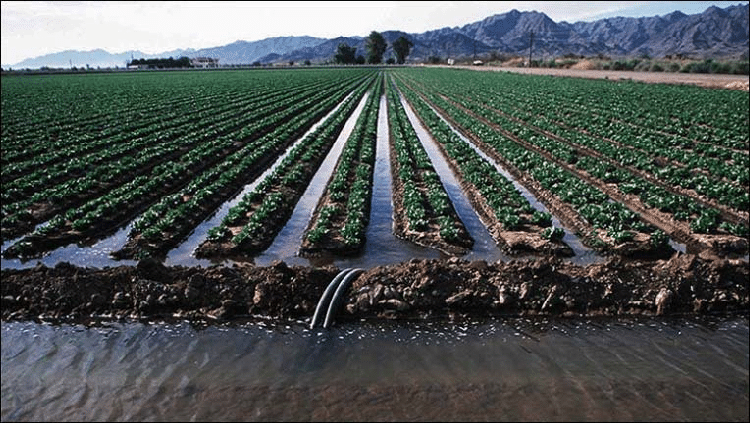
The level furrow is a narrow irrigation channel with closed ends dug with little or no grade. Until the furrow capacity is filled, a large stream of water is applied. This is a type of flat land furrow irrigation method.
Generally, level furrows are recommended for crops planted in rows between the furrows, as well as environments throughout the world, with the exception of humid climatic zones due to possible soil waterlogging or crop damage.
For this type of furrow irrigation to be successful, the land must be prepared very thoroughly and the water must be carefully managed.
The main advantages of level furrows are
Some of the disadvantages of level furrows are ,
2. Graded straight furrow

Graded straight furrows are small irrigation channels, preferably made on flat lands.
The layout and topography of the land is such, that the construction of straight furrows is possible.
If not already flat, the field is required to be leveled for this system to be constructed. The field should also have little to no slope.
Since there is no sloping in the field, the initial water stream has to be more than the intake rate so that the water can travel the whole length of the furrow.
This furrow irrigation system is suitable to irrigate crops planted in rows.
The main advantages of Graded straight furrows are
Some of the disadvantages of Graded straight furrows are
3. Graded contour furrow
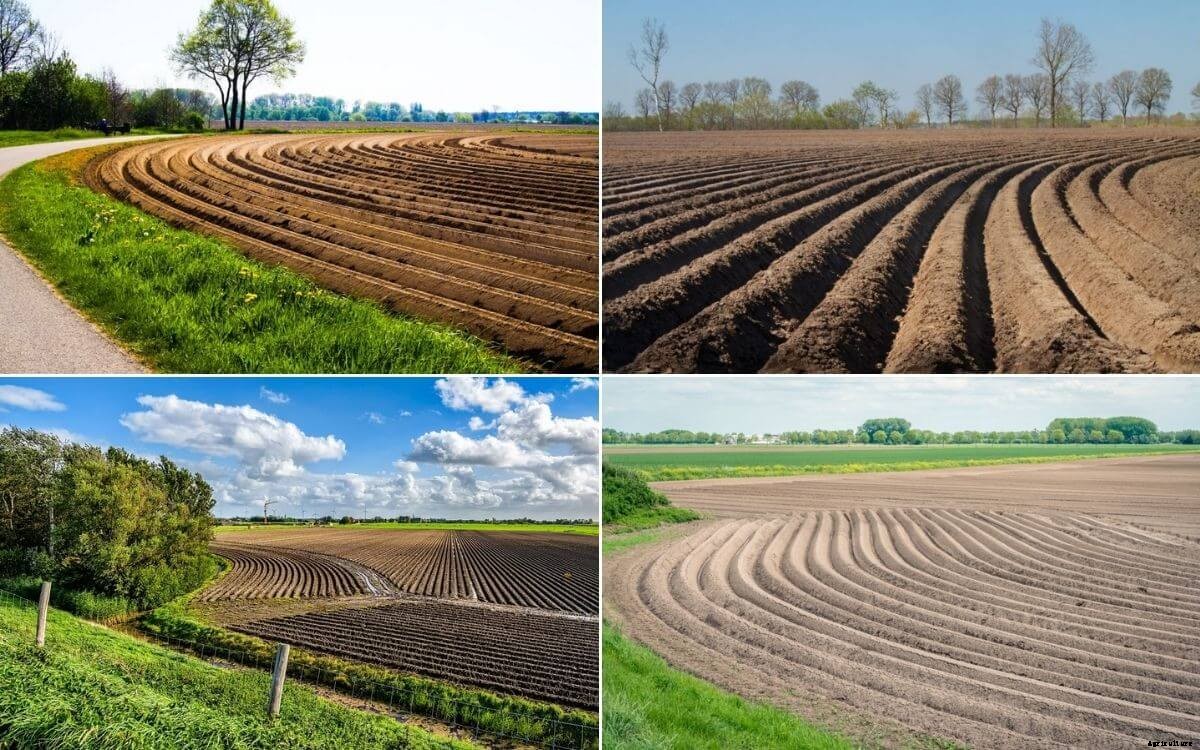
Graded contour furrow are small irrigation furrows made on lands with warped or uneven surfaces.
The furrow contours are designed in such a way that they follow the natural curves of the field.
This type of furrow irrigation system can be used to irrigate any type of soil except sandy soil and soils which tend to crack easily.
The water application is same as graded straight furrows.
The main advantages of Graded contour furrows are
Some of the disadvantages of Graded straight furrows are
4. Corrugations

These types of furrows are narrow and are closely placed. This type of furrow irrigation system is preferred for high density cropping or close growing crops.
Corrugation furrow requires a land with uniform slope.
These furrows generally have comparatively smaller water capacity.
The main advantages of Corrugations are
Some of the disadvantages of Corrugations are
1 . The design and development of furrows can be planned and executed gradually depending on the availability of labor and funds.
2. After necessary land formation activities are completed, land can be developed for a relatively low cost
3. Minimum soil erosion
4. Furrow irrigation system is applicable to wide range of slopes of the fields.
1 . Furrow irrigation is not suitable for soils with higher vertical infiltration and lower lateral infiltration
2. More water is needed compared to sprinkler irrigation or drip irrigation
3. There is a possibility of increase in salinity in the soil between the furrows
4. Water loss can be experienced at the downstream end end dikes are not constructed
5. It requires more labour when compared to rest of the surface irrigation methods
6. Furrow irrigation adds one extra step to the process of tillage i.e. construction of the furrows


