
Welcome to Modern Agriculture!

Introduction: Hello gardeners, farmers and friends, we are here with good information of advantages of polyhouse farming and disadvantages of polyhouse farming. Polyhouse is a house or a structure made of translucent material like polyethylene or glass where the plants grow under controlled climatic conditions.
Polyhouse farming should be designed in such a way that smart farmers can produce high-value crops out of season when prices of farm produce are at their highest. This is the way you can get higher incomes and a higher return on the high initial investment. Since you can control light, ambient temperature, humidity, and water for irrigation, you can generate all the crops that fetch a high price in local and regional markets. In polyhosues, you can generate pesticide-free produce or even organic produce that fetch a higher price due to their high nutrition value, better taste, and freshness.
The size of the polyhouse structure can differ from small shacks to big-size buildings as per the need. In developing countries like India, polyhouse farming is a popular greenhouse technology due to its low cost of construction and very easy maintenance.
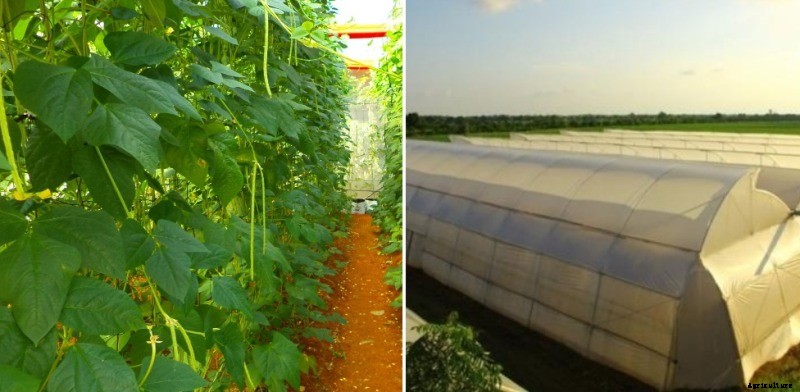
Polyhouse farming is a type of greenhouse which is covered around with polyethylene. And this is the most commonly used type of greenhouse farming in India due to its cheap construction price. This is the most economical when compared to glass or wood; however, is the least durable.
Based on the environmental control system Polyhouse can be divided into two types:
Naturally ventilated polyhouse – Naturally ventilated Polyhouse has vents at the top and at sides which exchanges air arising from the density difference of hot and cold air through air vents.
Environmental controlled polyhouse – This type of Polyhouse is constructed primarily to extend the growing period of crops or to increase the off-season yield by controlling the light, temperature, humidity, etc.
Based on the number of spans Polyhouse can be divided into two types:
Based on the construction type Polyhouse can be divided into three types:
Low Tech and Cheap Polyhouse:
These are the simplest type of Polyhouses and need the least amount of money to be constructed. They are made of easily and locally obtainable products like bamboos as supporting materials and the construction is done using these. They use an easy UV film for cladding and do not have high tech, temperature adjusters.
But, low-grade temperature and humidity controllers are present which serve the purpose. The light entering the Polyhouse is controlled by using shades on the transparent roof to modulate the intensity. They do not need much expertise and can be built in a very short period. They are generally used as shelters for crops during heavy rains and snow.
You shold not miss the Chickpea Cultivation Income, Project Report.
Moderate Tech Polyhouse:
These types of Polyhouses are more durable than the above-mentioned ones since they are constructed using galvanized iron rods which are sturdier and offer more resilient to natural conditions. The arrangement is screwed and grounded firmly and offers better protection against high winds and harsh climate.
Thermostats are present in this Polyhouse which precisely can manage temperatures. They are also fitted with an exhaust which helps in controlling temperature and humidity. These are most appropriate for areas that have a rather dry climate. They require a lot of care and regular maintenance and repairs.
High-Grade Polyhouse:
This Polyhouse for the more technologically advanced Polyhouses that are equipped with the latest technologies and have an automated system for everything. It overcomes the disadvantages of the latter two types with a technological solution.
In Polyhouse farming, we can protect crops from any adverse environment such as high humidity or high temperature. There is an advantage in Polyhouse to control temperature or humidity. There will be an increase in the production of vegetables, fruits or flowers in Polyhouse farming without losing their color and their quality.
Polyhouse farming can protect the crops by preventing the entry of animals and birds into the farm. When we cultivate in the normal farm, nearly 1/3rd of the crops can be lost due to the attack of insects and worms, whereas in Polyhouse farming, we can harvest the plants about 3 to 5 times more without much damage or loss.
We can farm any crop in Polyhouse regardless of season or place which grows like tulips, strawberries, and alpines, etc. One of the major reasons for the decrease in agriculture in India nowadays is no availability of enough agricultural lands. But the invention of Polyhouse farm is a solution for lack of agricultural lands. We can obtain more crops from less space in Polyhouse farming. The Polyhouse is made in such a way that it can give water and fertilizers in required amounts in a controlled manner which can result in high yields.
You may be interested in Cardamom Cultivation Income, Project Report.
Here we discuss some advantages of Polyhouse farming;
Here we discuss some disadvantages of polyhouse farming;
You may be interested in Rooftop Vegetable Gardening Design, Layout in India.


