
Welcome to Modern Agriculture!

Introduction to Groundnut seed germination process (Peanuts)
The Groundnut is also called as the peanut, is a legume crop grown mainly for its edible seeds. Groundnut plant is a self-pollinated crop belonging to the subfamily Papilionaceae of the Leguminosae family. Groundnut is an important oilseed and emerging as a food crop in India
Groundnut is a leguminous crop cultivated for edible purposes. It is sometimes considered as a grain legume because the seed can produce oil and the Groundnut crop is categorized as an oil crop. Groundnuts are self-pollinating plants, meaning they do not require outside aid, such as bees or other insects carrying pollen from one plant to another, in reproduction. After the seed is planted, the first flowers begin to appear in 4 to 6 weeks and continue blooming for 6 or more weeks. In this article we also discuss below topics;
Groundnut production is threatened by the presence of different pests among the pathogens are seed-borne viruses, bacteria, nematodes, and most especially seed-borne fungi. Most of these pathogens have been known to affect the viability of the seeds and seed quality. It is a tropical plant requires a long and warm growing season. It grows well in areas receiving 50 to 125 cm of well-distributed rainfall during the growing season, abundance of sunshine, and warm temperature. Soil temperature is an important factor and its effects are critical on Groundnut seed germination, the emergence of seedlings, early plant growth, rate of flowering, and pod development. When the soil temperature range goes below 19 ºC, the emergence of seedlings is low. The optimum temperature range for vegetative growth of Groundnut is ranging in between 26 to 30ºC depending on the cultivar. Reproduction growth is maximum at 24 to 27 ºC. The maximum rate of growth of pods between 30 to 34ºC as it requires a month of warm and dry weather.
You should not miss the Cotton Seed Germination Period, Temperature, Process.
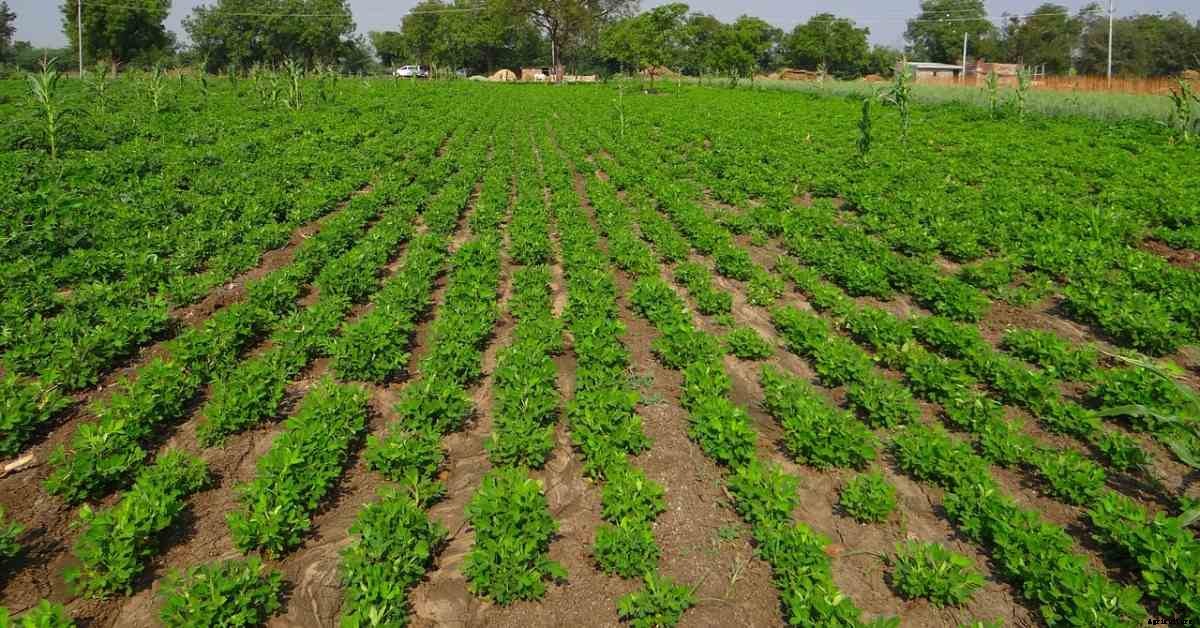
Groundnut plants do well in the well-drained, light-textured, loose, friable and sandy and sandy loam soils which help in easy penetration of pegs and their development and harvesting. Clay or heavy soils are not suitable for Groundnut crops as they interfere in the penetration of pegs and make harvesting quite difficult. It is sensitive to soil salinity. It gives good yields in the soil having the pH level between 6.0 to 7.5, well supplies with calcium and a moderate amount of organic matter.
Groundnuts are propagated through seeds and the seeds should be shelled just 2 weeks before planting. Groundnut seeds are grown in the nursery, then transplanted to the main area or they have directly sown in the main field. The seeds are sensitive to physical damage so they must be handled carefully. It is very important to note that split or damaged kernels will never germinate, so high-quality seed should be procured for planting. The seeds for planting must have been naturally dried. If the naturally dried seed is not available then, artificially conditioned seeds can be used, but excess heat application to dry the seeds can impair their germination property. Seeds dried under the sun are considered to have poor germination.
When Groundnut seeds are used for farms, then treating them with fungicides and doing a Rhizobium culture is highly important. There must be a gap of a week or 10 days between the two treatments. The seeds for 1 hectare of land may require 1.5 kgs of Rhizobium culture.
The Groundnut seeds differ in size, shape, and color of the seed coat or testa. The testa is thin and papery. In general, 3 unicellular layers, that is, the outer epidermis or sclerenchyma, middle parenchyma, and inner parenchyma constitute the testa. These all layers are maternal tissue representing the integument of the maturing ovule.
Seed size is a very important economic character. Seed length ranges about 7 to 21 mm and seed diameter from 5 to 13 mm. Seed weight is an important distinguishing character, which ranges from 0.17 to 1.24 g. Color of the seed coat is an important criterion for classifying cultivated Groundnuts and this may also influence the marketability of a cultivar. The color is highly subjective and the different grades are difficult to describe on a uniform basis. Though, this is an important diagnostic genetic character.
Each seed consists of about 2 cotyledons, upper stem axis and young leaf primordia (epicotyl), and lower stem axis (hypocotyl) and primary root. The embryo of the Groundnut seed is straight rather than curved. The embryo contains all the leaves and the above-ground parts that appear during the first 2 weeks of growth. The epicotyl has 3 buds – 1 terminal and 2 cotyledonary laterals. The former has 4 and the later has 1 or 2 leaf primordia. Therefore, the dormant embryo has 6 to 8 differentiated leaves ready to expand immediately after emergence.
The Groundnut seed with its high oil content is a good substrate for the development of pathogens that destroy the germinating Groundnut seed. Treat the selected kernels with 5g of Thiram or Captan or Ceresan per gram of kernels to check different seed and soil-borne diseases. The seed must be inoculated with proper strain of Rhizobium culture particularly in those places where Groundnut is to be grown for the first time.
In case if you miss this: Organic Beans Cultivation Practices.
For control of seed-borne diseases, treatment of seeds with Thiram (3 g/kg of seeds), Mancozeb (3 g/kg of seeds), or carbendazim (2 grams/kg of seeds) is recommended. Thereafter, seeds must be inoculated with proper strain of Rhizobium culture particularly in those fields where Groundnut is to be grown the first time. Then, the seed is treated with quinalphos 25 EC at 25 ml or chlorpyrifos 20 EC at 25 ml/kg of kernels for control of white grubs. To break the seed dormancy of spreading type varieties, then give the seed treatment of etharel. Sometimes rodents and crows are noticed to take away the seed from the field; to keep the intruders away but the care must be taken to avoid any injury to the kernels.
The correct planting depth of 50 to 75 mm ensures that the plant develops and produces optimally. A seed that germinates slowly as an effect of deep planting takes longer to emerge and a substandard plant will be produced. Seed germination is rapid if the soil moisture and temperature range are optimal (above 18°C). Shallow planting of seed (less than 50 mm) can only be considered when enough moisture is obtainable and the climate is moist. In situations where moisture is not limiting about 50 mm is the ideal planting depth.
Seeds must be sown within 15 cm each in 30 cm spacing between rows. Seeds are to be sown within 4 cm depth in the soil. Adopt a spacing of 30 cm between rows and 10 cm between Groundnut plants. Wherever Groundnut ring mosaic (bud necrosis) is prevalent, adopt a spacing of about 15cm x 15 cm.
You may also check the Basic Steps of Organic Farming, Organic Farming Types.
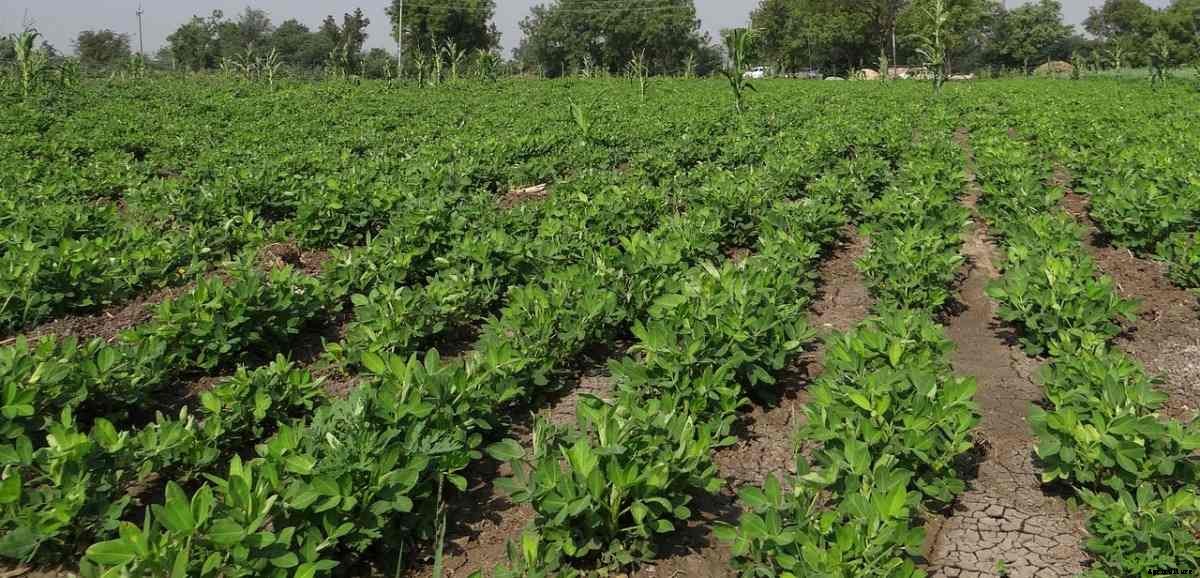
In bunch types, the row to row distance is kept 30-40 cm and in spreading type 45 to 60 cm. for this, 80-100 kg of seeds per hectare would be enough for bunch types and 60 to 80 kg for spreading types. Though, plant to plant distance would be 15 and 20 centimeters for bunch and spreading types respectively.
Sowing must be done about 5 centimeters deep behind the plow or with the help of a dibbler or seed planter. Then, sow the rain-fed crop with the advent of monsoon in the last week of June or in the first week of July. Complete the sowing as early as possible as delayed sowing causes a progressive reduction in the crop yield. Where irrigation facilities are available, sow Groundnut around 20th June or 10 to 12 days before the onset of monsoon with pre-sowing irrigation. This helps in the best utilization of monsoon by the crop because all the seed germination will take place before rains start which ultimately results in a higher yield. It will help in getting the field vacated in time for the sowing of Rabi crops.
Seeds must be sown about 5 cm deep with the help of country seed drill or they are sown behind the country plow. Dibbling of seeds by keeping 60 cm distance in a row to row and 10 cm distance in plant to plant for spreading type and 45 cm x 10 cm in bunch type helps in saving the seed requirement and increased the yield as the sufficient space is provided around the plant for its better growth and development. Groundnut is sown in flatbeds with 30 cm x 10 cm spacing.
Groundnuts can be harvested using the stacking method or mechanically. In the mechanical harvesting, Groundnuts are placed in windrows after being lifted, harvested with a combine, and conditioned in a drying unit. In the stacking process, the taproots are cut and the plants are collected and stacked by hand. In this procedure, the plant is loosened to be removed from the soil by hand. Then, Groundnuts are ready for picking once the pods can be removed from the stems without causing long shreds to form. At this stage, the Groundnut seeds rumble when the pods are shaken and seed already has a nutty taste.
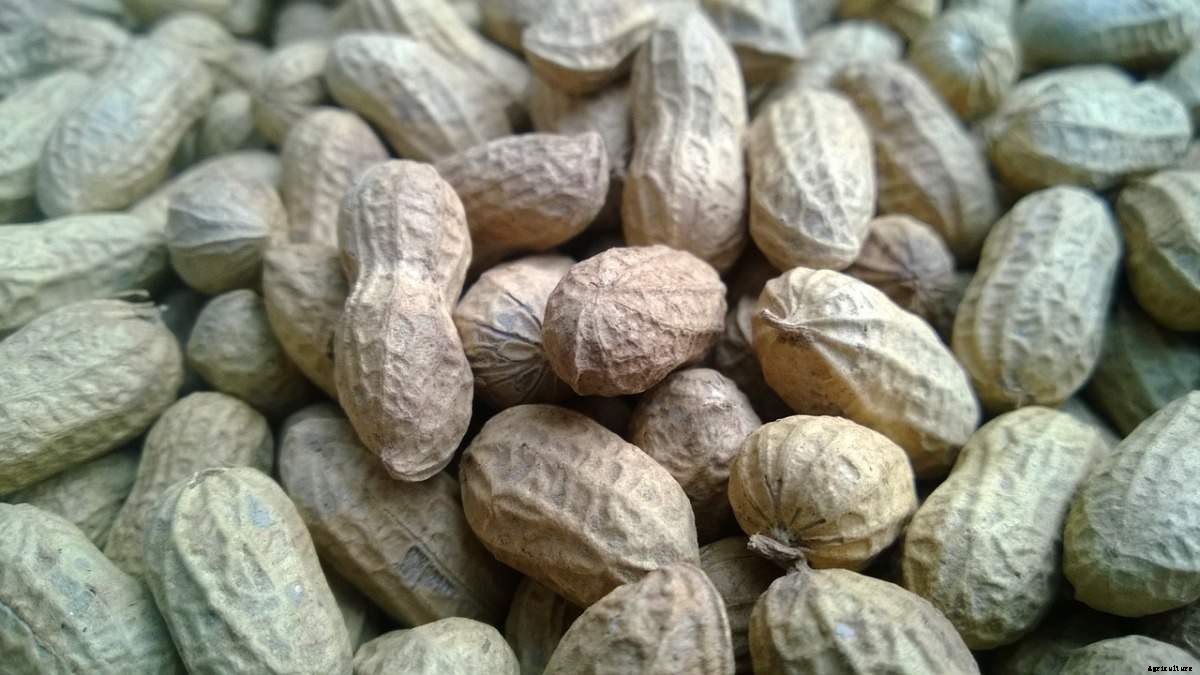
Seed germination usually occurs within 5 to 10 days, and within 25 to 40 days after sowing, yellow flowers form. Upon flower pollination, Groundnut plants send pegs down into the soil. The Groundnuts grow on these pegs underground.
Groundnut pods develop underground, an unusual feature known as geocarpy. After fertilization, a short stalk at the base of the ovary (termed a pedicel) elongates to form a thread-like structure called a “peg”. This peg grows down into the soil, and the tip, which contains the ovary, develops into a mature Groundnut pod.
The embryo turns horizontal to the soil surface and begins to mature taking the form of Groundnut. The Groundnut plant continues to grow and flower, eventually producing some 40 or more pods. The growing cycle of Groundnut takes 4 to 5 months, depending on the variety.
Normally, you can harvest peanuts in a fall when the plant leaves begin to yellow. Pull a plant and check the pods before harvesting the entire crop though to be certain about the Groundnut harvest time. The pods are the best indication of when to dig up Groundnuts. The peanuts must nearly fill the pods.
Gravity pulls the peg down into the soil where the Groundnut pod forms. The outer shell reaches full size well before the individual Groundnuts mature. Each peanut plant produces between 25 and 50 peanuts. Mature plants can be as large as 36 inches in diameter and about 18 inches tall.
Groundnut or peanut seed germination process is a very important step of growing groundnut plants from seed. You can use this information for growing Peanuts from seed and commercial Groundnut farming or organic groundnut farming practices. You may also like the Star Fruit Seed Germination, Time, Temperature, Process.


