
Welcome to Modern Agriculture!

Introduction: Hello farmers, we are here today with an excellent information of Micro-irrigation project in Telangana, Subsidies of Micro-irrigation by state governament along with Benefits, Types, Components, Importance of Micro-irrigation system. Microirrigation system is effective in saving water and increasing water use efficiency as compared to the conventional surface irrigation method. Besides, it helps reduce water consumption, growth of unwanted plants or weeds, soil erosion and the cost of cultivation. Slow and regular application of water directly to the root zone of plants through a network of economically designed plastic pipes and low discharge emitters.
In India, possibly more than 80 percent of the available water is used for irrigation. The irrigation process is the controlled application of water through man-made systems to meet the water requirements of agriculture.
Irrigation is an artificial application of water to crops or plants, particularly when an agricultural field does not get enough water through rains. Having perhaps the largest irrigated region in the world, India faces acute water scarcity. We need to adopt irrigation methods that help in not only in saving freshwater, but also give sufficient water to plants for growth. One such method now being followed in India is the Micro-irrigation process.
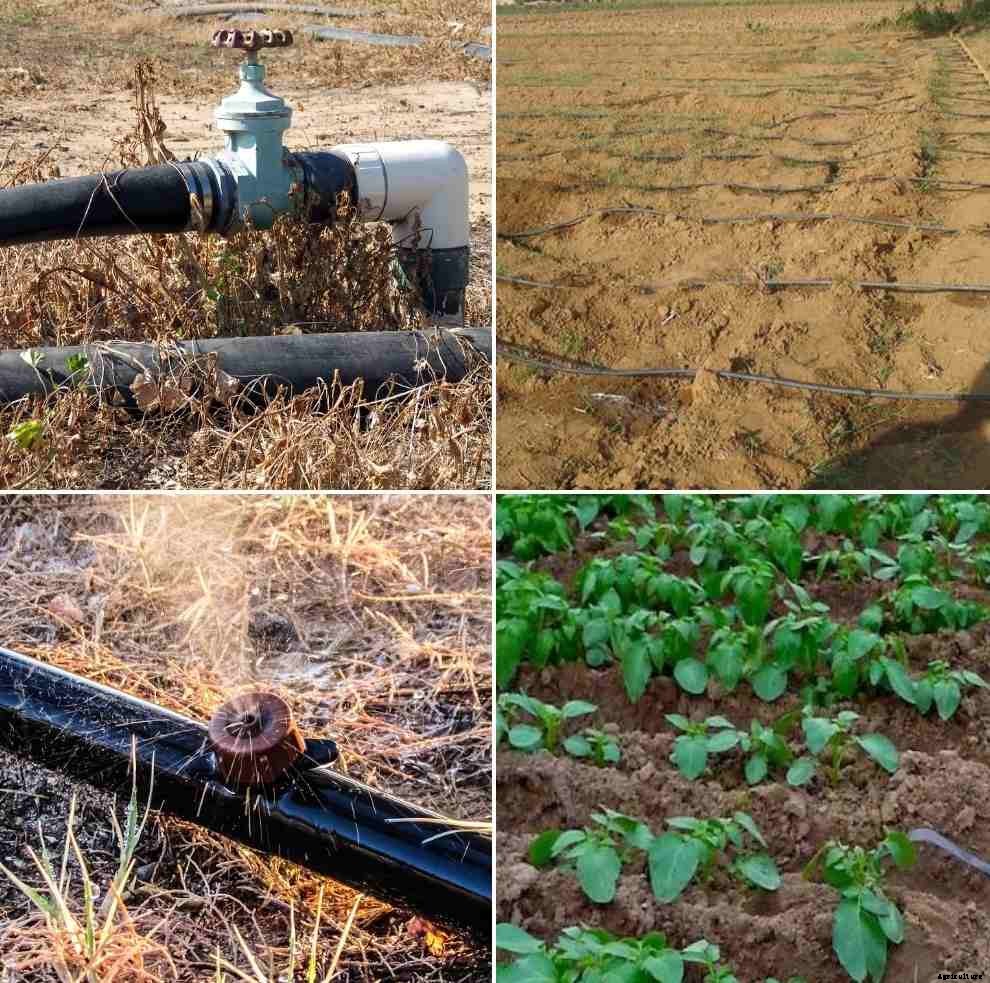
Micro-irrigation is also called trickle irrigation. It is an irrigation method with lower pressure and flow than a traditional sprinkler system. It is a modern method of irrigation; by this method, water is irrigated through drippers, sprinklers, foggers and by other emitters on the surface or subsurface of the land.
Main components of a Micro irrigation system in Telangana are as follows;
Water source, pumping devices (motor and pump), ball valves, fertigation equipment, filters, control valves, PVC joining accessories (Main and sub-main), emitters, field distribution lines, connectors and valves, emitters, and pressure gauges and regulators.
In this Micro-irrigation system water is applied drop by drop nearer the root zone area of the crop. In this system, the drippers are fixed based on the spacing of the crop. Many different types of emitters are obtainable in the market. They are mainly classified as Inline drippers, on-line drippers, Micro-tubes, Pressed compensated drippers.
Drip irrigation is most appropriate for wider spacing crops. The micro-sprinkler irrigation system is generally followed in sandy or loamy soils. This system is most appropriate for horticultural crops and small grasses. In this process, water is sprinkled in a lower height in various directions.
Portable micro sprinklers are also obtainable. They distribute more water than drippers and micro-sprinklers. They spray water in not more than one meter and it is used for preparing nursery and lawns in soils with low water holding capacity.
You should not miss the Polyhouse Subsidy in Telangana.
Trickle or drip irrigation were terms used to explain individual emitters or row crop emitters. Micro-irrigation system is a broader term that is used to cover all forms of small emission devices including individual emitters, row crop tubing, spray strakes, and micro-sprinklers. All of these devices were developed for water distribution to small crop areas, regularly to individual plants.
Given that around 65% of irrigation systems and 85%, if the drinking water comes from groundwater resources, the majority of the groundwater sources in the country are registering a fall in water levels. To arrest the decline in per capita water availability and per capita food grain availability, we want to increase production with judicious water use in farming. Its importance increases given that 140 million hectares are owned millions of farmers with an average farm size of fewer than two hectares.
Micro-irrigation systems (MIS) not only address the problem of water scarcity but effectively save fertilizer consumption per unit of land. This is because, in Micro irrigation systems, nutrients are released through the system, instead of their system application on top of the soil leading to wastage during the periodic flooding of fields under FMI. More, water and nutrients floating in the fields let weeds flourish.
Some of the advantages of Micro Irrigation systems are;
Any type of irrigation in a commercial agriculture system can greatly decrease the climate-related yield risks resulting from water stress. Compared to overhead irrigation systems, micro-irrigation can give some added measure of reduced risk.
Here we can discuss the benefits of Micro-irrigation;
You may also like the How to Grow Basmati Rice from Seed.
The Types of Micro-irrigation systems
The types of Micro-irrigation systems can be classified for a variety of parameters. Micro-irrigation encompasses several methods of water application to plants are drip, Sprinkler or spray, subsurface and bubbler irrigation.
Drip irrigation (Both on-line and in-line systems) – Drip irrigation is also known as trickle irrigation is an irrigation method which saves water and fertilizer by allowing water to drip slowly to the roots of plants, either onto the soil surface or directly onto the root zone, through a network of valves, pipes, tubing, and drippers.
Sprinkler irrigation system – Sprinkler irrigation is also called Spray irrigation. It is a process of applying irrigation water which is similar to rainfall. Water is distributed through a system of pipes generally by pumping. It is then sprayed into the air and irrigated soil through spray heads so that it breaks up into small water drops that fall to the surface.
Sub-Surface System – It is a system in which water is useful slowly below the land surface through emitters. Such systems are generally preferred in semi-permanent or permanent installations. Subsurface drip irrigation (SDI) is a low-pressure, high-efficiency irrigation that uses buried drip tubes or drip tape to meet crop water needs.
An SDI system is flexible and can give frequent light irrigations. This is particularly suitable for arid, semi-arid, hot, and windy areas with limited water supply. Farm operations become free of impediments that normally exist above ground with any other pressurized irrigation system.
Bubbler System – In this system, the water is applied to the surface of the soil in a small stream. The discharge rate for point source bubbler emitters is greater than the drip system or subsurface emitters but generally less than 225 l/h. Since the emitter discharge rate normally exceeds the infiltration rate of the soil, a small basin is usually required to contain or control the water.
Bubbler systems do not need elaborate filtration systems. These are appropriate in situations where large amounts of water need to be applied in a short period and suitable for irrigating trees with wide root zones and high water requirements.
You may also like the Turmeric Cultivation Income in Polyhouse.
That’s all farmers, hope it helps you understand the Micro-irrigation in Telangana.
You may be interested in Vegetable Gardening Calendar in India.


