
Welcome to Modern Agriculture!

Let us discuss today, the polyhouse subsidy, profit, cost, and economics.
What is polyhouse cultivation? Why most people are showing interest in polyhouse cultivation? Well, since the centuries cultivation of crops is changing with different farming methods and the polyhouse is one of the modern farming methods using a controlled environment. Growing crops under the controlled environment such as temperature, humidity, and fertilizers with the help of automated systems are called polyhouse cultivation. We will learn conditional factors of polyhouse farming and the future of polyhouse farming in India.
You can also assume this information for polyhouse subsidy in Karnataka, polyhouse subsidy in Maharashtra, polyhouse subsidy in Kerala, polyhouse subsidy in Telangana, polyhouse subsidy in Andhra Pradesh, polyhouse subsidy in Madhya Pradesh, polyhouse subsidy in Bihar, polyhouse subsidy in Uttarakhand, polyhouse subsidy in Uttar Pradesh, polyhouse subsidy in West Bengal, polyhouse subsidy in Gujarat, polyhouse subsidy in Rajasthan, polyhouse subsidy in Punjab, polyhouse subsidy in Haryana, polyhouse subsidy in Tamil Nadu, polyhouse subsidy in Chhattisgarh, polyhouse subsidy in Odhisa, polyhouse subsidy in Assam, polyhouse subsidy in Meghalaya, polyhouse subsidy in Himachal Pradesh, polyhouse subsidy in Arunachal Pradesh, and polyhouse subsidy in Nagaland.
People are tending towards polyhouse cultivation is due to more profits and one can grow crops throughout the year without depending on environmental factors and also farmers have very few problems with crop pests and diseases in polyhouse growing. This information may be applied to polyhouse cost for 1 acre in Karnataka, polyhouse cost for 1 acre in Telangana, polyhouse cost for 1 acre in Maharashtra, polyhouse cost for 1 acre in Tamilnadu, polyhouse cost for 1 acre in Kerala, polyhouse cost for 1 acre in Madhya Pradesh, polyhouse cost for 1 acre in Bihar, polyhouse cost for 1 acre in Uttar Pradesh, polyhouse cost for 1 acre in West Bengal, polyhouse cost for 1 acre in Odhisa, polyhouse cost for 1 acre in Punjab, polyhouse cost for 1 acre in Haryana, polyhouse cost for 1 acre in Gujarat, polyhouse cost for 1 acre in Rajasthan, polyhouse cost for 1 acre in Andhra Pradesh, and polyhouse cost for 1 acre in Chhattisgarh.
Traditional cultivation in open fields has been always risky due to unpredictable climatic conditions and exposure to insect pests and diseases. To satisfy the growing population of food and other needs, it is mandatory to grow crops throughout the year without depending on external weather conditions. One can avail government schemes for polyhouse subsidy in most states of India. As one can expect up to 80% of polyhouse subsidy, you may end up paying only some amount from your pocket. Even some rural banks may offer polyhouse subsidy and loans. Polyhouse horticulture is picking up every year in India due to the polyhouse subsidy and high profits throughout the year. Apart from this, growing vegetables, and flowers is very easy when compared to open field cultivation.
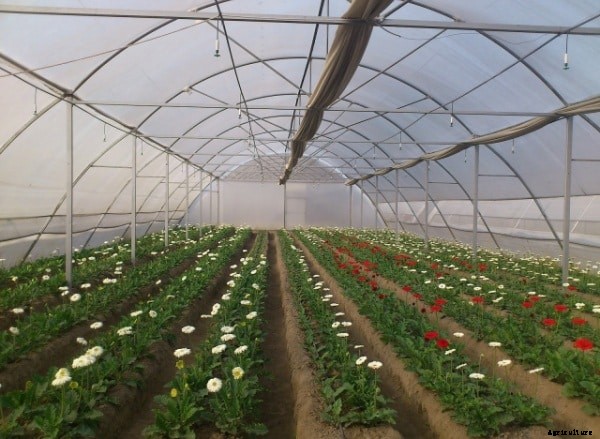
There are many advantages to growing crops in polyhouse.
Polyhouse and Greenhouse are protected structures for cultivation of certain crops. The greenhouse is made with glass so it is also called glasses, once the plants are growing it is termed as a greenhouse. Polyhouse is made of polyethylene material. In fact, both considered as same, but the greenhouse broad term being used.
There are 2 categories of polyhouses can be constructed based on environmental control factors.
Natural Ventilation Polyhouse: This type of polyhouse will have natural ventilation and Fogger system to prevent pests and diseases. The purpose of naturally ventilated polyhouse is to protect the plants from adverse climatic conditions. They will not have any special environmental control system. These types of polyhouses cost less.
Environmental Control Polyhouse: In this type of polyhouse system, crops are grown around the year by providing controlled environment factors such as temperature, humidity, fertilizer automation, Co2, and rooting medium. These factors can extend the off-season crop production.
Further, these polyhouse systems are grouped into 3 subcategories.
Low tech Polyhouse System: This polyhouse system can be built with low-cost material and maintaining this system is very easy. Usually, the construction of polyhouse is carried out with local material such as wood and bamboo. Generally, Ultra Violet (UV) film is being used as a cladding material. This type is suitable for cold climatic conditions. Temperature and humidity can be controlled by using shade nets. There won’t be any other controlled devices are used in this type of polyhouses.
Medium tech Polyhouse System: In this system, the construction of polyhouse is carried out by G. I (galvanized iron) pipes. To prevent any damage from the wind flow, the entire polyhouse structure is fixed to the ground, and screws are attached to the structure of the house of the canopy cover. In this system, humidity and temperature are controlled by arranging cooling pads, mist controllers along with Thermostats and exhaust fans. One can adopt these kinds of polyhouses in dry and composite weather conditions. This is pretty useful where the plants require good care throughout their life cycle.
Hi-tech Polyhouse System: Hi-tech polyhouse includes an automatic control system for temperatures, humidity, fertilizers, irrigation, and other complete environmental parameters for growing crops all the time.
Vegetable crops:
Herbs.
Fruit crops:
Polyhouses are best for raising nursery plant seedlings
Growing ornamental plants,
Cut flower production.
Hybrid seed production of flowers.
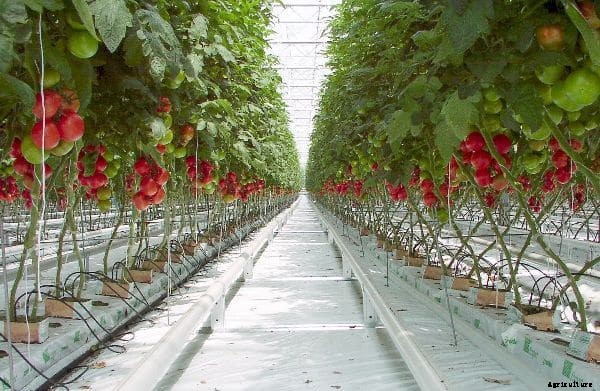
Polyhouse cost depends on the type of system you choose and the construction area. Here are some details of the construction cost of polyhouse. These figures may change time to time and region to region. Consider this as a ballpark estimate for polyhouse construction.
The cost involved in Polyhouse construction depends on the type of polyhouse:
You may be interested in High Density Guava Farming.
There are 2 types of polyhouse costs, we can consider.
The following Hi-tech Polyhouse/Greenhouse cost is for 1 Hectare or 2.5 Acres land.
Fixed Cost Items (in Indian rupees) for Polyhouse Subsidy
Land and development
Rs.4, 50,000Office Rooms
Rs.3, 00,000
Telephone, fax, and computer
Rs.1, 00,000Polyhouse construction
Rs.14, 00,000
Planting material and planting
Rs.30, 00,000
Cold storage
Rs.9, 00,000Refrigerated transport van
Rs.2, 00,000 Grading & packing roomRs.5, 00,000
Generator setRs.2, 50,000
Power related installationsRs.2, 00,000
Water supply system, drip irrigation/sprinkler system and misting linersRs.8, 00,000
Furniture related
Rs.75, 000
Total Fixed Cost
Rs.81, 75,000 (eighty-one lakh seventy-five thousand)Recurring Cost Items (in Indian rupees) for Polyhouse Subsidy
Manures and fertilizers
Rs.1, 50,000
Plant protection
Rs.1, 50,000Preservatives
Rs.3, 00,000Packing material
Rs.2, 00,000Airfreight
Rs.1, 20,00,000Labor charges
Rs.3, 00,000
Commission /InsuranceRs.15, 00,000
Employee SalariesRs.6, 00,000
Electricity charges/yearRs.6, 00,000
Overhead costs
Rs.1, 00,000 Maintenance costRs.1, 00,000
Miscellaneous expensesRs.4, 00,000
Total Recurring Cost Rs.1, 64,00,000 (1 Crore sixty four lakhs)Total cost = Fixed cost + Recurring cost = Rs.81, 75,000 + Rs.1, 64,00,000 = 2,45,75,000 (2 Crore forty five lakhs seventy five thousand)
Just to calculate the polyhouse profit, let us take a Rose cut flower cultivation for the project of above mentioned 1 Hectare /2.5 acres polyhouse.
Rose Cut flower project report for hi-tech polyhouse/greenhouse
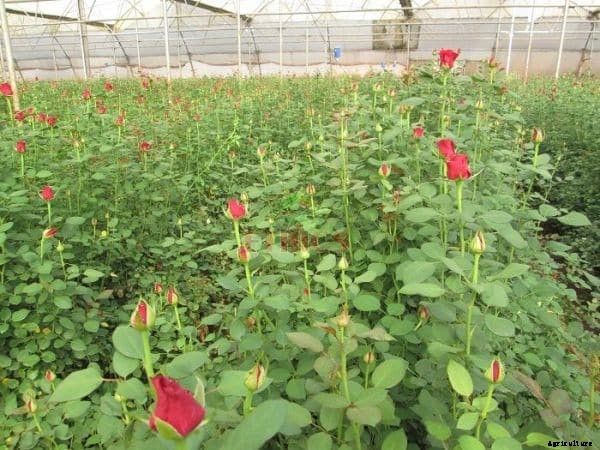
Net profit for first year = Gross income – Total cost (fixed plus recurring) = Rs.3, 30,00,000 – Rs.2, 45,75,000 = Rs.84, 25,000 (eighty four lakes and twenty five thousand).
You can expect more profits in subsequent years.
Here are some polyhouse profits/income details for different crops.
Note: The above-said figures subject to change depending on flower quality/ export market demand. However, you can obtain 5 to 7 times of yield and profits in polyhouse cultivation than traditional open-field farming.
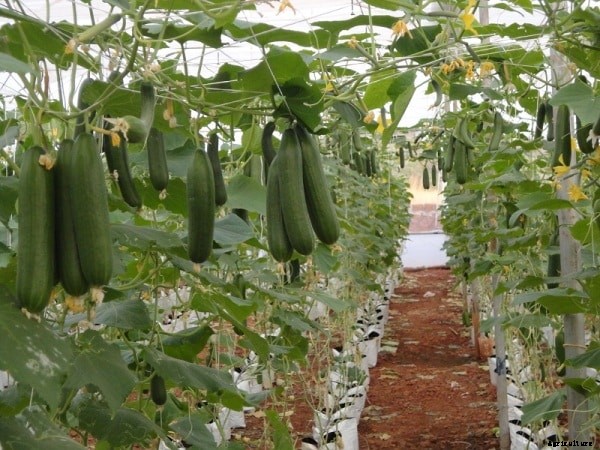
There are many states in India encouraging polyhouse cultivation practices. Each state has different subsidy percentages. You can get up to 80% of the subsidy.
From above mentioned project (1 hectare cut flowers) 80% of total cost = 0.8 x 2,45,75,000 = 1,96,60,000 (is your subsidy amount) remaining 48 lakh 40 thousand should be spent from your pocket.
Your horticulture department or any NABARD branch or National Horticulture board is the point of contact to inquire about the exact percentage for Polyhouse subsidy for different states in India. You can apply this information for Polyhouse subsidy in Karnataka, polyhouse subsidy in Tamilnadu, polyhouse subsidy in Telangana, polyhouse subsidy in Maharashtra, polyhouse subsidy in Andhra Pradesh, polyhouse subsidy in Kerala, polyhouse subsidy in Bihar, polyhouse subsidy in Madhya Pradesh, polyhouse subsidy in Uttar Pradesh, polyhouse subsidy in West Bengal, polyhouse subsidy in Gujarat, Ppolyhouse subsidy in Rajasthan, polyhouse subsidy in Punjab, Ppolyhouse subsidy in Haryana, Ppolyhouse subsidy in Uttarakhand, Ppolyhouse subsidy in Chhattisgarh, Polyhouse subsidy in Odisha, Polyhouse subsidy in Assam, Polyhouse subsidy in Himachal Pradesh, Polyhouse subsidy in Nagaland, Polyhouse subsidy in Meghalaya, Polyhouse subsidy in Tripura, government subsidy for Polyhouse.
You should check this as well: Mango Seed Germination Process.


