Welcome to Modern Agriculture!

If you’ve ever looked into aquaponics, you’ve probably had two thoughts at the same time:
“This looks amazing…”
…and
“This looks complicated.”
That second thought stops a lot of people before they even begin.
But here’s the truth, once you understand the basics, aquaponics is surprisingly simple. In fact, many beginners find it easier to maintain than traditional gardening because nature is doing most of the work for you.
Instead of constantly watering soil, dealing with pests, or buying fertilizers, aquaponics creates a small ecosystem where:
It’s a clean, efficient cycle that works with nature, not against it.
Now, let’s be real for a second; your first system doesn’t have to be perfect. Most beginners don’t fail because aquaponics is hard. They struggle because they’re missing a clear, step-by-step starting point.
That’s exactly what this blog is here to fix.
Think of this as your complete checklist, a simple, practical roadmap that walks you through everything you need to get started without the overwhelm.
By the end, you’ll know:
If you’ve been putting this off, this is your moment to start. You don’t need to figure everything out today, you just need to take the first step.
This is where most beginners rush, and it’s also where many go wrong.
It’s tempting to jump straight into buying tanks, pumps, and grow media. But before you build anything, you need to answer one simple question:
“What do I actually want from my aquaponics system?”
That answer will shape everything, from the size of your setup to the type of fish you raise.
Take a minute and be honest with yourself:
1. Is this for food, a hobby, or both?
2. Where will you place your system?
3. What’s your budget?
If you’re just getting started, your goal should be:
You’re not trying to build a perfect system, you’re building your first successful one.
Once you know your goal, the next step is choosing the type of system you’ll build.
This is where things can start to feel overwhelming, because suddenly you’re seeing terms like NFT, raft, and media beds everywhere.
Here’s the good news:
You don’t need to master every system, you just need to pick the right one for where you are right now.
Let’s break it down simply.
This is the most beginner-friendly and forgiving setup.
How it works:
Plants grow in a bed filled with media (like gravel or clay pebbles), while water from the fish tank flows through it.
Why it’s great:
Best for:First-time growers who want a reliable, low-stress system
This system uses narrow channels where a thin film of water flows over plant roots.
Why people like it:
But here’s the catch:
Best for:Growers with some experience or those expanding later
Plants sit on floating rafts with roots submerged directly in nutrient-rich water.
Why it’s powerful:
Challenges:
Best for:Intermediate growers or those scaling up production
If you’re just starting out, here’s the honest answer:
Go with a media bed system.
It’s the most forgiving, easiest to manage, and gives you the highest chance of early success, which is exactly what you need as a beginner.
You can always experiment with NFT or raft later once you understand how your system behaves.
You can have the perfect design, the right equipment, and great fish, but if your system is in the wrong spot, you’ll constantly struggle.
Location quietly determines how easy or frustrating your aquaponics journey will be.
Focus on these three essentials:
Plants need light to grow, it’s non-negotiable.
Indoor setup?
You’ll likely need grow lights to replace natural sunlight.
Your system relies on:
That means you’ll need:
Tip: Avoid placing your system where running cables or carrying water becomes a daily hassle. Convenience matters more than you think.
Aquaponics systems don’t like sudden changes.
Watch out for:
Simple fixes:
There’s no one-size-fits-all answer, it depends on your space and goals.
Outdoor systems:
Indoor systems:
Choose a location that is:
If it feels easy to maintain, you’re on the right track.
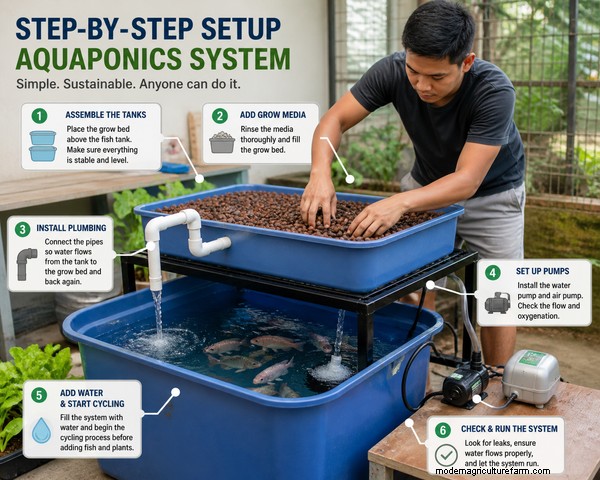
This is the part where most beginners either overspend… or miss something important.
You’ll see long, complicated equipment lists online, but the truth is, you only need a handful of core components to get started.
Think of your system as three simple parts working together:
Let’s break it down into a clear, no-confusion checklist.
This is where your fish live, and where everything begins.
This is where your plants grow.
This moves water from the fish tank to the grow bed.
Tip: Don’t go too cheap here, reliability matters.
Fish need oxygen just like we do.
Without proper aeration, fish can become stressed or die.
This replaces soil in your system.
Common options:
It supports plant roots and helps beneficial bacteria grow.
This connects everything together.
This is where many DIY builders get stuck; small mistakes can cause leaks or poor flow.
This is your “early warning system.”
You’ll use it to monitor:
Why it matters: Water quality is everything in aquaponics.
There’s nothing wrong with building your own system, but it helps to understand that aquaponics is all about balance.
Every part affects the others.
When your components are properly matched:
Your success depends heavily on what you choose to grow and raise.
Start with the wrong fish or difficult plants, and even a well-built system can feel frustrating.
Start simple, and everything becomes easier.
When choosing fish, you want species that are hardy, adaptable, and forgiving.
a. Tilapia
b. Catfish
c.Goldfish
Plants are where you’ll see the fastest rewards, so it’s smart to start with ones that grow quickly and easily.
Leafy Greens
Fast-growing and low maintenance
Herbs
Thrive in aquaponics conditions
Simple Fruiting Plants (Later Stage)
Slightly more demanding, best once your system is stable
If there’s one concept that separates successful beginners from frustrated ones, it’s this:
The nitrogen cycle.
Now don’t worry, this isn’t going to turn into a science lecture. You only need to understand the simple version to get this right.
Here’s what’s happening inside your system:
And in doing so, they clean the water for the fish.
That’s it. That’s the cycle.
Ammonia (from fish waste) is toxic.
If your system isn’t properly cycled:
This is where most beginners run into trouble, not because it’s hard, but because they skip or rush this step.
This is where everything comes together.
By now, you’ve chosen your system type, location, equipment, fish, and plants. Now it’s time to actually build and run your aquaponics system.
Don’t worry, you don’t need to get everything perfect.
You just need to get it running properly.
Tip:Stability matters, water is heavy, and shifting setups cause problems later.
Rinse your media (very important to remove dust)
This is where your plants will grow and where beneficial bacteria will live.
Pro Tip: Fixing leaks now is much easier than later.
Turn on your water pump
Your system should now be circulating and oxygenating properly.
This stage requires patience, but it sets the foundation for everything.
You may not see rapid growth immediately, that’s normal during cycling.
Important: Your system is still stabilizing, go slow.
Expect:
What you don’t want:
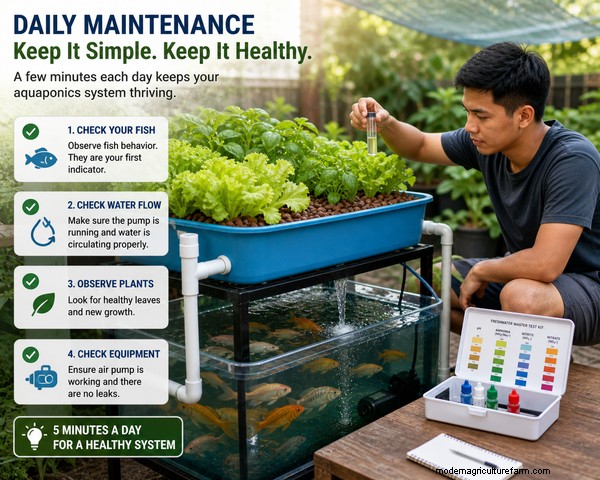
One of the biggest myths about aquaponics is that it’s completely hands-off.
It’s not.
But here’s the good news, it also doesn’t need hours of work every day.
In fact, once your system is up and running, maintenance becomes simple, quick, and routine. The key is knowing what to check and when to check it.
Think of this as a quick “health scan” of your system.
1. Check Your Fish
Fish are your early warning system.
2. Check Water Flow
No flow = no oxygen + no nutrients.
3. Observe Your Plants
Plants tell you if nutrients are balanced.
4. Quick Equipment Check
Small issues caught early prevent big problems.
This is where you keep your system stable long-term.
1. Test Your Water
Check:
This tells you if your system is balanced.
2. Inspect and Clean Components
Good flow = healthy system.
3. Check Plant Growth
Regular harvesting actually improves productivity.
4. Monitor Water Levels
Top up water as needed (due to evaporation)
Stable water levels help maintain balance.
Catch these early:
These are small problems until you ignore them.
Let’s be honest, most aquaponics problems don’t come from bad luck.
They come from a handful of very common mistakes that almost every beginner makes at some point.
The good news?
Once you know what to watch out for, these are easy to avoid.
This is probably the #1 mistake.
More fish = more waste = more nutrients… right?
Not exactly.
Too many fish early on:
Fix:Start with fewer fish and increase gradually as your system stabilizes.
It feels harmless, but it’s not.
Uneaten food:
Fix:Feed only what fish can eat in a few minutes. Less is better than more.
You can’t “see” water problems right away, but they build quickly.
Skipping water tests leads to:
Fix: Test weekly, especially in the early stages. Your water tells the real story.
It’s tempting to go big or advanced right away.
But complex systems:
Fix: Start simple (like a media bed system). Master the basics first.
A bad location creates constant problems:
Fix:Choose a stable, accessible spot with balanced light.
This one isn’t technical, it’s mental.
Aquaponics takes time to stabilize.
In the first few weeks:
Fix:Be patient. A stable system rewards consistency.
Small issues don’t stay small.
Fix: Address issues early, before they grow.
Almost every mistake comes down to one thing:
Trying to rush the process.
Aquaponics works best when you:
You don’t need to guess. Your system will tell you.
Look for these signs:
1. Stable Water Parameters
Your system is balanced and predictable.
2. Healthy, Active Fish
Your environment is stable enough to support more life.
3. Consistent Plant Growth
Nutrient flow is working efficiently.
4. You Want More (This One Matters Most)
Growth naturally leads to expansion.
You don’t need to rebuild everything. Start small.
Option 1: Add Another Grow Bed
Option 2: Increase Fish Stock Gradually
Option 3: Improve System Efficiency
Option 4: Expand to a Larger System
Starting your first aquaponics system might feel like a big step, but it’s really just a series of small, manageable ones.
You don’t need to master everything today.
You don’t need a perfect setup.
What you do need is:
Because that’s how every successful grower began.
Along the way, you’ll make adjustments. You’ll learn what works in your space. And before you know it, what once felt complicated will start to feel natural.
That’s the beauty of aquaponics it rewards consistency, not perfection.
What Matters Most Moving Forward
If you take one thing from this guide, let it be this: Start simple. Stay consistent. Trust the process.
Focus on building a stable system first. Growth, expansion, and experimentation can come later.