
Welcome to Modern Agriculture!

• Protein content should be 25-28% for starter feed (as well as 1% calcium and 0.5% phosphorus), 22% for fattening and 24% for laying hens. The feed must be finely ground. If possible, use starter feeds for turkey chicks, as they usually contain 25-28% protein. If you use chicken starter feed containing only 20-22% protein, the quail chicks will grow more slowly. Alternatively, it is possible to use pullet feed.
• From 5 weeks of age, add ground shells or limestone. Laying hens need 3% calcium. If it is very hot the quail will eat less, so increase this to 3.5% calcium for laying hens.
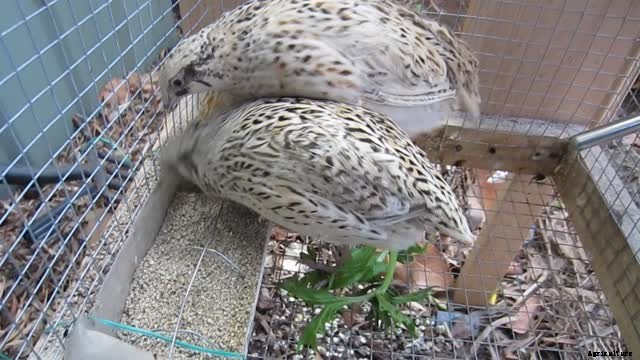
• In addition, provide a little fruit and vegetables (lettuce, apple, cabbage, banana, papaya, courgette, carrot), especially on family farms. If they are used to it, the quail will also appreciate leftovers of rice or cooked pasta, though the quantity should be limited. These leftovers should not be left in the cages too long as they will rot quickly, meaning that the feeders will have to be thoroughly cleaned.
• With a good overall protein content, and lysine in particular, soya meal has much lower calcium and phosphorus values, although it is six times as rich in potassium. It also gives the meat a very good flavour.
To increase the protein and energy levels of the feed, add insects such as termites, fly larvae or pupae, or mealworms.
• Place a lure of animal excrement or entrails in an open bowl to attract flies to lay their eggs.
• After 24-36 hours the eggs become larvae and 4 or 5 days later, pupae.
• Give them to the quail as they are. Dry them in the sun or roast them to avoid putrefaction.
• The larvae contain more than 50% protein and almost 5,500 kcal per kilo of dry matter compared to more than 70% protein and almost 4,500 kcal for the pupae.


