
Welcome to Modern Agriculture!

There are a number of benefits of why you too should raise pigeons.
In general pigeons should be raised in pairs of two. Each pair consists of one male one female and live together for the rest of their life’s. They can live for about 12 to 15 years. When living out in the wild in order to build a house for themselves they both go around collecting straw.
The female pigeon can start laying some eggs at the age of five to six months, can lay about 2 eggs on each occasion and have a breeding power for about five years. The eggs are incubated by both the male and female.
The baby pigeons hatch out of the egg around 17 to 28 days of them being layed. For the first 4 days they eat crop milk which is in the parent’s stomachs, then after that the female pigeons feeds them for ten days through the lip. After that they start eating supplementary food on their own. When they are about 26 days old they can be suitable for consumption.
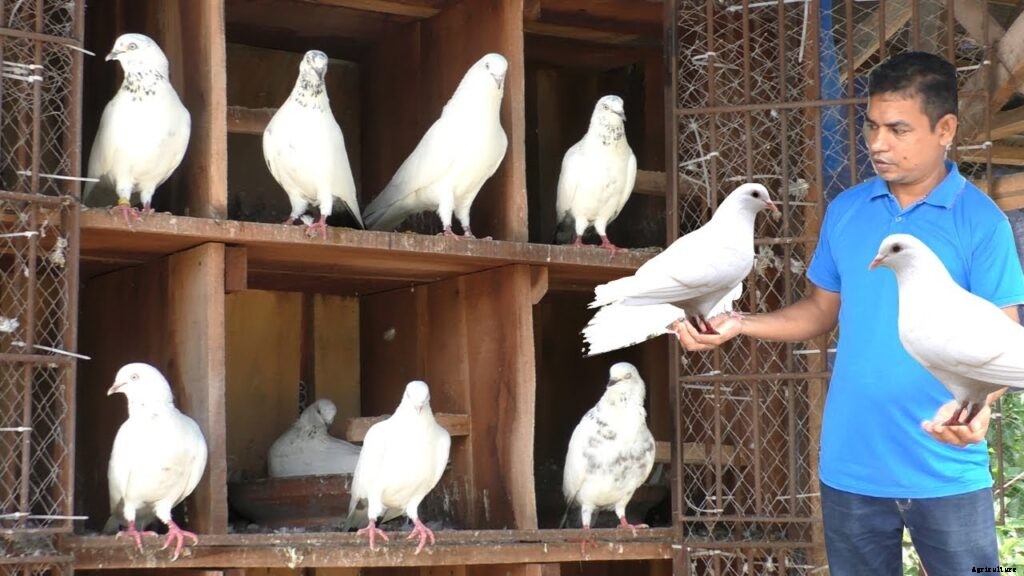
You can find around three hundred kinds of pigeon breeds which fall between two kinds.
In general, the main reason why a lot of folks raise pigeons is for meat production. The younger the pigeon is the more soft and juicy the meat is.
When raising pigeons proper housing is very important. Below are some factors to consider when it comes to housing.
In general pigeons eat rice, wheat, paddy, enamel, maize, legume, aestivus mustard, triticum, gram etc. To give them some feed you can just put the feed in front of the house and they will consume it on their own.
For them to grow healthy you have to give them the right balanced diet. The balanced feed you can provide for them is similar to the chicken diet. Each bird can consume about 35 to 50 grams of grainy feed each day and the feed should at least contain 15 to 16% protein.
To assist in baby pigeons growing faster you can feed them lime stone, oyster dust, bone dust, greet mixture, salt and mineral mixture. This will also add some nutrients in their regular feed. Some green vegetables can be fed to them as well.
The baby pigeon which is also known as a SQUAB does not require extra feed for about five to seven days. They take crop milk from their parent’s stomach. Some people consume this ‘pigeon milk’. Both parents feed the baby pigeons this way for about 10 days. After 10 days they are then able to fly and search for their own food. To make it easily for them you should keep fresh feed plus water near to their house.
Pigeons will need some clean water to drink and clean themselves. So you must put a water pot near the house, the water pot should have clean water daily to serve the birds clean water always.
In general, male and female pigeons stay together as a family. When it’s the egg laying period they both go out to find some straw to make a small nest. If you have to supply an artificial nest then go ahead and do so. A female pigeon can begin laying eggs at the age of five to six months, they lay 2 eggs per month. The eggs are incubated by both parents. Since the eggs are small it is wise to sell them for profits than eat them.
Pigeons are very resistant to lots of diseases compared to other domestic birds. They usually suffer from paratyphoid, pox, TB, influenza, cholera, newcastle etc. Below are some remedy methods to deal with these diseases.


