
Welcome to Modern Agriculture!

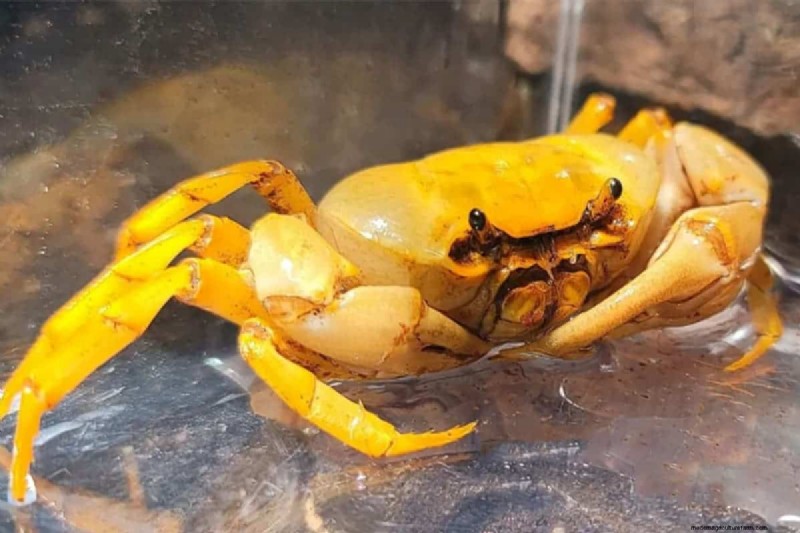
The Banana crab (Terrathelphusa sp.) is one of the rarest semi-terrestrial crab species you can find on the pet trade market. Nonetheless, many hobbyists would like to have it because of its unique yellow appearance.
When I first saw this crab, I decided to read up on it online. To my surprise, there was very little information available. Furthermore, there was no specific mention of the exact species; only the genus, Terrathelphusa, was mentioned. Therefore, I decided to conduct my own research, and as a result, I can say with a reasonable degree of certainty that this is Terrathelphusa mas.
The Banana crabs are relatively small semi-terrestrial crabs. You will need a 10-gallon tank for a couple of these crabs, with clear water, high humidity, and temperature. In this case, these crabs can make great pets in paludarium setups.
Unfortunately, the ecology of this species is poorly researched, and much is still unknown about them. In this guide, I have gathered everything that is currently known about Terrathelphusa mas, including ideal tank setups and how to care for them.
Kingdom: Animalia – Multicellular animals
Phylum: Arthropoda – Joint-legged
Class: Malacostraca – Crustaceans
Order: Decapoda – Ten-legged
Suborder: Pleocyemata – Brooding
Infraorder: Brachyura – True crabs
Section: Eubrachyura – Advanced crabs
Subsection: Heterotremata – Diverse
Superfamily: Gecarcinucoidea – Freshwater crabs
Family: Gecarcinucidae – Tropical freshwater crabs
Genus: Terrathelphusa – Land crabs
Species: Terrathelphusa mas
It should be noted that the species Terrathelphusa mas is relatively new. In 1989, this was the result of a study that concluded that the new genus, is easily recognized by its oval, relatively smooth, and swollen carapace, and cannot be confused with any other taxa.
The genus name “Terrathelphusa” is thought to be derived from the Latin words “Terra”, which means “land” and the name “Thelphusa”, which is in allusion to the semi-terrestrial habits of the crabs of this genus.
The species name “Mas” is derived from the Iban word for “Gold,” referencing the golden appearance of this newly discovered species.
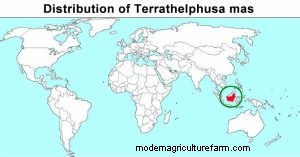 Banana crabs are endemic to the island of Borneo. This species can be found at high elevations on Gunung Penrissen, but it is absent at low elevations.
Terrathelphusa mas are recorded from limestone and sandstone habitats. These crabs often live in burrows up to 3 ft (1 m) deep amid dense soil debris.
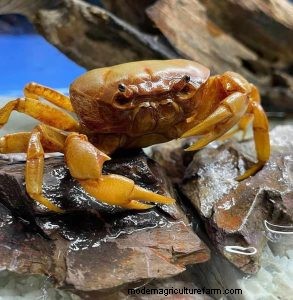
For a detailed description of Terrathelphusa mas and how it differs from other species of its genus, you can refer to this scientific paper.
Related articles:
This is a semi-terrestrial species. In their natural habitat, these crabs construct relatively deep burrows (up to 3 ft or 1 m) which help them to maintain an optimal moisture (humidity) level.
Note: Semi-terrestrial crabs have modified lungs and require high moisture to breathe.
Banana crabs are mostly nocturnal, meaning their peak activity occurs after dusk. This behavior is driven by their instinct for self-preservation since it helps them stay safe while searching for food, which is easier to find at night.
Despite their small size, these crabs are not completely peaceful and inoffensive. In overcrowded tanks, they can easily resort to violent behavior, to “regulate” their population. The males in particular tend to fight using their large front claws.
Banana crabs are pretty messy and destructive and may redecorate your paludarium to their liking. You should keep that in mind.
Features:
Banana crabs are omnivorous scavengers. It means that they feed on both plant and animal matter. They are not picky eaters and will consume a wide variety of food such as:
Just like most other crab species, they are opportunistic feeders. They adapt their diet according to the food available in their habitat during different times of the year.
If Terrathelphusa mas is kept as a pet, suggested foods include:
Features:
Related article:
You can leave their food for 24 hours before removing it.
However, make sure any uneaten food is removed to prevent mold. Keep in mind that Banana crabs tend to store food in their burrows
Do not give them the same food for weeks. Ideally, you need to change their diet at least every week.
Although these crabs prefer old or decaying over young leaf litter, keeping them with plants isn’t entirely safe, especially if they are not well-fed. In such cases, they may consume any plant matter regardless of its condition.
They will also cut and uproot everything that is possible in your tank.
As with all crustaceans, calcium is a crucial component of a Banana crab’s exoskeleton and overall health. Growing a new exoskeleton requires a high amount of Ca (calcium) to facilitate calcification.
Calcium can be found in:
Always keep a small piece of Cuttlefish bone in their enclosure. Supplement their diet and make sure they get enough calcium (for the exoskeleton) by regularly feeding specialized invert foods.
In addition, the process of molting puts crabs in a vulnerable state. That is why it is crucial to have many hiding places in the tank.
Related articles:
It is crucial to remember that Terrathelphusa mas is not an aquatic species of crabs. They are semi-terrestrial and need a particular setup to thrive.
The minimum recommended tank size for one Banana crab is a 10-gallon (40-liter) tank.
As adults, one male and one female may be kept together in the same enclosure of 20 gallons (80 liters) or more. However, two adult males would require more space to reduce territorial fighting.
Of course, having a larger tank is always preferable since it can be easier to make diverse areas for them to hide.
Important: Banana crabs are very good escape artists. It is good to have your tanks covered.
Once again, Banana crabs are semi-terrestrial crabs. Even more, they prefer land over water. Therefore, the land area should take at least 70-90%.
These crabs do not need a lot of water.
Therefore, instead of creating a complex tank setup with filters and aeration, you can use a simple water bowl.
The bowl should be deep enough to completely submerge your crabs. As long as water pools can completely cover their entire bodies, they will be fine. Therefore, 2-3 inches (5 – 7 cm) will be deep enough.
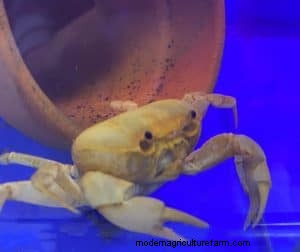 Important: Banana crabs cannot stay in the water all the time. They will drown. It is crucial to provide a variety of surfaces for them to get out of the water.
This species needs only freshwater! They do not need either salt, nor brackish water.
If you use tap water, add Seachem Prime to remove chlorine, chloramine. This water conditioner will also bind to heavy metals, any ammonia, nitrites, or nitrates present for up to 48 hours. Consider Prime as your additional safety net.
If you are using RO/DI systems, you will have to remineralize the water with Salty Shrimp GH/KH+ or GH+ (Read more about it here).
Pros and Cons of Water Bowls
Pros:
Cons:
If you do not want to use a water bowl and decide to go for a classic paludarium setup for Banana crabs, you need to know their preferences. These crabs thrive in water with:
pH: a pH range of at least 7.0 – 8.0.
Temperature: temperature should be around 75 – 82°F (24 – 28°C).
Hardness: KH 0 – 10 and GH 4 – 16.
For the terrestrial area, we can use:
For the aquatic section:
I’d start with at least 10 cm (4 inches) deep. The deeper the better.
To allow them to dig and form caves, the substrate should be moist enough to hold its shape when squeezed but not so wet that it drips. A mix of coconut fiber and sand is ideal for achieving this “sandcastle consistency.”
Tip: Test the consistency by inserting and removing a pencil. If the tunnel stays intact, the substrate is good. Regularly spray with fresh, dechlorinated water to maintain moisture, as it will evaporate over time.
Optimal temperatures for Banana crabs are anywhere between 71 – 82°F (22 – 28°C). They do prefer a warm and humid environment.
Tip: If you decide to use a heating pad, it should cover 1/3 (or less) of the tank so that crabs can move from warmer to colder places anytime they want. This allows your crabs to regulate their body temperature according to their needs.
Semi-terrestrial crabs have adapted lungs and need high humidity to breathe effectively. It is crucial for their survival and one of the reasons why they create deep burrows in their natural habitat.
For optimal conditions, an ideal range would be between 70 and 90%.
Humidity can be changed by adding more moisture, less ventilation, or by adding more ventilation. This is normally a trial and error process, so expect it to take some adjusting to get it perfect.
Related article:
No special requirements. You may not even need one. Banana crabs are nocturnal animals.
Banana crabs will appreciate all types of leaves, rocks, wood, plants, PVC pipes, and other decorations to enrich the environment in your tank.
It is very important to minimize stress on your crabs by giving them a lot of places to hide.
Related article:
Related article:
There are a few indicators that give away the gender of this species.
Related article:
Currently, the pet industry completely depends on wild-caught species.
Their mating habits, gestation periods, and early development stages remain largely unknown. Unfortunately, there is no information available on how Terrathelphusa mas reproduces, not even in scientific literature.
The ideal situation for Banana crabs is a species tank. Multiple crabs should be kept in groups of one male with multiple females.
You also need to follow several conditions:
In a paludarium setup, it is possible to keep dwarf shrimp and even small fish with them. Banana crabs generally do not spend a lot of time in the water in any case.
Banana crabs are small, semi-terrestrial crabs that thrive in paludariums.
They are excellent scavengers and require minimal care. With their striking coloration, they make an attractive addition to any paludarium setup.


