
Welcome to Modern Agriculture!

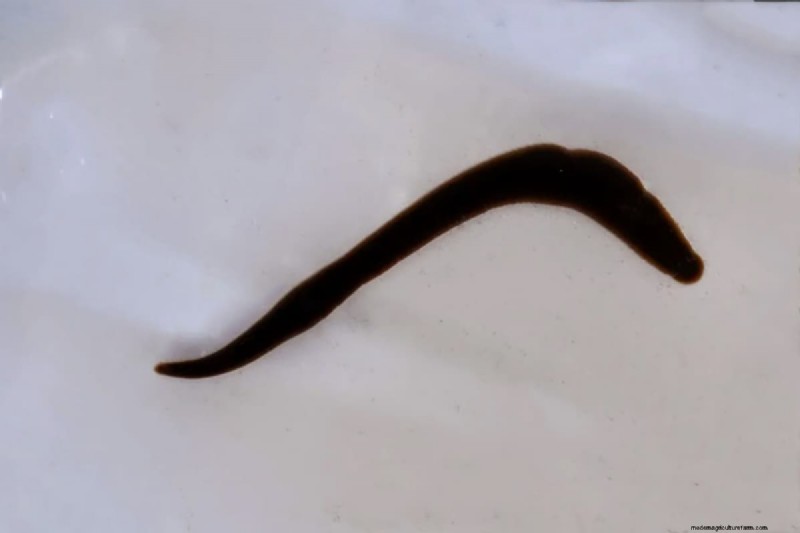
The topic of leeches in shrimp tanks is quite controversial because opinions vary on whether they pose a threat to shrimp. In my opinion, there is a simple explanation for that – the main issue is that aquarists often can’t identify the leech species in their tanks.
One of the most common leeches in the world, the Asian leech (Barbronia weberi), would be an extremely unwelcome guest in a shrimp tank as it is a predatory leech.
In this article, I will delve into what the Asian leech is, its life cycle, how it can get into our tanks, how it reproduces, and much other interesting information based on scientific research and the experiences of aquarists.
Domain: Eukaryota (Organisms with Cells)
Kingdom: Animalia (Animals)
Phylum: Annelida (Segmented Worms)
Class: Clitellata (Clitellates)
Subclass: Hirudinea (Leeches)
Order: Arhynchobdellida (Jawless Leeches)
Family: Salifidae (Freshwater Predacious Leeches)
Genus: Barbronia
Species: B. weberi
This genus currently contains eight species: B. arcana, B. assiuti, B. borealis, B. gwalagwalensis, B. nepalensis, B. rouxi, B. shillongensis, and B. weberi.
Note: Nowadays, the genus Barbronia draws significant scientific interest due to its rapid global expansion facilitated by human introductions. The capability of a single leech to produce hundreds of offspring annually, even without mating, is a key factor here.
Initially, Barbronia weberi had a native range from Afghanistan and Pakistan to Java, Sumatra, Borneo, India, and Southern China.
In recent years Asian leech has become established on every continent, except Antarctica. It was introduced to South and North America, Australia, New Zealand, and Europe (Italy, England, Hungary, Austria, and Germany).
The aquarium trade is the most probable source of introduction of this species.
These leeches generally prefer stagnant (ponds, lakes, swamps, etc.) or slow-moving bodies of water and are often associated with aquatic vegetation using plants for the attachment of cocoons.
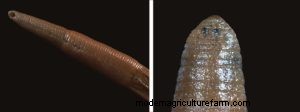 photo source
Shape. The body is elongated, segmented, worm-like, tapering towards the front. This species has tiny bumps covering its body, giving it a rough texture.
For a detailed description of Barbronia weberi, you can refer to this scientific paper and here.
The life cycle of Asian leeches typically involves several stages:
According to the study, the average life span of Barbronia weberi is about 122 days. The maximum lifespan recorded was 216 days, but this can be considered an exception rather than the norm.
Barbronia weberi is hermaphrodite species, each individual possessing both male and female reproductive organs and assuming both roles simultaneously during mating.
However, according to the study, it was also found that Asian leeches can reproduce without cross-fertilization as well. Therefore, it only takes one leech in the aquarium for an infestation to occur later on.
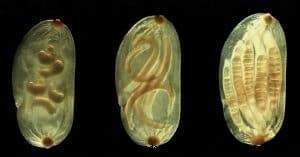 photo source
Some facts about Asian leeches reproduction:
 Asian leeches typically inhabit substrates where they have access to decomposing organic matter or small organisms, such as worms, which they feed on.
While they can swim using undulating movements through water, it’s not their primary mode of transportation.
They are nocturnal animals. However, their activity patterns can also be influenced by factors such as food availability, environmental conditions, and the presence of predators.
Although leeches may congregate in areas with high food availability or during mating, they are still not considered social animals. They lead solitary lives.
As I mentioned earlier, all leeches of the Family: Salifidae and Genus: Barbronia belong to the category of freshwater predacious leeches.
According to the study, in its natural environment, Barbronia weberi feeds on a range of invertebrate taxa including: oligochaetes (worms), snails, crustaceans, and even insects.
In aquariums their main food will be all kinds of worms, including:
Although adult eeches can go for long periods without food, once they gain access to food, their appetite becomes insatiable. Instances of cannibalism among them are also not uncommon.
A while back, I came across reports from aquarists stating that after the appearance of these leeches, the number of planaria sharply decreased in the tanks.
This suggests that planaria could theoretically also be part of the Asian leeches’ diet. However, this is currently just speculation and requires more evidence.
Related article:
No, by no means it is safe to have Asian leeches in shrimp tanks. Period. These leeches are fast enough to catch not only weak but also healthy shrimp. Molting shrimp will be an easy meal for them.
Of course, you can always find information on the Internet where aquarists claim they have never had issues with leeches in their shrimp tanks, and so on.
However, I believe they may be mistaken. They are primarily mistaken about the types of leeches because not all leech species pose a threat to shrimp.
Nevertheless, since identifying leech species requires specialized equipment, I lean toward the position that it’s better to err on the side of caution.
Therefore, if you spot leeches in your aquarium, it’s best to assume the worst and try to remove them immediately.
Freshwater snails are not the primary food source for this species of leech. However, if they are hungry, there have been cases of them attacking snails as well.
Therefore, I would also exercise caution, especially if you keep decorative snail species which do not have trap doors that would allow them to close their shell when threatened.
No, Asian leeches cannot harm your fish. On the contrary, many fish species will eat them. The leech’s movements trigger their hunting instinct.
Actually, it is very easy to accidentally introduce Asian leeches into your tank.
These leeches are often associated with aquatic vegetation (such as the waterweeds Hydrilla verticillata, Elodea sp., etc.). Thus, their eggs will often hitchhike on aquatic plants. In most cases, they are just too small to see and a few weeks later, you start to see them in the tank.
Sometimes they can come even with new live food, particularly with worms.
Related article:
Right from the beginning, I need to say that unless it is a bare-bottom tank, it is almost impossible to get rid of them.
Yes, you have heard me right.
I have checked lots and lots of forums, I have asked people about this problem and I have also tried some of these methods myself, such as using salt, dog dewormer, No-planaria products, etc.
Unfortunately, none of the methods I tried seemed to work for me.
I have heard that a very high concentration of these products might be effective, but in my situation, it wasn’t a feasible option because it could also harm the shrimp. Using elevated concentrations of copper is also not an option.
Later, I read in one study that Barbronia weberi doesn’t like too warm water (exceeding 86°F or 30°C) I haven’t had the opportunity to test this theory yet.
There is no need to explain, that Copper is very dangerous in fish and shrimp keeping. All crustaceans, like dwarf shrimp, crabs, crayfish are especially sensitive to it.
The downside of this method is that:
Related article:
There are many types of fish that will eat leeches.
Cichlids (like Julidochromis, Oscar, Red Devils), Loaches (like Clown loaches, Zebra Botia, Macracantha Botia loaches), Bettas, Mollies, Tetras, Pea puffers, etc. will often go straight after them.
The downside of this method is that:
Use the tweezers to grasp the leech by its body.
The best way to keep Asian leeches (basically, any pests and/or parasites) out of your tanks is to head off the problem before it takes hold.
Therefore, always quarantine everything!
Treat everything as if it is heavily infected. I seriously mean it.
Plants, rocks, driftwood, decorations, etc. – anything coming from another source that may have been in contact with any biological material.
If you practice an extended quarantine you will notice that there are leeches and can deal with them.
Related articles:
The Asian leech (Barbronia weberi) is typically a freshwater predator of invertebrates.
In aquariums, they typically arrive on plants, and even one individual is enough for them to infest within months.
Unfortunately, it is really hard to get rid of them because this invasive species of leeches is highly resilient, and practically anything that can kill them will also harm your shrimp.
That’s why the primary method of combating them is through preventive measures. Avoid adding untreated or unquarantined plants to your aquarium.


