
Welcome to Modern Agriculture!

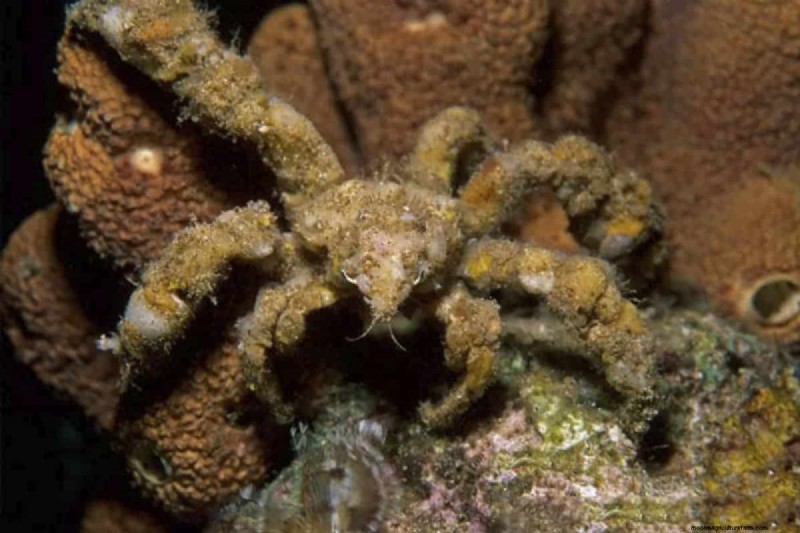
Camposcia retusa, commonly known as the Decorator crab, is a colorful and highly sought-after crab in the marine aquarium hobby owing to its dazzling appearance, and ease of care.
Nonetheless, despite considerable interest, scientific knowledge about these crabs remains limited. Very little is known about this species’ natural life traits. Much of what is currently known about the Decorator crabs is based on aquarium observations.
Based on existing studies and the experience of enthusiasts, this complete care guide for Decorator crabs covers all aspects of their life and how they should be cared for within your tank.
I couldn’t find a specific etymological source for the term “Camposcia” beyond its common usage in relation to this species. It’s plausible that the genus name originates from the Latin word “campus,” which means “field” or “plain.” This could indicate a connection to the habitats where these crabs are typically found.
The species name “Retusa” comes from the Latin word “Retusus” meaning “Blunted or rounded off” possibly describing a characteristic of the crab’s body shape or features.
This species is widely distributed across the Indo-West-Pacific region, inhabiting both tropical and subtropical waters.
The Decorator crabs were found near:
The Decorator crabs prefer to inhabit muddy and rocky weedy areas of the lower intertidal zone, hiding in and under coral reefs, big boulders, and rocks.
Decorator crabs are relatively small crabs in the genus Camposcia. Adults typically grow to about 0.6 – 0.8 inches (1.5 – 2 cm) in carapace width and around 3 – 4 inches (8 – 10 cm) across the leg span. Lots of articles mention that they can grow up to 1.2 inches (3 cm) in carapace width, but this is more of an exception.
Keep in mind that the exterior appearance of the Decorator crabs will also vary substantially in shape and color depending on what they use for decoration.
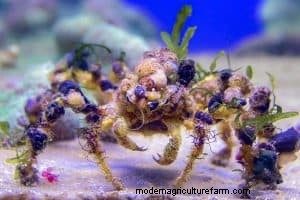 photo credit to Nikolay Safonov
Distinguishing characteristics of Decorator crabs:
For a more detailed and scientific description of Camposcia retusa, you can read this study.
Related articles:
According to the study, decorating in this species appears to function primarily as an antipredator response, with crabs decorating at higher rates when access to shelter is limited.
However, it is still unknown how it chooses its decorations. For example, experiments showed that the way Camposcia retusa decorates itself doesn’t help it blend in with its surroundings.
It was noticed that Decorator crabs mostly decorate themselves with sponges, algae, and detritus. They mostly put decorations on their shell and back legs, which might be because of their body shape.
They decorate by using their claws to grab materials around them. They then move these materials to their mouthparts, where they roughen the edges. Finally, they attach the decorations to their bodies. Decorations stick to the crab’s body with small, velcro-like hairs (setae). The ones they use for decorating have hooks to keep the decorations in place.
Surprisingly, even as they grow bigger, they keep decorating themselves just as much.
Interesting fact: Of the 900 species from within this superfamily, at least 75% are estimated to decorate to some degree.
Currently, there is no data available on the maximum lifespan for Camposcia retusa in the wild.
However, in captivity, these crabs can live up to 3 – 5 years, if appropriately cared for.
As evident from the description, these crabs exhibit decorating behavior, which has made them popular in the aquarium hobby.
Note: However, this behavior is not constant. In other words, they don’t continuously change their appearance. Once decorated, they will add new decorations at a slower pace than initially.
Decorator crabs are nocturnal and will spend most of their days hidden from the light in order to avoid being seen. It is at night when they roam around the tank looking for food or a new hiding spot.
These crabs are very slow-moving; don’t expect any sudden movements from them. They prefer crawling over climbing and typically avoid climbing whenever possible. This might be because they have to carry extra weight on their bodies, making them less agile and slower.
Features:
These crabs are classified as opportunistic omnivores. In their natural environment, they eat carrion, small sea stars, mollusks, worms, algae, and ascidians, all slow-moving or stationary organisms.
In aquariums, the Decorator crabs will eat anything extra in the tank. This may include meaty foods leftovers, detritus, and (or) the algae that grow naturally in the tank.
Note: Uneaten food was removed the following morning.
Adults can be fed 3 – 4 times a week whereas juveniles should be fed daily.
However, the most important rule is that you should not let them starve. Otherwise, despite their relatively peaceful temper, they can become unpredictable or aggressive.
Features:
Although, these crabs are generally considered safe to keep in reef tanks, personally, I would not do that!
First of all, there is a possibility that they may occasionally nibble on soft corals, especially, if they are hungry or lacking food options. Considering the fact that they are not particularly mobile, they might simply miss the food you give them.
Another problem is that their decorating behavior may involve them picking up small items from the tank, which could accidentally disturb or damage delicate coral structures.
So, if you still decide to keep them, make sure to watch them closely and give them different foods. At least, this helps reduce any possible harm to corals.
Decorator crabs are low-maintenance and easy to care for. They do not require large tanks and are pretty forgiving when it comes to water conditions.
Even more, sometimes you do not even need to buy them, they are great hitchhikers.
Because of their relatively small size, even nano marine tanks (10 gallons or 40 liters) will be good enough for a crab.
Important: If you are a beginner, you should understand that there are several potential problems with small tanks:
Temperature: Decorator crabs prefer warm water in a range of 78 – 86°F (26 – 30°C). However, they can easily tolerate temperatures down to 72°F (22°C).
pH: Maintain optimal pH values of 8.1–8.5 for the crabs to thrive in your saltwater aquarium.
Hardness: Keep water hardness values between 8–12 dKH.
SG: They can tolerate specific gravity in the range between 1.021 and 1.030. However, the ideal range is 1.0264 – 1.0279 (35 – 37 ppm).
Calcium and Magnesium: Keeping calcium concentration in the range of 400 to 450 ppm and magnesium between 1250 and 1350 are optimal.
Since these crabs are nocturnal animals, they do not really need much light.
In their natural habitats, they tend to live in areas that are protected from sunlight such as coral reefs, rockpools, seagrass leaves, etc.
If you keep corals and fish in the tank, the lighting should be adapted to their needs.
There are no special requirements.
As long as you have got a filter that works great with the size of the tank you have got, you will be fine.
There are no special requirements either.
The aim of incorporating decors in an aquarium is to replicate the natural habitat and provide enough hiding places for them.
Additionally, they naturally use materials to camouflage themselves. Therefore, providing decorations and hiding spots mimics their natural habitat, reducing stress and promoting their well-being in the tank.
Despite its popularity in the aquarium trade, there have been no documented instances of successful larval cultivation of these crabs.
Currently, the pet industry depends on wild-caught species.
Factors such as water quality, temperature, and the availability of suitable food sources are crucial.
In scientific literature, there are two studies on this issue. In one of them, a detailed procedure for a reliable larval culture protocol of Camposcia retusa is described.
On average, the development time from C1 to C10 (fully grown animal) is about 7 months.
Unfortunately, sexing Camposcia retusa is extremely difficult, and it will likely be very challenging for ordinary aquarists. Scientific literature indicates that sexual dimorphism starts to appear at the C5 (molt) stage:
Decorator crabs are not very prolific. They generally have several dozen eggs.
The eggs are incubated in the chamber limited by the sternum and abdomen, and the hatchlings remain under the female abdomen for a certain period before dispersing.
Incubation generally lasts around 1 month. The eggs hatch into miniature versions of the adult.
It was found that egg incubation generally takes between 21–25 days under the following conditions:
Note: At salinity 26–32, all larvae died within 3 days. Zoeal survival was significantly higher at salinity 35 and 38. Culture salinity should be kept between 35–37 for zoeal larvae, then reduced to 30–33 at the megalopa stage.
Larvae normally hatch overnight, and occasionally in the early morning. In the morning of the day of hatching, aeration was first stopped, then the room light was turned off, and a torch was directed to an upper corner of the tank to attract the positively phototactic larvae. The larvae gathered were then gently scooped with a small beaker with as little water as possible.
Food is arguably the most important factor that affects the success of the larval culture of marine crabs. Prey size should be suitable for easy consumption by larval mouthparts.
Experiments showed that newly hatched Artemia nauplii at a density of 10 individuals per milliliter seem sufficient for Camposcia retusa larvae. Larvae fed with rotifers resulted in no survival.
Lowering stocking density during the megalopa stage may reduce cannibalism rates among megalopae.
The Decorator crab is commonly found in hobby aquariums due to its ability to live in captivity. As with other Majoid crabs, these crabs decorate their carapaces and legs with items found on the coral reef floor, including sponges, corals, rubble, etc., throughout their life.
These crabs are very easy to care for and require minimal attention.
However, if you’re looking for a crab that will actively crawl both day and night, these crabs may not be suitable for you. It’s also worth noting that keeping them in a reef aquarium can be problematic for corals, so proceed with caution.


