Welcome to Modern Agriculture!

Atlantic salmon raised in the Faroe Islands and tilapia farmed in China have been shown to generate a net surplus of the essential omega‑3 fatty acids EPA and DHA, according to a recent study published in Reviews in Fisheries Science & Aquaculture.
The research, led by Dr. Wesley Malcorps of Blue Food Performance and the University of Stirling’s Institute of Aquaculture in partnership with the Stockholm Resilience Centre, employed an updated FIFO Performance Tool to assess the efficiency of contemporary and historic aquaculture diets. The tool calculates Fish In: Fish Out (FIFO) metrics, revealing how much wild fish is needed to produce farmed fish and tracking the retention of key omega‑3s.
Key findings indicate that net production of EPA and DHA (neFIFO <1.0) is largely driven by the use of marine ingredients sourced from by‑products that would otherwise be unsuitable for direct human consumption. This approach transforms certain aquaculture operations into net contributors of these valuable nutrients.
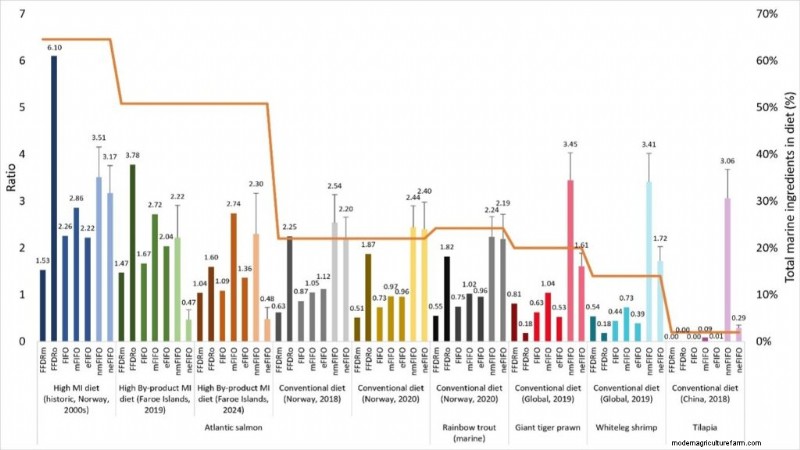
Fish dependency (dark shade), fish efficiency (medium shade), and nutrient (EPA+DHA) efficiency (light shade) metrics, for key aquaculture species, as calculated using the FIFO Performance Tool. Values vary within species depending on diet composition, production system, and other environmental or management conditions. (Image source: Blue Food Performance)
The study builds on existing literature that examines marine ingredient use in aquaculture, comparing different methodologies for measuring ‘fish as feed’ dependency and efficiency. It underscores the importance of aligning FIFO with Life Cycle Assessment (LCA) frameworks used for carbon footprinting and broader environmental impact analysis.
The FIFO Performance Tool, developed by Blue Food Performance, has already gained traction in the industry, with more than 100 users—including leading feed manufacturers, ingredient producers, NGOs, and academic researchers. The latest update enables users to compare species diets, benchmark alternative ingredient scenarios, and evaluate FIFO performance across a range of aquaculture operations.
Dr. Wesley Malcorps, the study’s lead author, stated: “A unified ‘fish‑as‑feed’ sustainability framework moves us from fragmented, unverified claims to credible impact—through consistent measurement, clear comparability, and shared transparency.”

Dr. Richard Newton, LCA Specialist at Blue Food Performance, added: “nFIFO represents the culmination of years of evolution in metrics that gauge the efficiency of marine ingredients in aquaculture. We must become far more efficient with our resources to deliver not just food, but quality nutrition.”