
Welcome to Modern Agriculture!

Recirculating Aquaculture System (RAS) of fish farming is such that water being used in the pond is recycled. For instance rather than flushing out dirty water, the water is passed through a system that will sieve out the dirt from the water and then the same water is returned back into the pond for use by the fish.
Recirculating aquaculture system, or RAS, provide a constant and controlled environment for the fish, allowing for optimal and fully manageable production of African catfish, Tilapia and other fish species.
Now am sure you may also wish to know if this system has any advantage over earthen pond and flow through system of fish pond, well the advantage it has is that it helps in conserving water and so is best suitable for areas with limited supply of water as water is recycled for re-use.
Also, pond management does not easily constitute a nuisance to the neighborhood as the water to be flushed out is re-used but the major disadvantage is that it needs regular supply of electric power to operate and so in a country like ours, operating it could be expensive.
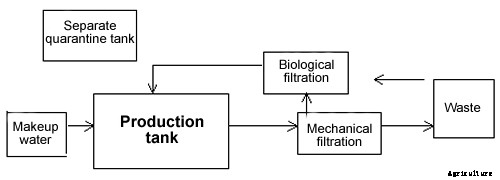
The water in the system is recirculated through tanks and a series of water treatments to remove waste products. Unless the water is treated, fish will stress, resulting in retarded growth, increased pre-disposition to disease and finally death.
You should have a good general knowledge of the principles of water chemistry and a good knowledge of the biology of the species being cultivated.
Production tanks vary in size and shape. Smooth, round tanks with sloping bottoms are useful as solids can be concentrated and subsequently removed from a centre drain. This design facilitates thorough cleaning and ensures aeration is evenly distributed.
In simple recirculation systems, water may be treated by two processes: mechanical filtration (to remove solids such as faecal matter, uneaten feeds, etc.) and biological filtration to remove dissolved toxic wastes.
Depending on your location and the species you are planning on farming, you should consider including other components such as disinfection devices, foam fractionators (or protein skimmers), dedicated aeration units and temperature control.
You should also make sure you have access to water quality testing equipment, a purpose-built facility to accommodate bulk feeds and hygiene measures to limit the spread of disease.
The need for high quality human food grows as the world’s population grows. Most of the world’s wild fish populations are now at or beyond maximum sustained yield, meaning that additional harvest only reduces the fish available for next year’s catch. In addition, there is concern that wild caught fish may sometimes be contaminated with mercury or other pollutants.
Aquaculture is seen as a way to produce more fish from a controlled environment. However, traditional extensive aquaculture (ponds, raceways) requires an abundant water supply.
The same human pressures that increase the demand for fish also decrease the water available to grow them in. All of these factors encourage the use of recirculation aquaculture, where a large amount of high quality fish can be grown in a small amount of water.
The engineering and biology behind recirculation aquaculture is well established and you will learn the details of these in this course. The economics (essentially competing in price with wild caught fish) is currently the limiting factor preventing broader commercial development of aquaculture. At this time, most successful recirculation enterprises focus on niche markets of high value fish. Recirculation technology is not feeding the world…yet
The design of your recirculating aquaculture system will depend on the specific requirements of the species you want to culture.
When designing a recirculating system, it is important you understand the impact of different factors on a species. These factors include water quality requirements, stocking density and size of stock, feed types and disease.
The costs of establishing and operating a viable recirculating aquaculture facility are usually much higher than most people anticipate.
Here are some Amazing Recirculating Aquaculture System (RAS) in Fish Farming books to guide you further:
Reference


