
Welcome to Modern Agriculture!

by Dr Robert Tillner, Product Manager, Aller Aqua Group
Farming fish in increasingly sophisticated Recirculating Aquaculture Systems (RAS) has gained popularity across the globe. Whether RAS are built from scratch or existing fish farms have converted to RAS technology – fish produced in RAS represent a steadily growing volume of the total aquaculture production volume.
One of the reasons is that the control measures in RAS technology allow for fish production under constant environmental conditions. This accurate optimisation between water parameters and fish biomass requires external factors to seamlessly integrate into this equilibrium. In this respect, feed is the most influential external factor in RAS and needs to provide the following benefits from a farmers' point of view:
Consequently, feeds for RAS need to target the specific requirements of this highly sophisticated and complex production technology by taking the following features to a new level:
Nutrient digestibility and palatability
In RAS, feeds with high nutrient density can unleash their full potential if the nutrients are readily available for fish metabolism and growth. The gross energy level is therefore not a useful indicator as nutrients get lost via faecal excretion.
In contrast, the digestible nutrient content of raw materials indicates the nutrients retained in the fish body after non-digestible energy has been lost in the faeces. Thus, assessing nutrient digestibility of each raw material is the groundwork for any feed of stable quality. Nevertheless, for accurate determination of nutrient digestibility the following obstacles need to be considered:
Taking these obstacles into account, the determination of nutrient digestibility of raw materials for different life stages under varying environmental conditions and subsequent feed formulation results in high and constant performance.
Faeces quality
Nutrient digestibility and palatability play an essential role but are not enough to develop an optimal feed for RAS. The physical quality of fish faeces largely influences the water quality in RAS and is mainly dependent on the feed the fish has eaten. Consequently, low stability and weight of faeces dramatically reduces the efficient removal by mechanical cleaning units, such as drum filters in RAS.
As small faeces particles become smaller and more and more suspended, they are not removed by the drum filter but accumulate in the water and are carried into the biofilter. Here, the faeces particles become substrate for undesired bacterial growth. Eventually, the efficiency of the biofilter drops and potentially toxic nitrite levels in the water rise. Consequently, the RAS becomes biologically unstable which in turn negatively affects fish growth by unfavourable environmental conditions.
Balancing nutrient digestibility of raw materials and faeces quality to ensure shaped and compact faeces particles will allow effective removal and the lowest possible impact of suspended matter on fish environment and filtration technology.
Fish metabolism and DP:DE ratio
Knowledge about nutrient digestibility of raw materials and their effects on faeces quality are necessary and powerful tools to formulate stable quality feeds. These tools are applied to determine the exact amount of nutrients required by fish of different life stages for optimal growth and the optimal ratio of digestible protein to digestible energy (DP:DE).
The optimal ratio between digestible protein and digestible energy allows for minimal waste of feed protein, mainly in the form of ammonia and urea, and at the same time allows the optimal usage of precious feed protein for fish growth. Consequently, lowest possible excretion of nitrogen into the water positively affects water quality and the dimensioning and loading of the biofilter. The equation is simple: better water quality equals better fish growth and health.
Structure for stability
The ideal feed formulation must allow the production of a feed with physical characteristics matching the high standards of RAS:
The demands towards nutritional and physical feed quality are unquestionably high. Realising these demands in feed production is a result of dedicated trials, but also decades of experience on how to reach the desired target with big scale machinery. Upgrades in factory equipment parallel the development of RAS and allow for production of physical feed quality matching the most sophisticated demands.
Feed functionality
The previous passages described the nutritional and physical characteristics that are defined and implemented in a feed for RAS. Both are important in the development of a feed for RAS, but the highest demands go beyond nutrition and physical quality.
Feed functionality targets ways of supporting RAS by direct effects of the feed that are neither of nutritional nor of physical nature:
Introducing Aller Aqua's POWERRAS concept
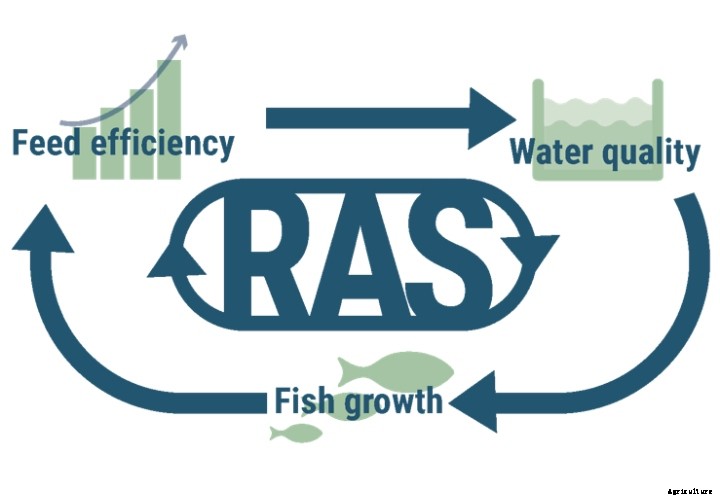
The abovementioned features have been optimised through continuous research and trials, and now match the sophisticated demands for feed for RAS. Ultimately, the features create benefits for the farmer in terms of feed efficiency, water quality and fish growth.
These findings jointly represent the latest addition of RAS-optimised feed technology by Aller Aqua's new POWERRAS concept, which is the culmination of efforts and sophistication in feed development over the last couple of years. Aller Aqua Research has closely followed the increasing sophistication of RAS in order to be able to match the latest requirements by RAS farmers.
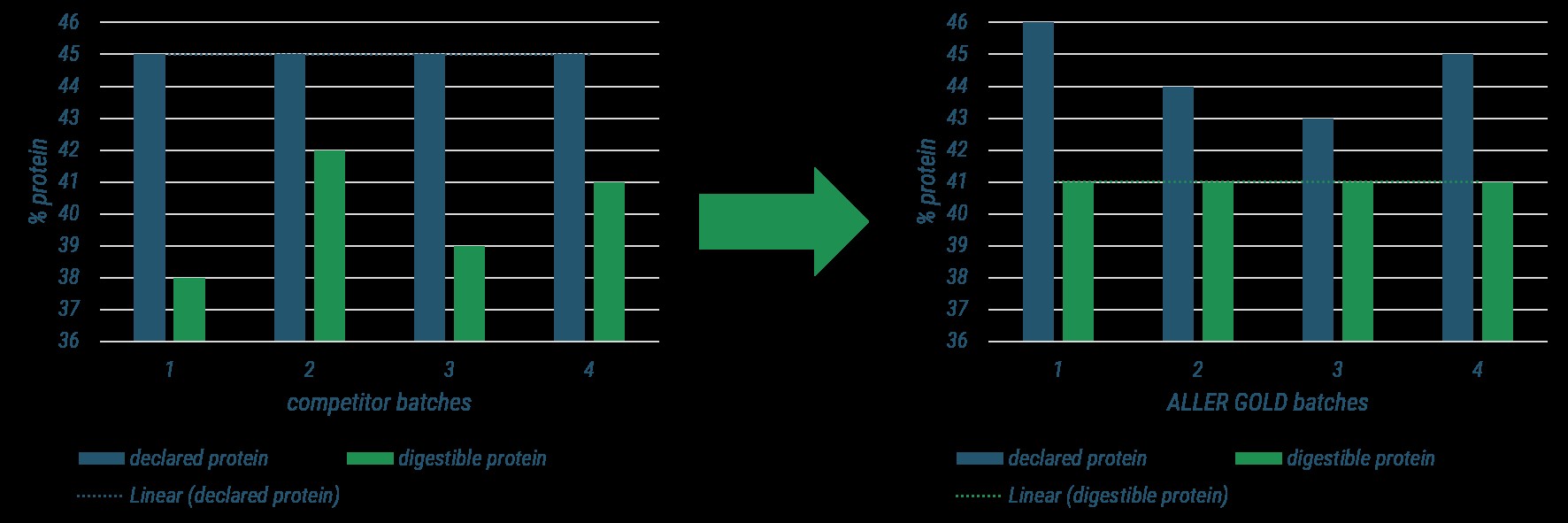
Left: Difference in declared versus digestible protein content between batches in conventional feed formulation. The feed is formulated based on a fixed protein level which results in variable digestible protein contents between batches and variable performance on the farm.
Right: Feed formulation based on a fixed digestible protein content between batches which results in variable declared protein content, but constant performance on the farm.
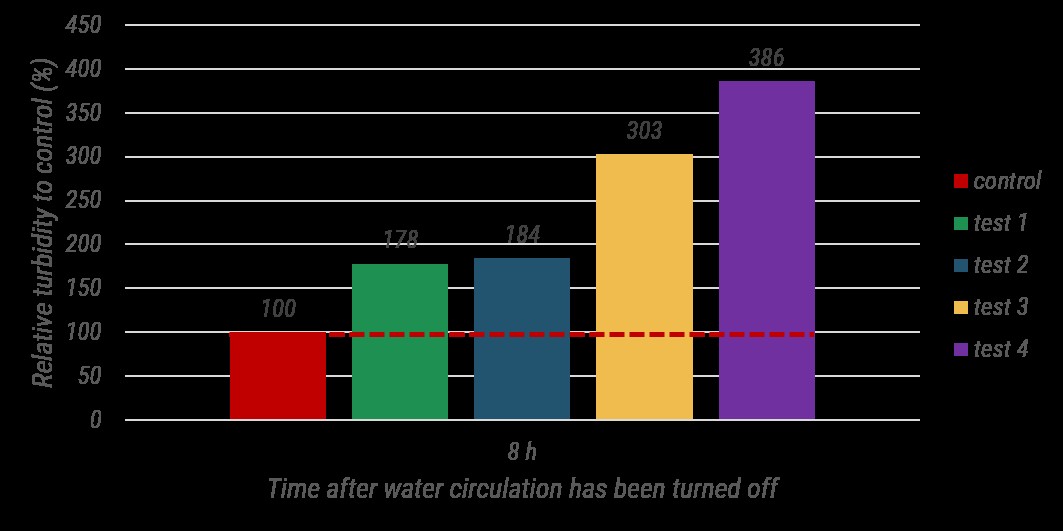
Relative water turbidity in four decoupled tanks with four different feed test batches eight hours after the water circulation has been turned off to fine-tune feeds towards lower water turbidity (values are in % compared to respective control at time 0, control=100%).


