
Welcome to Modern Agriculture!

The British Alpine Goat originates in Great Britain. It was created by crossing local goats with Alpine goats imported from Switzerland. Used in crossings with Saanen and Toggenburg in England and France, it has given rise to the British Alpine and French Alpine breeds. In Spain the first herd appears at the end of the ’70s, coming from the neighboring country.
Throughout the decade of the 80, it is distributed practically in purity by the north of the Autonomous Community of Castile where it crosses with autochthonous races. In the 90 extends from the northwest of Leon by the north of Zamora until Salamanca, in turn, a few herds are established in Catalonia.
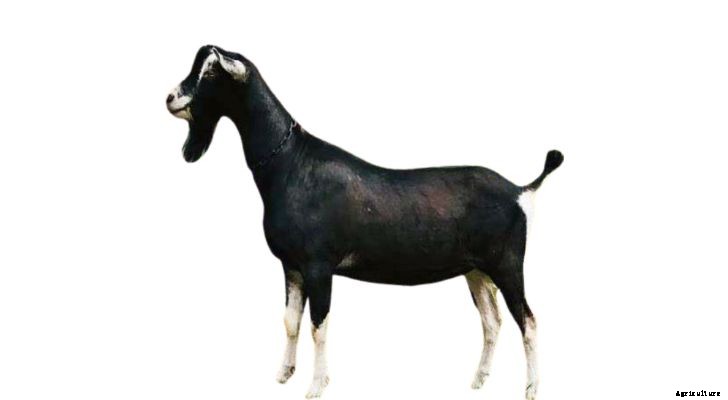
The British Alpine Goat dairy breeds are originally from the Alps. Polychromatic animals, short, thin, smooth and shiny. Body elongated and fleshless. Thin triangular head on the muzzle. Horns of medium length and in the form of a lyre. The front and profile are slightly concave. Horn’s ears long and thin neck. Fine, long, strong and straight.
Voluminous udders, globose at birth, well placed with a broad base and soft, thin and elastic skin. Nipples are long and well placed. Nervous temperament. The Alpine is a goat of height and average size. The live weight of the females ranges between 60 and 80 kilos and males between 80 and 100 kilos.
It is rustic and it is adapted to breeding in permanent stables like the grazing, or to the life in the mountain. It is exploited mostly in intensive and its main product is the milk that is mostly intended for cheese making. Other abilities of this breed are the production of skins and the production of meat of suckling goats.
Alpine goat is a large dairy, enjoys a high adaptation to mechanical milking. Its well-shaped udder, with nipples of variable length, releases the milk with great ease in one go. The kid’s goat weighs at birth 4-5 kg female and male respectively. It takes a month to reach 9.5 kg which is ideal for marketing. The majority of the farms carry out the rearing of the kids through artificial feeding.
The puberty of the males is evident at 120 days and in females at 150 days. The mean age at first calving is 450days and in Spanish herds of 410 days. The interval between births is 365 days. The goats of this breed stand out for their pronounced seasonality with a duration of the 210day sex season.
The British Alpine Goat eats flowers, herbs, shrubs, foliage.
The British Alpine Goat use it because of its multi-purpose breed, they raise it by the production of meat, the production of their milk since it obtains good cheeses and butter, and by the production of wool, they have excellent black and shiny Coat.
Currently, the census of 25,400 specimens, belonging to 68 farms, is distributed in the Autonomous Communities of Asturias, Cantabria, Castile and Leon, Galicia and the Basque Country.
This guide has been a deep dive into the history and development of one breed of goat, but there are many more breeds out there. The British Alpine is just one example that can provide you with insights to help your business flourish in today’s competitive market. If you want to learn about other breeds or how they’re bred, contact us! We would love to talk to you about all things goats’ milk-related so we can find ways for your company’s needs. Maybe the next blog post will be on another type of dairy animal? Stay tuned!


