
Welcome to Modern Agriculture!

Sheep housing is very important for raising sheep farming. To raise animals has its science. In the case of sheep, they can be the enterprise, wool will protect it from weather agents. However, For sheep housing is necessary to have some constructions that allow the protection of the sheep in rainy seasons or in the season of Winter.
So the sheep will not die or affect their health. Following some standards for building establishment according to the number of sheep that you intend to raise, is one of the very important factors, and do not exceed that limit.
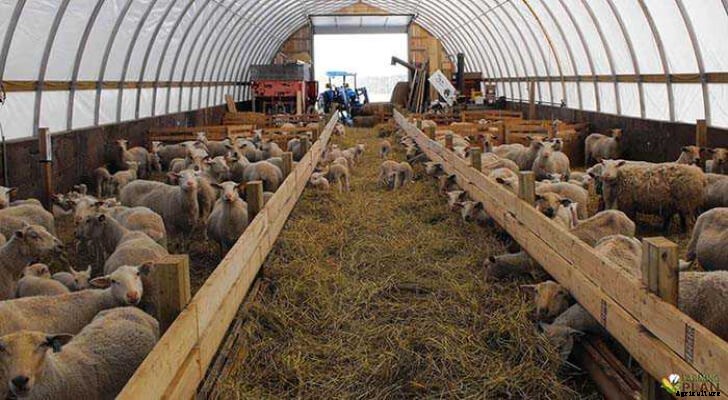
Housing corrals are mainly used for females shortly before calving, until weaning of young, and for fattening lambs. Next to the corral is a ship that is frequently open on one side. The ship serves to protect the animals against inclement weather. Individual parts are installed in a part of the ship. When it is very cold, these can be provided with heating.
Another part of the ship is used to store food. Here you can install the feeders for concentrates and eventually for hay. Fresh silage or forage is normally supplied in outdoor feeders. The pens should be constructed in such a way that they reach for groups of 50 to 100 sheep with their offspring. It should take into account an area of about 4 square meters per female. You May Also Like To Read Gute Sheep
This type of corral can also be used for fattening lambs. The Parade, the communal corral, and the feeders are dismantled. A corral of this size reaches 200 fattening lambs.
The most common feeders are those placed next to the fence of the corrals. These feeders can be constructed entirely of wood or cement with wooden posts.
1) Wooden feeder next to the fence: The sheep requires 30 to 40 cm. Of feeder length per animal. The lambs need 15 to 20 cm. Of feeder per animal. Sometimes a trough is constructed as a division of two pens. This type of feeder must be filled mechanically. Because of its high cost, its use is limited. Both types of the feeder can be used to feed forages, concentrates and complete rations of forage mixtures with concentrates.
2) In the field, a trough on two levels is often used. It consists of a forage holder rake-type hay and underneath it a crib for concentrates and/or minerals. In climates with a lot of rain or a lot of sun, it is best to place the trough indoors. The feeders have a height of 110cm. The distances between the rake bars are 10 cm.
The design and size of the pens for sheep will depend on the number of animals that compose the sheep and the productive purpose of the sheep. The total area can be calculated on the basis of the space that each animal must-have in the enclosure, which can vary between 1.4 and 1.6 m2 depending on the breed. On the basis of this individual surface, the size of the paddocks is calculated.
In order to force the sheep to adopt orphaned offspring, special cages are used. In this type of cage, the sheep and the brood remain together for a day or two until the sheep accept it. You May Also Like To Read Suffolk Sheep
Sheep need little shelter because they have the protection of wool. They generally take advantage of the natural protection of trees, shrubs, and hills. If the sheep are in an open field without natural wind protection, it is recommended that objects be placed for this purpose. Large round bales or hay feeders can provide the necessary protection. Another alternative is to install windbreaks such as sheets of pressed wood or metal anchored in the ground.
For their wool does not need to be in stables, you can be in open spaces, however, according to the climatic conditions where the activity takes place they have to foresee the construction of a barn or a stable so that the sheep are protected in rainy weather, Or winters season, and thus prevent diseases in sheep.
Large round bales or hay feeders can provide the necessary protection. Another alternative is to install windbreaks such as sheets of pressed wood or metal anchored in the ground. For their wool does not need to be in stables, you can be in open spaces.
However, according to the climatic conditions where the activity takes place they have to foresee the construction of a barn or a stable so that the sheep are protected in rainy weather, Or winter’s season, and thus prevent diseases in sheep.
A shed protects sheep from predators, from inclement weather such as rain, snow, and wind causing illness and death. The shed because of the shelter it provides, makes more efficient the use of the energy consumed by the animals by reducing the mortality of lambs and the nutritional requirements of the sheep. On the other hand, this infrastructure will allow working on rainy days with animals on foot treatments, vaccinations, and other management activities.
When building a shed you should have some basic considerations like
• Surface: The construction of a shed should consider a minimum area of 1 m² per adult ewe, and 1.3 m² per ewe with breeding, ie for every 10 ewes with offspring will be required 13 m² of the shed built.
• Orientation: The orientation of the shed is in direct relation to the predominance of the winds. For the construction of the shed is ideal to take advantage of a place where the soil has some slope as this will allow better drainage of liquids and therefore better management of guano.
• Ventilation: The purpose of ventilation is to provide fresh air throughout the shed, to maintain optimum temperature and humidity, and to maintain low levels of ammonia. It is important to avoid drafts, which are also detrimental to sheep health, and they are responsible for pneumonia in lambs.
It is a good idea to provide an enclosure free of drafts for deliveries. A typical female requires a yard of about 4.5 x 4.5 x 3 feet to give birth. You may decide to install a heating lamp to dry the lambs but use it sparingly.
Excessive use of heating lamps can create respiratory problems in lambs. Heating lamps present a risk of fire. Therefore, be sure to follow the installation instructions and keep them away from hay, straw, and excessive dust. Enclosures for food and rest.
On some farms, sheep may be housed in breeding or loafing lots. Since many females are pregnant in the winter when the animals are usually in a covered enclosure, it is important to provide them with adequate space to reduce injuries and stress.
Type of sheepInside ft2Rest area ft 2Female10-1225-40Female With lambs in a group12-1625-40Lambs Fattening Weaned6-815-20*ft2 = square feetThe space of the feeders is decisive for the growth and proper nutrition of their animals. In a group feeding or self-feeding situation, females require 8 to 20 inches of space per animal, depending on the type of food.
Feeding with hay requires 8 to 10 inches per animal while feeding with silage requires 12 to 20 inches. Lambs fed in the same way require 3 to 4 inches per animal. The lambs that receive supplementary feed (creep feed) require 1 to 1.5 inches of space per animal in the feeder.
If you are considering raising sheep, it is important to understand the science behind their housing. Properly constructed and maintained sheep hutches can provide protection for your flock from weather agents like rain or snow in any season of the year. For more information on our various styles of huts, contact us today! We would love to help you build a home that will fit your needs and budget. Have questions about this article? Feel free to reach out at any time by emailing me.
As A Reference: Roysfarm

