
Welcome to Modern Agriculture!

Duck Farming contributes to improving food security in many developing countries by generating income for poor farmers, particularly women. This activity efficiently uses local resources, requires few inputs and makes important economic, social and cultural contributions to the improvement of the living conditions of peasant households. Poultry has many advantages, particularly when they are reared in diversified production systems.
They are small animals, reproduce easily, do not require large investments and they themselves can at least partially procure their food. They are able to feed on kitchen waste, discard grains, worms, snails, insects and vegetation. In Asia, the ducks find their food in the rice paddies.
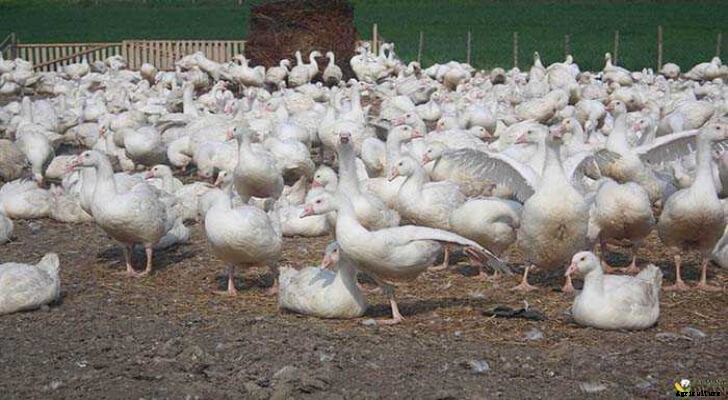
Duck Farming is considered an activity with prospects. The advantages are obvious when the ability to live in unfavorable environmental conditions, to resist diseases and parasites, and to produce excellent meat is recognized in these birds.
The intensive breeding of certain types of ducks has increased in various regions of the world. For centuries Europeans and Asians have known that duck is one of the most useful and versatile pets.
It is for this reason that the Takao Method is born of the use of available resources and observation of what takes place in nature. It is named after the Japanese expert, a pioneer of the cultivation of high-quality organic rice, obtained with the help of an Army of ducks. Ducks are raised in symbiosis with rice, eating insects and harmful herbs for production and fertilizing the soil organically, allowing a richer and healthier crop.
Instead of using harmful and increasingly expensive chemicals, the Japanese expert method introduces the duck into the field as an organic fertilizer and competitor for insects, predators and rice parasites. This productive diversification allows farmers to increase incomes, supplement the diet with protein from the meat of ducks, have an additional product to sell in case of emergencies or inclement weather affecting annual production. And all this reduces the workload in the fields, which provides more free time for the farmer and his family, reducing environmental damage and increasing food security at the local and regional levels.
Japanese farmer Takao Furuno, a doctor at Kyushu University in Fukuoka Prefecture, has successfully experimented with an integrated and sustainable system of organic rice cultivation by introducing ducks into rice fields to fertilize and strengthen rice plants and protect them from Pests and weeds, demonstrating that it is possible for small farms to get a better crop of rice in terms of nutrients and yield.
The method consists in releasing the ducks in the rice field one or two weeks after sowing. It takes 15 to 20 ducks per 1,000 square meters of farmland. It is also appropriate to create a shelter to protect rain ducks and a fence to protect them from animals, built with materials available locally. Furuno’s research to deepen the knowledge and divulge the method has shown that the most suitable species of ducks are Aigamo, a cross between Kamo (wild duck) and ahiru (domestic duck).
Aigamo ducks do not migrate, are easily found in all Asian countries and are strong eaters of the golden snakes that live in the waters of rice paddies feeding on the outbreaks. Eating these snakes, in addition, the Aigamo ducks are characterized by having very tasty meat. Duck droppings represent an important source of natural fertilizer.
In addition, with their movements in the water, the ducks trigger a process that increases the oxygen content of the soil, making it more nutritious for plants. After years of testing and studies on the natural symbiotic relationship created in an integrated system, Furuno discovered that by introducing in the field some fish (local) and a herb capable of fixing nitrogen (Azolla), growth can still be promoted More significant rice and ducks.
Researcher Hiroyuki Mori of the University of Occupational and Environmental Health (Japan), in addition, conducting his studies on the methane released into the air by crops, discovered that ducks can control the methane released by rice fields, which generates The greenhouse effect, the cause of global warming.
The wisdom of traditional agriculture has always sought economic incomes and food security in the Diversification of production rather than monoculture. In this case, the introduction of ducks makes production more profitable since farmers do not need to buy expensive chemical fertilizers or pesticides.
It is also estimated that ducks allow increase the productivity of small plots by 50%. Organic rice can be sold at a higher price, which is a great advantage for small producers who can hardly reduce production costs. Finally, the higher nutritional quality achieved in households with quality rice and duck meat contributes to the alleviation of malnutrition.
When the rice harvest time comes in autumn, the ducks will be ready to be sold or to fly to reproduce in the paddy fields, giving life to a new cycle of nature. And it is no less important that this method also contributes to the beauty of the fields and the landscape.
Also thanks to the support of the NGO Duck and Rice Association, created by Takao Furuno, today the method is widely applied in rice-producing countries such as Bangladesh, Cambodia, China, India, Indonesia, Laos, Malaysia, Philippines, South Korea, Taiwan, Vietnam, and also in Cuba. In Japan, more than 75,000 small rice farmers have already adopted this method.
Ducks are animals that live in pairs or groups and who lament when their companions die. They are animals adapted to the water, land, and air that fly hundreds of kilometers each year in their migrations. When flying they do so in formations that reduce air resistance and are more efficient and can fly at a speed of 95 kilometers per hour.
They are sociable animals that enjoy being with others. They spend their days looking for food in the grass or on the surface of the water and sleep together during the night. Ducks are very meticulous animals with cleanliness and like to keep their nests clean, they also enjoy grooming their feathers and spreading their beautiful plumage to possible couples.
Foods in the form of crumbs or granules, with 10% protein, special for ducks are the most recommended. This food should be available to the animal during the 24 hours in the first four weeks of life. Therefore, after the fourth week, it is advisable to change the balance for another cheaper food, which usually contains less protein.
A reasonable fattening diet may consist of a “kitchen leftover soup” made with bran, ground oats, barley flour and a little cornmeal. A mixture of old bread soaked with boiled fish remains an excellent diet, but growth will be slower.
Therefore, it is not a meat of massive taste. There is usually a dislike for the amount and type of fat it presents. Globally, domestic ducks are very important as a source of food. Especially in Asia, where the production and marketing of their eggs are the most important.
Breeds breed to market their meat duck Peking, duck duck, Rouen duck, etc.
Among the breeds are the following: the Indian Runner duck, Khaki Campbell duck, Buff Orpington duck, among others.
The breeding facilities for meat ducks that are going to go to work, must have the same conditions as for the players. The bell has to deliver from 2500 to 3000 Kcal. for 250 to 300 ducklings.
To breed ducks, physical characteristics should be considered where these animals are to be reared.
The storage of duck eggs is really different from storing hen’s eggs. Once the eggs are gathered, they should be washed and dried, then stored in a dry and cool place. If the eggs are put in the refrigerator, they can be kept for up to six weeks. They can also be frozen if you are going to use them at a later date. They can last in the freezer for up to six months.
If storing the duck eggs in the refrigerator, be sure to keep them away from other foods. Especially onions and things that contain ingredients that have a strong odor. The shell of an egg is porous. So it tends to collect odors easily, which can cause the taste of the egg to be altered. This is also true if you are storing other types of eggs in the freezer. Be sure to keep them separate.
There are several ways to determine the sex of ducklings, including:
If you’re looking for more information on how to raise your own domestic ducks, we recommend reading up on the following topics. What is a Muscovy duck? How can I tell if my duck has mites or lice? Do domestic ducks make good pets and show animals? These are some of the questions that might be answered in this article! We hope it’s been helpful. Good luck with your new duck family member!
As A Reference: Wikipedia


