
Welcome to Modern Agriculture!

The Indian runner duck is also known by the name of Indian runner or penguin ducks. It is a bird native to Southeast Asia (India and Malaysia) and later selected in the United States and mainly in the United Kingdom by Mr. J. Donald, in order to further improve its conditions for laying eggs.
They were brought to the United Kingdom in 1850 by a captain of the English Merchant Marine. Indian runner duck is the most laying egg. Depending on the purity of the breed. In some cases, the Indian runner duck exceeds 300 laying eggs per year.
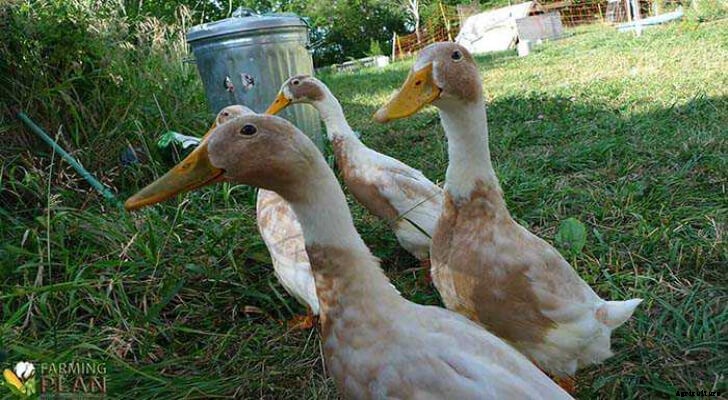
The Indian Runner duck is a very fine duck that walks erect on two legs looking like a human being. Pure-breed Indian runners must have a thin, elongated body and be well erect on their two legs. It is easy to distinguish if they are of the pure race, or have previous crosses their progenitors, with the simple fact of seeing as they walk of Erected.
The Indian Runner duck is the breed for its beauty in the form of walking, but preferably as a laying bird.
This breed does not make a nest and lays eggs on the ground in the first place he finds. Except in certain cases do not incubate their eggs, having to do so with dwarf hens, other birds, or incubators. Eggs can be White, grayish, blue, or light green and weigh about 71gm. They like water and bathe like all ducks.
Ideally when raising them, is that there are three or four females per male. If there were more males they would fight to cover the legs and with more females there is the danger that it cannot mate with all, being part of the eggs without fertilizing.
The best way to verify the purity of the race is to observe that they walk well erect of their paws because there are enough crosses with mallard and common duck.
Pure-breed Indian runners must have a thin, elongated body and be well erect on their two legs. It is bred for its beauty in the form of walking, but preferably as a laying bird. Rustic and fearful bird measures 25 to 50 cm and can weigh up to 2 kg. It starts from the age of 6 months and continues in a sustained way for even 5 years. The incubation lasts about 28 days.
Runner duck is a rustic bird that likes to eat grass, (not so much as to the geese or the duck dumb) worms, snails, slugs and any other animal that is put within its reach. Eat well the residues of homemade food and let’s not say anything about the leftover bread that you love.
RING DIAMETER: 14 mm
White ducks are considered as the ones that put more eggs. The best known pure colors are White, wild (Colvert), chocolate, blue (from Cumberland), black and brown and white (panaché) mixture. They can also be mixtures of all previous colors.
Dusky Mallards or Dark Wild Ducks, are characterized by being a Dark Phase of the mallard’s wild color.
The Mallard or Wild Indian Runners are characterized by having the wild color of the mallard.
The Trout or Salmon Indian Runners are characterized by being a Clear Phase of the wild color of the mallard.
The Silver or Silver Indian Runners are characterized by being a Clear Phase of the wild color of the mallard. They are even clearer than the Trout or Salmon.
The Indian runner duck is a rather larger-sized duck and constitutes a visual reference for savages far greater distance than all other claims. They have a reputation for being a little noisy and have good voices, that of the male similar to the mallard duck and the female sharper than the savages.
The Indian Runner Duck is excellent in controlling the pests of bugs that can be in the orchards, eating snails, slugs, grasshoppers, etc. These birds are beautiful visually, and although many people look for the taste of their flesh, the ecologists defend and admire them for their grace and their characteristics.
It’s easy to see why Indian Runners are so special. These ducks stand upright like penguins and, rather than waddling, they run. The females usually lay about 300-350 eggs a year or more depending on if they come from exhibition or utility strains. Plus, the males have long tails that give them their unique appearance! If you want to learn more about this breed of duck, we encourage you to visit our blog for additional information on these fascinating animals. Hope this guide has helped you! Good luck with your search for an Indian Runner!
As A Reference: Wikipedia


