Welcome to Modern Agriculture!

L. Holloway is an experienced keeper of chickens and other fowl who has spent nearly a decade educating others on their habits and care.
Most of us get chickens with every intention of letting them free range. After all, isn't that sort of the point? To not only move away from our dependence on confined animal feeding operations on factory farms, but to produce a higher-quality product for our family that we would otherwise not be able to purchase?
Unfortunately, for any variety of reasons, it may simply not be possible to let your flock free range. Neighbors are too close, predators are too numerous, or maybe you just can't convince your chickens to leave your flowerbeds or vegetable garden alone. Whatever the reason, it can be hard to see their little faces gathering at the gate, waiting to be let out in the morning, knowing that you have to say "no."
But if keeping your chickens confined has you feeling like the warden of a tiny chicken prison, take heart—confinement doesn't have to be incarceration. With a little creativity and some effort, you can turn their coop and run into a chicken playground that they will never want to leave.
It's natural to assume that chickens would want to be free, because that is what we would want. Freedom is very important to us as human beings, but the truth is, chickens are not people. Chickens are wonderfully intelligent, complex, and emotional creatures, but their wants, needs, and instinctive drives are going to be different from ours because they have evolved with different needs.
The main reason chickens tend to be so eager to free range is not because they long for the abstract concept of freedom, but because it is usually easier to fulfill their needs outside of their coop and run. By providing enrichment opportunities that fulfill these drives in confinement, you can have happy chickens that are also protected from predators and accidental death.
To understand what really makes your chickens tick and be able to meet their enrichment needs in confinement, you have to place yourself in the mindset of a chicken. Remember that they are small, feathered prey animals that adapted to survive in the dangerous jungles of Southeast Asia. They are hardwired to search for food, socialize, and evade predators.
Virtually all of the enrichment opportunities you can provide to your chickens will relate to one of these three drives, and once you understand their basic psychology, you will be able to utilize the tools available to you to keep them fulfilled.
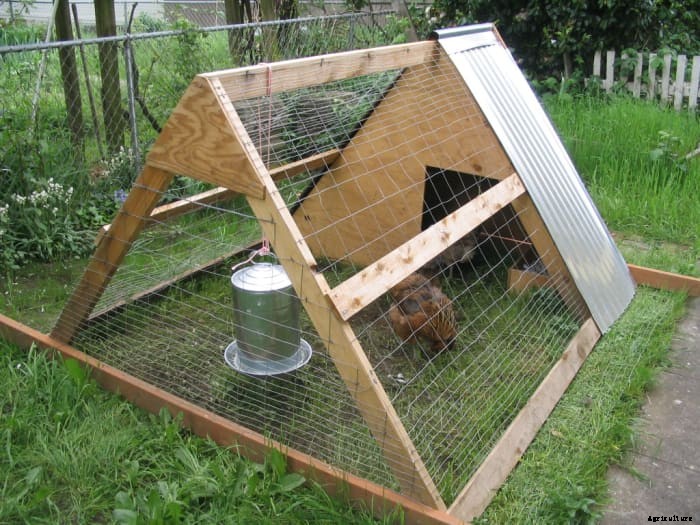
When faced with the prospect of having to keep our chickens confined, the first course of action we tend to pursue is to build a chicken tractor, which is a mobile coop that can be periodically moved to a fresh patch of ground. While chicken tractors are very useful from a dietary perspective, they don't do much to alleviate the boredom of being confined, and you will likely find that your chickens still want to escape their enclosure whenever given the opportunity.
If you choose to utilize chicken tractors, understand that they will benefit your chickens as far as allowing them to forage for greens and insects, but on their own will not be enough to satisfy their enrichment needs.
If you haven't built your chicken coop yet, now is the perfect time to start thinking about how to design it to keep your chickens occupied. You may not be planning on keeping your chickens confined, but it is always ideal to be prepared, and it certainly won't hurt anything to have a really appealing coop for them to come home to, even if they do free range.
Not only will ample vertical space make it easier for you to access, clean, and modify your coop, it will give you more options for placing enrichment opportunities. Multiple levels to explore, networks of roosts, and even chicken swings are all good ideas for utilizing vertical space. If you haven't built your coop yet, plan for it to be tall enough for you to walk into easily. This will make life vastly easier on you, and happier for your chickens.
The most successful confinement coops I have build for my birds have utilized a maze-like configuration where the chickens have to plan how they are going to journey from one area to another. In most coops, the space is one big open box, and there is no challenge to walk from the door to the roost, or from the roost to the nesting box. By creating a variety of paths and obstacles for the chickens, you make their world more interesting and varied. Just make sure that every nook and cranny of your chicken "maze" is easily accessible for cleaning, retrieving birds, or repairs and modifications.
Some ways you can create a "maze" for your chickens is to create obstacles that force them to climb, go around, or go under barriers in order to get to specific parts of the coop, like to get outside, or to get to their feed. It doesn't have to be too complex—just something that prevents them from mindlessly walking from point A to point B.
Much to the same tune of the chicken maze, you should break up the visual space of your coop and run. Imagine what it would be like to live in a big empty house with no rooms and very little furniture, and you can start to imagine what it is like for chickens in most chicken coops. On the other hand, put in some walls, furniture, and architectural elements, and your home will be vastly more comfortable.
You can accomplish this by building your coop in a non-standard shape, such as with a wrap-around run or in an L-shape. If you already have a standard "box-shaped" coop and run, you can break up the space within it by building walls and using "chicken furniture" such as logs and other items. Your goal is to prevent your chickens from having an unbroken line of sight from one end of the space to the other.
The most successful confinement coop I have implemented actually has no access at all to the outdoors, but is open to the fresh air on three sides and has a long bank of windows on one wall. This allows ample sunshine to enter the coop, and it prevents chickens from feeling claustrophobic. It has worked so well that more than once I have had to remove otherwise wild or feral chickens from it, because they darted in while I was cleaning or feeding the birds there and then refused to leave.
If you must keep your chickens confined completely in a coop (as is sometimes necessary), make sure it has windows. The sunlight and fresh air that enters through windows will vastly improve their quality of life and make it easier for human caregivers as well.