
Welcome to Modern Agriculture!

Brown Swiss, cattle breed native to Switzerland and probably one of the oldest breed cattle in existence. While these cattle are classified as a dairy breed in the United States, they are often considered a double-purpose breed elsewhere, as they are heavier boned and thicker fleshed than the cattle of the other dairy breeds. Brown Swiss cattle are also called Braunvieh cattle. Brown Swiss cattle are becoming an increasingly popular dairy breed cattle across the world. They are claiming to be the second highest milk producers, and come from the Alpine pastures of Switzerland. The color of the Brown Swiss varies from light brown or gray to dark shades of these colors. Brown Swiss breed cows are good, persistent milkers, producing milk of average butterfat content as compared with other breeds of dairy cattle.
This breed has been founded in Italy, Austria, the United States, Mexico, and the South American countries. Brown Swiss cattle were first introduced into the United States in 1869.

Most dairy historians agree that Brown Swiss cattle or Braunvieh cattle are the oldest of all dairy breeds. The beautiful brown Swiss cows were developed in the north-eastern part of Switzerland. Bones create in the ruins of Swiss lake dwellers date back to probably 4000 BC, and have some resemblance to the skeleton of today’s Brown Swiss cow.
The first Brown Swiss cattle in Canada were imported to the Eastern townships of Quebec from the United States in 1888. Although considered a dual-purpose breed means dairy and beef in Europe, pioneer North American breeders recognized their great potential for milk production and concentrated their efforts for improvement in the direction of developing a dairy cow. Brown Swiss cattle are now found throughout Canada.
Read: Red Sindhi Cow Cost, Profile.
Close protein/fat ratio – Brown Swiss milk possesses the closest protein/fat ratio of any dairy breed cattle.
Feet and legs – Properly structured legs allies to strong, black, well formed feet, that mean Brown Swiss cattle have few problems. No doubt this is one of the key qualities that enable many Brown Swiss cattle to continue producing in the herd until they are 12-15 years of age.
Quiet Temperament – Dairymen, members of the association, all of whom have worked with a variety of breed cattle are completely unanimous in their praise of the docile temperament and inquisitive nature of these quiet cattle breeds.
Longevity – The characteristic longevity of the breed is very evident in the Brown Swiss cattle. While the breed, cattle tend to be later maturing than other breeds, cows tend to reach their peak in 5th or later lactations. Some breeds find it difficult to reach this stage, while the strength of the Brown Swiss cattle allows them to lead long productive lives.
Strength & Hybrid Vigor – Brown Swiss cows are cattle breed of great substance and strength. The experience of having Brown Swiss cows ‘go down’ with metabolic problems or any other reason is rare amongst Brown Swiss owners.
Brown Swiss cattle are renowned for their role when crossed with other dairy breeds or for that fact with beef breeds as well, in generally improving the production and strength of the parent breed. This is obvious throughout the world from the tropics to the alpine regions.
Brown Swiss or Braunvieh bulls are noted for their scrotal and testicular development at a young age and are capable, fertile breeders at 12 to 14 months of age.
Read: Organic Dairy Farming.
The average Brown Swiss or Braunvieh cow will produce over 22,000 pounds of milk, or about 2,600 gallons of milk, during one lactation
After the Holstein Friesian, Brown Swiss has the second-highest annual milk yield, over 9,000 kg (20,000 lb) per annum. These milks contain on average 4% butterfat and 3.5% protein, making their milk excellent for the production of cheese.
Brown Swiss has an average protein content of 3.5% with 4% butterfat. Since the fat content is about 4.6% on average, this gives Brown Swiss cow milk the closest fat/protein ratio compared to other breeds.
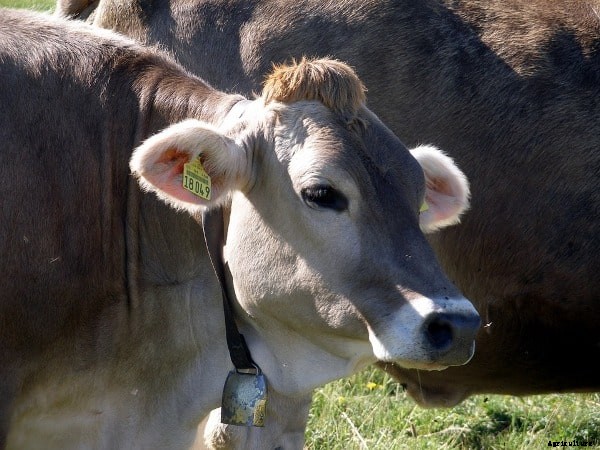
The Brown Swiss or Braunvieh cattle are brown in color with a creamy white muzzle and dark nose, dark-blue eye pigmentation which helps the breed to resist extreme solar radiation. Brown Swiss cattle have been bred horned and polled, when horned the horns are short and white growing dark color towards the top. The Brown Swiss breed is robust, a prolific breeder, long-lived, adaptable, and very well-balanced in a build with good hooves and limbs.
This breed has a dual purpose utility as they are used for dairy and beef purposes providing milk and meat output.
The Brown Swiss cattle are highly adaptable to diverse geographical regions of milk production such as mountainous areas, extreme climates and forage conditions or tropical environments and as well adapted to intensive systems. The good composition of the milk protein, especially for cheese making is considered in the breeding as well.
– Brown Swiss is the number one breed for protein in Germany.
– Brown Swiss or Braunvieh has by far the highest share of organic farms.
– In no other cattle breed are so many heifers and cows going to the alpine pastures for grazing.
As the Brown Swiss or Braunvieh is popular within the dairy and beef industry, it can be found in over 60 countries from the Tropics to the Arctic Circle including Europe, the United States of America-USA, South America, Canada, Australia, South Africa and New Zealand.
Read: HF Cow Facts.


