
Welcome to Modern Agriculture!

Chris Lesley helps us understand what to do with an egg-bound chicken.
When raising a backyard flock, nothing is more exciting than collecting a carton’s worth of eggs each day. Every chicken owner puts in a lot of work for their flock, from feeding the birds to cleaning the coop, and a fresh omelet is a nice reward for all that labor! But what happens when a hen isn’t laying her share of eggs every day? Well, there’s a chance that she may be egg bound, which is a serious health concern. But, what is egg binding exactly, and how can this problem be solved? Read on to find out!
When a hen is egg bound, she has an egg stuck inside of her and doesn’t pass from the shell gland to the vent. In a normal hen the laying process takes 25 hours, 24 of which are spent in the uterus while the shell is developed. Once the shell is formed the egg needs to exit through the vent. But, here’s the catch: the egg needs to turn around inside the hen’s reproductive tract before it can exit. The egg spends most of its time in the reproductive tract travelling, “pointy end first,” but the blunt end of the egg needs to exit the vent first. The egg must turn completely around; if the egg can’t turn around then it can’t exit, so it gets stuck in the reproductive tract and won’t budge.
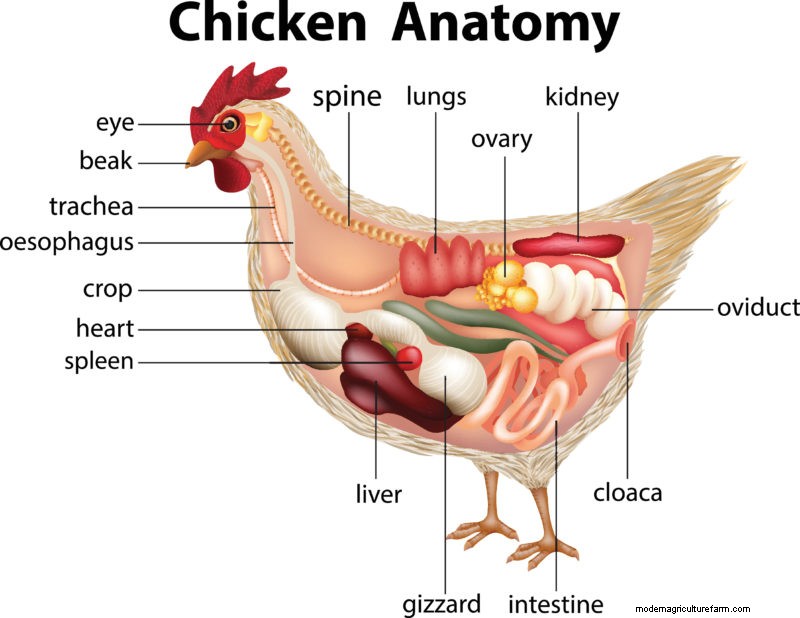
Chicken anatomy. The ovaduct is where hens can get egg-bound. Adobestock/blurringmedia
Studies have found that egg binding is relatively rare. However, when it does occur, it is typically at the very beginning or the very end of the laying season.
There can be any number of reasons why a hen has become egg bound. Some of the most common causes are:
There may be other causes of egg binding as well, such as stress, premature laying, or simply refusing to lay the egg because a nest box is unavailable. It’s most likely that multiple factors will be at play when a hen becomes egg bound.
Just as there’s a number of different causes of egg binding, there are also a variety of symptoms that can be present. Here are a few of the most common:
Many symptoms of egg binding resemble other ailments. Since egg binding is relatively uncommon, there’s a good chance that the chicken with these symptoms has a different ailment. However, if she is egg bound, her life may be in danger! Due to this life threatening nature of egg binding, always be sure to complete a thorough examination before ruling it out as the cause of your hen’s discomfort. Normal to large birds may experience these symptoms for several days and will be alright. However, smaller birds will have a rapid onset, and unfortunately a rapid death too.
The first step in treating an egg bound hen is to make sure that’s actually what’s wrong. You can do this by carefully palpating the abdomen; if you feel an egg, then she’s definitely egg bound. Be careful not to crack the egg, as this could cause a fatal E. coli infection. Also, note that an egg with a soft shell won’t be very easy to feel, but the abdomen will still be very swollen and soft.
The next step is bath time! Place the hen in a tub of water with ½ cup of Epsom salts per ½ gallon of water. Let her soak for 20 minutes, then place her in a dark area away from the flock to lay. This step can be repeated several times.
If necessary, you can lubricate the vent with K-Y or petroleum jelly, or even give calcium or oxytocin injections to induce contractions of the abdomen.
Another option is egg piecemeal, in which the egg contents are taken out by poking a hole in the shell and taking them out with a syringe. Then, the shell is removed separately. This should be done by a veterinarian, as it is extremely risky. Sometimes, a hen may have multiple eggs built up behind one stubborn egg. This will require a vet as well, and can be very costly.
Egg binding is not a fun process for any hen or her owner. While it can be treated, it is best to prevent it altogether. To prevent egg binding and keep your layers healthy, give them the correct feed, control the spread of infections or parasites, and keep the stress levels low!
Chris Lesley has been raising chickens for over 20 years and is a fourth generation chicken keeper.


