
Welcome to Modern Agriculture!

Dealing with an egg bound chicken can be traumatic for all involved if you do not know what to do about it.
The good news is that egg bound chickens are not at all that common.
However some hens will suffer from this during their lifetime, so we have put together all the information you need to deal with this emergency.
We have also included some tips on how to prevent egg binding as there are certainly things you can do for your ladies to minimize the likelihood of egg binding.
You have probably heard the expression egg bound chicken, but what does it actually mean?
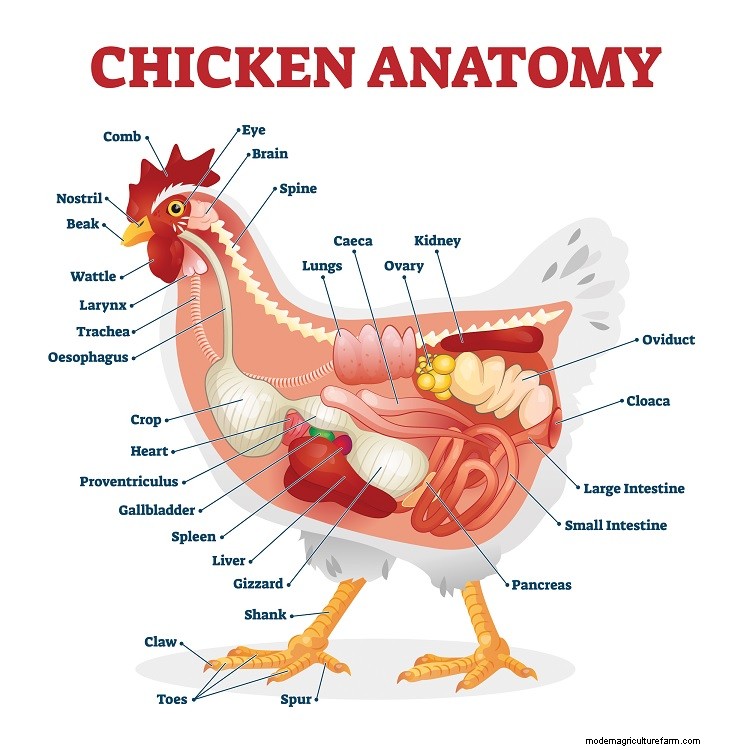
If a chicken is egg bound it means she has an egg stuck inside of her and she is having difficulty in passing it. The egg is literally stuck in the last portion of her reproductive tract, and the chicken is unable to pass the egg as easily as she would normally.
Usually the egg travels pointy end first all the way to the shell gland or uterus.
Once the shell has been laid over the egg, the egg starts to turn so that the blunt end passes first (this is sometimes where the trouble starts). The egg can get stuck and cannot complete the maneuver – this can happen to any color of egg.
There are a few different reasons why a chicken becomes egg bound:
Lack of calcium: Our hens use lots of calcium to build strong bones, to put a shell onto the egg and to help the muscles contract and push that egg out. If they are lacking in calcium the muscles do not have enough energy to contract and push the egg out as they would do normally.
Obesity: Chickens that are obese can have a hard time expelling an egg because their muscles are weaker and cannot contract as strongly as they should.
Infection: Occasionally a chicken will have an infection in their reproductive tract. There may be no symptoms that you notice, but it can cause all sorts of problems including muscle weakness.
Malformed eggs: Eggs that are very large or misshaped can be a problem for the chicken too.
Stress: Stressors such as a new coop or flock members can cause a hiccup in their egg system.
Premature laying: This can happen when young pullets are artificially forced to lay eggs when they are still too young.
Worms: A bird with a high internal parasite load is susceptible to becoming egg bound.
Genetics: There is not much you can do about this except to not use the hens as breeders.
Retaining an egg: Occasionally a hen will deliberately hold on to her egg until a nest box becomes available. This damages her muscles and can cause her to become egg bound.
As chickens are a prey species, they have learned how to hide the fact that they may be ill or feeling unwell. In the wild the weakest, oldest and sickest were the first to be killed or driven away from the flock.
Our backyard chickens are not much different.
They hide their symptoms very well (and unless you know your birds) so it is easy to miss some of the more subtle signs of illness or distress.
Many of the signs and symptoms listed below can be seen in a variety of ailments, so you need to practice your detective skills!
The good news is you can treat this condition effectively if it is discovered early enough.
There are a couple of things you can try at home to get the egg to pass.
The first thing you need to check is that there is actually an egg stuck – to determine this you will need to do an internal exam of your hen.
You will need to hold your hen under your arm with her facing backwards. Using a latex glove coated with vaseline, gently insert your index finger into her vent.
Insert the finger, aiming straight forward and very slightly upward. If there is an egg you should be able to feel it. If you have inserted your finger to a depth of 2 inches and cannot find an egg – there is not one.
If you felt an egg, what next?
Next is the fun part!
You are going to fill a tub with warm water adding ½ cup Epsom salts to ½ gallon of water and immerse your hen gently in the water so that her abdomen and vent area are soaking. Be very gentle with her – you do not want the egg to break.
Some hens struggle at first but they will gradually settle down. The warm water is soothing to them and will help the exhausted muscles to relax a bit.
Keep her sitting in the bath for about 20 minutes then remove her and dry her off carefully.
Next you need to separate her from the flock and give her a quiet, darkened area in which to sit and hopefully pass that egg. You can also lubricate the inside of the vent with vegetable oil or Vaseline to help the egg slip out.
Check on her hourly to see if she has passed the egg yet.
If she does not pass it within a couple of hours you will need to repeat the bath. If you have no success after 3 or 4 baths, it may be time to contact your veterinarian for further treatment. If you can feel or see the egg it is possible to remove the egg piecemeal. This is not generally recommended as it can lead to injury and infection.
To remove an egg you will need a 20 ml syringe, a large needle and a pair of tweezers. This is better done if you have help available to hold the hen still.
Gently poke a hole in the egg using the needle.
Once you have a small hole established remove the needle and place the tip of the syringe in the hole and withdraw the contents. Once the contents are gone you can enlarge the hole slightly and pull out the shell. It may collapse but make sure all pieces of the shell are removed.
Your hen will need to rest overnight after her ordeal. Try to keep her in a darkened environment for several days to try and discourage egg laying.
Prevention is not always possible (especially if it is a genetic issue), but there are several things you can do to help prevent egg binding.
Yes it can do if you have pullets that have not started to lay yet. To be on the safe side remove them from the light until they are 20 weeks old.
If more than one hen is egg bound it can point you towards something that is affecting your flock in general. Try to eliminate possible causes one by one until you find the reason.
There is no need to add it directly to their feed. Instead place the oyster shell in a separate feeder near the regular feed and the hens will help themselves.
Some chickens will be chronically egg bound and the only relief from it might be the removal of the reproductive tract or hormone suppression.
Other hens will have one incident and then go on to be a good layer and never be troubled by egg binding again.
If you keep your laying flock in tip-top condition you go a long way to preventing problems from arising.
There has been some anecdotal evidence that egg binding is slowly on the rise – whether or not this is because chickens are living longer is not known.
We hope you never have to deal with this problem. But if you do, you now have all the necessary information at your fingertips.
Let us know your questions in the comments section below…


