Poultry Shed Design and Construction Plan Information
POULTRY SHED DESIGN AND CONSTRUCTION
The following information is about Poultry Shed Design and Construction.
POULTRY SHED DESIGN AND CONSTRUCTION – INTRODUCTION OF POULTRY FARMING:
The process of poultry farming is completely for raising the domesticated birds such as turkeys, chickens, ducks, and geese of the commercial income from its products like meat and eggs. These are consumed as food all over the globe. Poultry farming started in the late 19th century. For human consumption, poultry farming is one of the most efficient producers of proteins. The main reason for the rapid expansion of the chicken is during World War II where there was a shortage of pork and beef. The production period of the boiler is seven weeks and the five months is the production period of laying hen.
The hens which are raised for eggs are Layers. The hens which are raised for meat are called Broilers. The chickens being raised around the world are more than 50 billion for the source of food. The breathing, pulse rate, and body temperature are high for chickens. The range of temperature where they can survive is between 150˚F to 109˚F which is higher than the other domestic animals. All over the world UK and USA are the countries that are top-rated consumers of meat and eggs of chickens. The average consumption of eggs and meat is 29 million every day.
POULTRY SHED DESIGN AND CONSTRUCTION – ADVANTAGES OF POULTRY FARMING:
The major advantage of intensive poultry farming is high yield.
Poultry farming gives us many other by-products like eggs and meat.
The eggs and chicken are the most profitable income for the rearers.
As chicken has a unique personality. The behavior of chickens can reduce the stress level of ours.
The products are more profitable than the hen birds.
Some birds which are more capable in hard conditions can survive as it is a good advantage for the breeders.
The birds are more immune to fight against diseases and parasites.
POULTRY SHED DESIGN AND CONSTRUCTION – POULTRY BREEDS:
Layers-The breeds that produce eggs:
The egg-producing chickens are called layers. All varieties in the layers are used for commercial purposes. They start laying eggs within 5-6 months of age. They are estimated to lay 275-300 eggs in a year. They even lay some strained eggs, i.e. 300 eggs in a year. The breeds that produce more eggs are Leghorn, Minorca, Ancona, Fayoumi, Isa brown, Babcock, Star cross, Lohmann, etc.
Leghorn:
These have originated in the rural area of Tuscany in Italy.
The purpose of the breed is to lay eggs.
They are very friendly in nature, very noisy, and very active.
They are large in size.
They are tolerant of all climates.
They give very high productivity. The eggs are large and white in color.
The weight of fully grown male birds is 3.4 kg and of hen is 2.5 kg.
The average count of eggs is 280 in a year. But they sometimes even reach 300-320 eggs in a year.
Minorca:
Their origin is from Spain.
These are also called Red-faced black chicken.
They are very friendly in nature, very active, but a little shy-natured.
The breed size is large.
They can also tolerate heat.
The egg productivity of this breed is also high. The egg color is white.
The weight of the male bird in this breed is 2.8 kg and the hen is 2.2 kg.
The average egg production is 250 per year.
Ancona:
This breed originates from the city called Ancona which is located in Italy.
It is also named black leghorns.
They are large in size.
The nature of this breed is very friendly, flighty, and very active.
These can tolerate all climatic conditions.
The egg production is high; the color of the egg is white.
The weight of the male bird in this breed is 2.5 kg and the hen’s weight is 2.1 kg.
They start laying eggs at the age of 5 months.
The average egg count is 220 eggs in a year.
Fayoumi:
It is originated in Egypt.
It is used for ornamental purposes.
The breed is friendly and flighty.
These are medium in size.
The eggs are small in size, the color of the eggs is off-white.
The weight of a male bird in this breed is 2 kg and a hen’s weight is 1.6 kg.
This breed starts laying eggs at the age of 4 -5 months.
Broilers – The meat-producing breeds:
The meat-producing chicken is called broilers. These are very soft and tasty. These are used for cooking purposes. The commercial rate for this breed is very high. The average weights of all the breeds are 2 – 2.5 kg within 7-8 weeks of their age. They will be ready for the marketing within 8 weeks. The breeds that produce meat are Plymouth Rock, Cornish, Sussex, Brahma, Aseel, Cochin, Starboi, Hy-line, Rose broiler, etc…
Plymouth Rock:
It originates from the United States.
The breed is also named rocks and barred rocks.
They are calm, easily handled, and friendly in nature.
The size is big and is heavily weighted.
The egg is large in size and light brown in color.
The weight of the male bird in this breed is 8 lbs and the hen weight is 7.5 lbs.
The hen lays 4 eggs per week.
Cornish:
The breed originates from the country of Cornwall in the United Kingdom.
These are also named Cornish India.
The purpose of this bird is for the meat.
The bird’s nature is friendly, calm, quiet.
The size of the bird is large.
The egg is brown in color; the eggs are medium in size.
The weight of a male bird in this breed is 3.86 kg and a hen is 2.57 kg.
The average count of eggs in a year is 160-180.
Aseel:
It is an ancient breed. And it is from India. This breed is originally kept for cockfighting, but nowadays it is kept for ornamental purposes.
These hens are very smart, it is strongly muscled.
These are brood but only a few eggs per year.
The feathering is close, hard, and sleek.
The size is 4-5 lbs.
POULTRY SHED DESIGN AND CONSTRUCTION – DESIGN AND CONSTRUCTION OF POULTRY SHED:
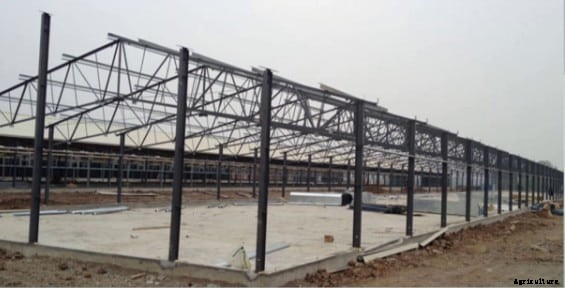
Poultry Shed Design and Construction.
Planning the poultry farm:
The plan of poultry farm should be started on a small scale. We get an idea of getting more improvements and consequences on the existing system after a few days of establishment. In the first stage of planning the environments where the farm is decided to be constructed should be good and population free and the management systems should be proper. The estimation of the cost of materials and labours should also be calculated. The attitude of the local population should also be observed as some people refuse farm construction and rearing. We should plan the waste disposable methods. The equipment required for the labours and spare parts also has to be procured.
Economics of the poultry farm:
The economics are most important for the establishment and operations of the venture. The most important capital investments are:
Capital cost implements on:
Land.
Material.
Equipment.
Labour.
Building or construction.
Installation.
Operating cost implementation:
Personal.
Maintenance and spares.
Electricity.
Fuel oil.
Water and sewage.
Short life operating equipment (2-3 years).
Insurance.
Packaging materials.
Sundries (stationary, detergent, etc.).
Location of poultry farm:
The farm should be located away from residential and industrial areas.
It must have good ventilation for air and light.
The road facility should be good for the farm.
The basic requirements are electricity and water, which should be provided sufficiently.
The labour for the farm should be available at cheaper rates.
The location should be in some elevated places where water-logging would not be a problem for the farm.
Design for the Poultry farm:
When you start the farm on small scale any special layout is not required as it involves the construction of the house.
The design should be in such a way that the visitors or outside people should not come near the birds.
The design of the farm should be in such a way that air passes frequently through the shed.
The distance between the growers and chick shed should be a minimum of 100- 150 feet.
There should be an egg storage room, the feed storage room, office room which should be located near the entrance to minimize the movement of the people around the sheds.
Poultry houses of different types:
Brooder house: The birds are brooded and reared to produce egg-type chickens from the age of 0-8 weeks.
Grower house: The egg-type birds are grown in this grower house.
Brooder cum Grower house: The birds are reared from 0-18 weeks of age. In this time span, the brooding and growing of the egg-type chicken takes place.
Layer house: In this house, the birds are reared up to 18 weeks of age. And also up to 72 weeks, the birds can be reared.
Broiler house: In this house, the broilers are reared up to 6 weeks of age.
Breeder house: The ratio is maintained appropriately with both the male and female breeders.
EC (Environmentally controlled) house: for optimum growth the entire environment is manipulated accordingly.
The temperature required for rearing birds in the poultry farm:
Poultry Shed Requirements.
The temperature of the environment for the birds is 22-30˚C. The relative humidity is 30-60 %.
Poultry Shed Design and Construction Plan – Direction of the Poultry farm:
The direction of the farm is oriented to the east-west as this provides good light and heat to the farm.
Poultry Shed Design and Construction Plan – Size of the Poultry farm:
Each broiler requires one square foot of floor space. The layers need two square feet of space on the floor. So the size of the farm depends on the number of birds reared.
Poultry Shed Design and Construction Plan – Length, height, and width of the Poultry farm:
As per the land occupancy, the length of the farm can be of any extent. Depending on the number of birds reared it should be a comfortable space for the birds.
The width should not be more than 22 – 25 ft in the tropical countries, so as to allow ventilation and aeration at the mid-portion of the farm.
The height of the sides from the roots of the foundation should be 6-7 feet and the center should be 10- 12 ft.
Poultry Shed Design and Construction Plan – Foundation of the Poultry farm:
To prevent the seepage of water good foundation is essential. The foundation of the farm should be 1 – 1.5 ft below and above the surface.
Poultry Shed Design and Construction Plan – Floor of the Poultry farm:
The farm floor should be made of concrete such that it is rat-proof. It should be free from dampness. The extension of the floor should be 1.5 feet outside the walls on all sides to protect the birds and farm from rats and snakes.
Poultry Shed Design and Construction Plan – Doors of the Poultry farm:
In the case of deep litter poultry houses, the doors must be open from outside. The preferable size of the door is 6 x 2.5 ft. The footbath should be constructed at the entrance to fill the disinfectant.
Poultry Shed Design and Construction Plan – Sidewalls of the Poultry farm:
The height of the side walls should be 1-1.5 feet; the side walls protect the birds during rainy days. The side walls also provide good ventilation through windows.
Poultry Shed Design and Construction Plan – Roof of the Poultry farm:
The roof can be constructed with asbestos, tiles, thatched, or concrete, which depends on the investment and cost of implementation of the facility.
Poultry Shed Design and Construction Plan – Overhang of the Poultry farm:
The roof with the overhanging should not be less than 3-5 feet in order to prevent the rainwater to enter the room.
Poultry Shed Design and Construction Plan – Lighting of the Poultry farm:
The light should be provided at a height of 7-8 feet above the ground level and should be hanged from the ceiling. The interval of two bulbs must be 10 feet if we are using incandescent bulbs. The interval between two bulbs is 15 feet if we are using fluorescent lights.
POULTRY SHED DESIGN AND CONSTRUCTION – TYPES OF POULTRY HOUSING SYSTEMS:
The types of systems and their advantages would be discussed below.
Free Range/Extensive
Semi-Intensive
Intensive
Slate Cum Litter
Slatter floor
Deep Litter
Cage
Free-range/ Extensive:
When adequate land is available then this system should be adopted.
This is one of the oldest systems in poultry.
Letting them loose on the ground and rearing them in poultry is called a free-range poultry system.
The free-range system will provide water, shelter, feed, greens, shade, etc…
The major source of feed for the birds is Forage.
The shelter is roofed with a temporary roof and supported by ordinary poles.
The density of stocking is 300-400 birds per hectare.
But, at present, this system is completely outdated.
Advantages of Freerange:
The investment is less.
The expenditure on housing is very least.
The birds consume feed from the good grass so the feed requirement is also less.
The soil gets fertile.
Disadvantages of Freerange:
If there is no proper care for the birds the adult birds would be affected by the diseases.
The adoption of the scientific management process is not possible.
Due to predatory animals, there may be losses incurred.
Unless special nests are provided, special care for eggs may not be possible and we may lose eggs due to breaking.
Semi-Intensive system:
The small-scale producers use these semi-intensive systems mostly.
In this system, the birds of half age are reared in the houses and the other half of age are allowed to free-range (open ground).
Mostly the birds are confined to houses at the night.
The houses would be simple with littered earth floor or slatted floor and thatched roof.
The house provides shelter and protection to the birds even in inclement climatic conditions.
The stocking density of birds is 4-5 birds in m sq. of a house.
6 x 1.5 sq m of the area is sufficient for 6-18 birds.
A single bird requires 2 sq. m. of floor space.
The birds are moved each day on each area of grassland.
This system is similar to the deep litter system but this system requires more space.
This system is less durable but more expensive.
Advantages of Semi-intensive System:
It needs more commercial land for birds were compared to the free-range.
It protects the birds from extreme climatic conditions.
To some extent control of some scientific operation is possible.
Disadvantages of Semi-intensive System:
The fencing which is used for the protection is of higher costs.
In this, there is a need for regular cleaning and removal of litter material from the pen.
Intensive system:
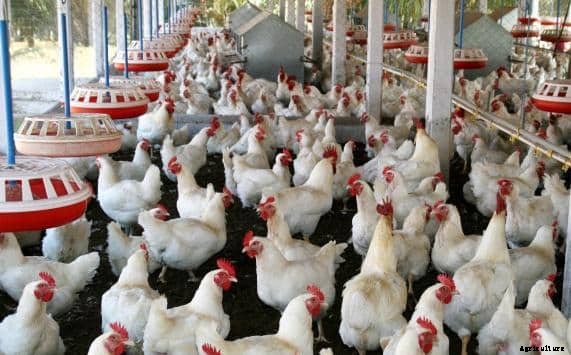
In this system, the birds are completely confined to a house, on the ground, in wire-netted floors, in cages, or on slates.
It plays a major role in poultry farming nowadays.
A high number of birds can be raised in this system. It is also a modern method of poultry production.
Deep litter systems:
The poultry birds like broilers are kept in large pens on the floor.
The floor is covered with sawdust, straw, or leaves up to the depth of 2-3 inches.
The bird density in this deep litter system is 5-7 birds per sq. meter.
In this, there will be easy access to feed, water, egg collection and it also provides good protection to the birds.
The only disadvantage of this system is the bedding used should be of high quality and there is a possibility of diseases from the litter.
Slatted or wire-floor system:
These houses are with slated or wire mesh floors.
The slated wooden pieces of width 2.5-5 cm, 2.5 cm apart, running through the length of the houses are made.
The slates are 3 feet above the ground so as to allow a build-up of droppings.
The density of birds in this house is 6-8 birds per sq. meter.
The things like feeding, watering, and egg collection can be handled from outside of the house.
The suitable houses for the adult birds are cooler houses, but they are more expensive.
Combined with both slatted floor and deep litter system:
This house system is 60% of the slate area and 40% of the litter area.
The houses are slated on either side leaving the central portion of the littered floor.
The area is raised with a concrete floor of 0.5 meters so as to accumulate manure below the slatted area.
In slatted areas, the waters and feeders are placed.
The density of birds maybe 5-7 birds per sq. meter.
This management of the system is expensive and more complicated.
Aviaries:
These are multi-tiered buildings and are cage-free housing.
In aviaries, there will be many levels of floor.
The birds may jump from one different level to other different levels. It is more useful for vertical spaces (platforms and perches).
The density of birds is up to 25 birds per sq. meter.
Advantages of Intensive system:
Minimum land is required for farming.
The farms can also be located near the market area.
In this system, day-to-day management is easier.
More energy is saved due to restricted movements and production performance is higher.
The practices of scientific management can be applied easily and accurately. The practices like breeding, feeding, medication culling, etc.
Easily the sick birds can be treated, detected, and isolated.
Read this: POULTRY QUESTIONS and ANSWERS.
Disadvantages of Intensive system:
The natural performances of birds will be affected more like scratching the floor with legs, roosting and spreading the wings, etc.
It also affects the bird’s welfare.
They cannot grasp the nutrients from the sunlight and feed source. Every nutrient should be provided to the birds if not they become nutrient deficient.
The diseases spread more in this system.
Cage system:
Cages are small compartments with wire netting floors.
In the initial stages introduction of individual eggs, pedigree recording, and culling of poor layers are done here.
In the world, 75% of commercial layers are kept in cages only.
The cage system is suitable for a high density of birds with less space availability.
The birds in cages are provided with the feeders and waterers attached outside of the cage. The feeding trolleys and egg collection belts may work on an auto operating system.
The droppings are collected in trays, on belts, on the floor, or deep pits under the cages.
Chicks (0-8 weeks) need 0.3 Sq. ft., growers (9-16 weeks) need 0.5 sq. ft. and layers (above 17 weeks) need 0.6 Sq. ft space on the floor.
Types of cages are based on the bird density, the number of rows, arrangement of cages, and types of bird reared.
Based on bird density:
Single or individual birdcage (one birdcage).
Multiple birdcages (3-4 birds per cage).
Colony birdcage (it can hold more than 11 birds in a cage).
Based on the number of rows:
Single-deck.
Double-deck.
Triple-deck.
Four-deck.
Flat—deck.
Based on the arrangement of cages:
Stair-step cage.
M-type cage.
L-type cage.
Battery cages.
Based on the type of birds reared:
Brooder cages:
The feeder length in front of the cage is 60 inches.
The height of the cage front and back is 12 inches.
The depth of the cage is 36 inches.
The no. of chicks that can be accommodated in the cage is 60 for 0-8 weeks.
It has a single or double deck system. The cages are attached with feeders and water from outside. For the first 7-10 days newspapers are spread on the floor of the cage. During the first week, the feed isprovided inside the cage.
Grower cages:
The specific length of the front feeders is 30 inches.
The height of the cage front and back is 15 inches.
The depth of the cage is 18 inches.
The number of birds that are accommodated for 9-18 weeks is 10 birds per cage.
Layer cages:
Conventional cages:
The height of the front feeder is 15 inches.
The front height of the cage is 18 inches and the back height of the cages is 15 inches.
The depth of the cage is 18 inches.
Reverse cages:
The front feeding length is 18 inches.
The front height of the cage is 15 inches and the back height of the cage is 15 inches.
The depth of the cage is 15 inches.
In this cage, 3-4 birds can be accommodated.
Breeder cages/elevated cage layers:
The height of the cage is raised up to 6-7 feet. It is constructed using concrete pillars.
The distance between the two pillars is 10 feet.
The concrete platform is made 2 feet wide.
The inter-platform depends on the type of cage and the distance is 6-7 feet.
The total height of the house is 20-25 ft and 30-33 ft wide.
In tropical countries, these types of houses provide sufficient ventilation.
POULTRY SHED DESIGN AND CONSTRUCTION – TIPS OF POULTRY FARMING:
The very first tip is to select a good site and location so that it could be easy for commercial marketing and easy rearing.
Good housing for the birds can also produce good products.
The light is more preferable in the housing of hens.
The feed must be efficient and protein contented.
In case if you are interested in this: Quail Farming Business Plan.