
Welcome to Modern Agriculture!

Rabbit Farming Business is one of the most profitable and lucrative business throughout the world. One can obtain decent profits with a proper rabbit farming business plan. As meat consumption is increasing and rabbit meat is considered as healthy and nutritious. Commercial rabbit farming has different steps to consider to be successful in rabbit farming business. You must learn some basics of rabbit farming and their management before starting on a large scale. There are many training centers available for taking the livestock courses. Department of Livestock or animal husbandry in your region is the best source for the rabbit training information.
White Giant Breed
Medium weight breeds of 3 to 4 kg.
Lightweight breeds of 2 to 3 kg.
Availability of White Giant and Soviet Chinchilla breeds.
Address:
Department of Livestock Production and Management,
Veterinary College and Research Institute,
Namakkal-637002, Tamil Nadu,
Ph: 04286 -266491, 266492.
Well, Rabbit farming business can be started in the backyard within a small shed which can be constructed by locally available materials with a low investment. Make sure the location and shed are being constructed is secured from wild climates and other predators such as dogs, cats..etc. Generally, Rabbits can be reared in two systems of housing methods.
Deep litter system of a rabbit farming businessThis method is suitable for rearing a small number of rabbits. To stop these little animals to dig burrows the floor the ground ought to be composed of concrete. The Litter materials such as paddy husk, timber veneer or wood shavings can be filled with 5 to 6 inches from the floor. Deep litter system isn’t acceptable for rearing over 30 to 35 rabbits. Male rabbits should be placed separately. This sort of housing isn’t acceptable for the intensive method of rabbit rearing. Rabbits reared in deep litter system are more vulnerable to diseases. Management of rabbits in this system of rearing very difficult.Cage system of rearing in rabbit farming business How much is floor space required in this method?
Adult rabbit cage sizes in rabbit farming business
Adult rabbit cage should have 1.5 ft length, 1.5 ft breadth, and 1.5 ft height. This cage is suitable for 1 adult rabbit or 2 growing rabbits
Growing rabbit cage sizes in rabbit farming business
Note: The above-mentioned cage sizes are suitable for 4 to 5 rabbits up to 3 months of age.
Cages for kindling in rabbit farming business
The crate size for growing rabbits is adequate for these animals going to be kindled. However, the underside and sides of the cage ought to be composed of weld net of 1.5 inches x 1.5 inches. This used to protect against the young bunnies to emerge from this cage.
Nest box for safety in rabbit farming business
To supply safer and serene surroundings during kindling the nest box is very much required. This nest boxes could be composed of wrought iron or timber. Nest box dimensions should be in this way to maintain inside the kindling cage.
Essential nest box sizes in rabbit farming business
About nest box for your rabbits
Nest boxes are intended to start in the top part. The base of the nest box ought to be composed of weld net of 1.5 inches x 15 inches dimension. A ring size gap of 15-centimeter diameter needs to be reached in the longitudinal part of the nest box, 10 cm in the base. This gap helps for the movement of the Dam in the nest box into the cage. Designing of this hole 10 cm in the base of the nest box prevents the young rabbits getting out of this nest box.
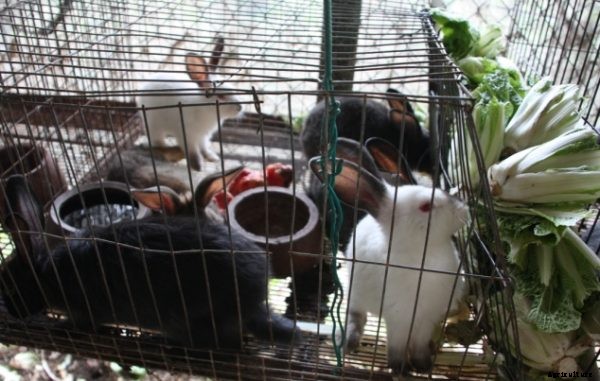
Cages for rearing rabbits in the backyard should be constructed 3 feet to 4 feet from the floor surface. Make sure that the cage bottom is waterproof.
Feed and water troughs for rabbits usually composed of iron. The feed trough should be designed in the form of “J” and they are usually fit outside the cages. To decrease the investment cost the feed and water may also be offered in cups.
Feeding management in rabbit farming business
he female rabbits showing the signals of heat taken to the male rabbit’s cage. If the female rabbit is at the correct time of heat period that used to lift her tail and allow the male rabbit to mate with her. After successful mating, the male rabbit falls on one side and produce a specific sound. One male rabbit should not be utilized for more than 3 or 4 days in a week. In the same way, a male rabbit should not be used for breeding not over 2 to 3 times every day. The breeding male animals should be given adequate rest and good feed nutrition. 1 or 2 male rabbits may also be also reared on the farm and they are sometimes utilized in case the rabbits used for breeding eventually become sick.
Pregnancy identification can be done by palpating the abdomen of the female bunny 13 to 14 days following breeding process. Palpation should be completed in the abdominal area in between the hind legs. When there is the mass is palpated in between the fingers then the bunny is pregnant. Those rabbits that are not pregnant after 13 to 14 days of mating, they again allowed for mating with the male rabbit with the same procedure. If a female rabbit is not becoming pregnant after 3 to 4 subsequent mating, that rabbit should be removed and sold. 25 days after mating there is generally increase in the body weight of pregnant rabbits from 600 to 700 grams. This increased weight can be recognized by lifting the rabbits. When the pregnant rabbits allowed to near the male rabbits for mating, they will not mate.
Following the pregnancy diagnosis was completed, the pregnant female rabbit should be fed together with the increased quantity of concentrate feed from 100 grams to 150 grams surplus than the normal feeding. The pregnant rabbits ought to be moved to the kindling cage on 25 days after mating. 5 days prior to the expected date of mating nest box should be held in the kindling cage. Dried coconut fiber or paddy straw should be used as a bedding material in the nest box. The pregnant rabbits pluck the hair in their stomach and create a nest for your young ones or two days prior to kindling. During this age, the rabbit should not be disturbed and individuals from outside should not be permitted near the kindling cage.
Usually, kindling takes place on the first morning. Kindling (giving birth to young bunnies)usually completed for a span of 20 to 30 minutes. The dam herself wash her young ones in the first morning. Nest boxes should be examined in the early morning. The dead young ones must be taken out of the nest box. During the examination of the nest box, the dam gets restless. So the dam ought to be removed before examination of the nest box.
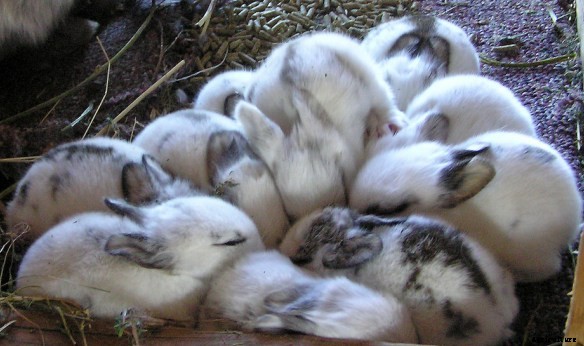
During birth newborn rabbits eyes are shut and they don’t have hair on their body. All newborn rabbits are usually lying in the bedding material made by the dam in the nest box. Usually, the dam provides milk to the young ones once every day in the early morning. If we compulsorily make the rabbit nourish her young ones there will not be some milk secretion in any respect. The skin of these newborn rabbits received the sufficient quantity of milk from their mother is generally shiny. But the skin of these newborn rabbits who have not got the sufficient quantity of milk out of their mother is tender and wrinkled in their body temperature is low and they seem very lazy and weak.
Young rabbits are allowed to stay few weeks in the nest box. Later nest box was taken out of the kindling cage. Weaning of young rabbits or bunnies could be performed at age 5 to 6 weeks. While weaning, the first dam should be taken out of the kindling cage and the bunnies are allowed to stay for 1 to 2 weeks in precisely the exact same cage. Later the genders of the rabbit should be identified and the different genders should be kept in various cages. We should not suddenly alter the diet or feed of those weaned rabbits.
Signs: Continuous sneezing and coughing and rabbits rub their nose with the forelimbs. Breathing sound resembles the rattle sound. You can observe fever, diarrhea in this case.
Treatment: Treatment isn’t effective against pasteurellosis. Though the rabbits effected with pasteurellosis recuperate after the medical treatment, however, the rabbits that are affected by this disease transmit the infectious germs to other healthy rabbits on the farm. Therefore culling the affected rabbits in the farm is the only control step of pasteurellosis in the rabbit farming business.
Enteritis
There is an assortment of microorganisms responsible for producing enteritis in rabbits. A sudden change in the feed, the surplus quantity of carbohydrate in the feed, immuno-depression, unhygienic water and feed will be the factors predispose the rabbits to enteritis caused by several microorganisms. The clinical signs of enteritis in rabbits are nausea, enlargement of stomach, dull hair coat and dehydration. On account of the reduction of water due to diarrhea which leads to dehydration, rabbits become dull.
Wryneck disease
Rabbits affected with all the pasteurellosis are influenced with wry neck disease. This disease affects the middle ear and the brain of rabbits. Due to the affection membrane of the ear and pus is discharged in the ear, the bunny turns its head to one side. Successful treatment of pasteurellosis controls the throat disease in rabbits.
Mastitis Mostly nursing dams are affected by mastitis disease. You can observe affected udder is hot, reddish and painful to touch. To control this disease, affected rabbits should be provided with appropriate antibiotics.
Diseases due to fungal infection Skin infection is generated in rabbits from Dermatopysisfungus. There is a reduction of hair around the nose and ear of rabbits. Due to aggravation rabbits continuously rub the affected region’s results in the creation of wounds in these regions. Later on, secondary bacterial infection in these areas causes pus formation.
Treatment of this disease: Griseofulvin or benzyl benzoate cream should be applied on the affected areas. Griseofulvin mixed @ 0.75g/kg of feed and given for a period of 15 days to control this.


