
Welcome to Modern Agriculture!

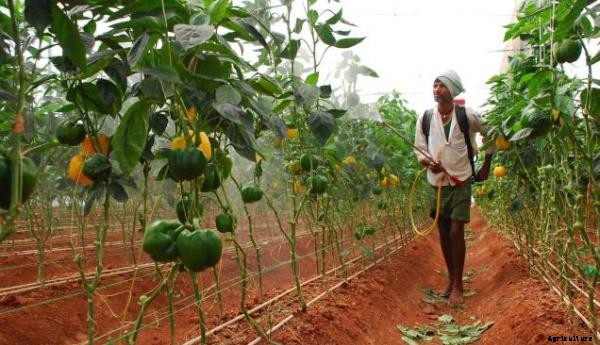
Introduction of Capsicum Cultivation:- Capsicum is one of the excellent vegetables and has great demand in the market. In some countries, capsicum is also being called as “Bell Pepper”, “Green Pepper”, and “Sweet Pepper”. The shape and intensity of pungency is different from chilli. Capsicum is like fleshier and of different shapes and colours. Usually, it looks like a bell, hence its being called as bell pepper. All the cultivars (varieties) are very mild in pungency and even some of them are non-pungent. Capsicum plants are bushy and reach about 60-75cm high and semi-perennials that are grown as annuals in commercial cultivation. Capsicum is used in salads, stews, stir-fries, baked and stuffed dishes, salsa, pizzas and cheeses and pickles. Capsicums are also being used for producing paprika which is used for coloring foods, flavoring and in sauces. When it comes to the history of capsicums, they were originated in the Americas, but are now spread worldwide. Capsicum can be grown in controlled and protected environments such as greenhouse, polyhouse and shade nets. Capsicum grown in protected area has more demand due to good quality of produce. Commercial growers can opt for capsicum crop for good profits. The crop management practices of capsicum are similar to chilli crop. Growing coloured capsicum is increasing day by due their attractive colour and to use especially in salads. Capsicum is rich in vitamins such as “A’, ‘C’, minerals and antioxidants. One can expect more yield from polyhouse, greenhouse or shade net when compared to open field cultivation. Capsicums can be grown indoors / back yards, in pots and containers as well.
Scientific Name or Botanical Name of Capsicum:- Capsicum annuum.
Genus of Capsicum:- Capsicum L.
Family Name of Capsicum:- Solanaceae.
Common Names of Capsicum:- Bell pepper, Sweet pepper, and Green Pepper.
Capsicum Names in Other Parts of World:- Paprikaschote (German), Simla Mirch (Urdu), Paprika (Dutch), Barbaroni (Somali), Nерц (Mongolian), Piobar (Scottish), 菜椒 (Chinese), звънец чушка (Bulgarian), Siling pari (Filipino), Ma tes plug (Cambodian), කාපිරි මිරිස් (Sinhalese), ớt chuông (Vietnamese), พริกหยวก (Thai), 피망 (Korean), πιπεριά (Greek), ピーマン (Japanese), Paprika (Latvian), Kapie (Czech), Le poivron (French), Dolma biber (Turkish), Paprika (Swedish), Loceng lada (Malay), Peberfrugt (Danish), 鐘形辣椒 (Taiwanese), Bell paprika (Hungarian), Pimiento (Spanish), भेडेखुर्सानी (Nepali), Peperone (Italian).
Capsicum Names in India:- Capsicum (English), Simla Mirch (Hindi), Kudamilagai (Tamil), Capsicum / Bengulooru Mirapakaya / Simla mirchi (Telugu), Dhobli Mirchi (Marathi), Shimla mirch (Oriya), Kuda mulagu (Malayalam), Donne menasinakaayi (Kannada), Shimla Mirch (Bengali), Simla marcha (Gujarati), Capsicum (Assamese), Simla Mirch (Punjabi).
Health Benefits of Capsicum:- The following are some of the health benefits of capsicum.
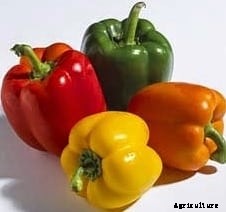
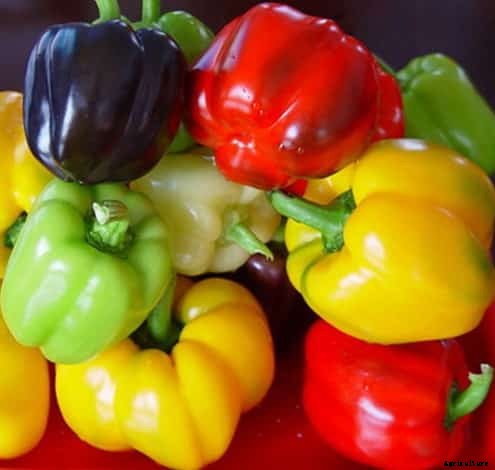
Cultivars (Varieties) of Capsicum:- Well, there are many varieties of bell pepper with different shapes, colours, and flavours which are grown throughout the world depending the purpose. Commercial growers of capsicum should consider locally improved varieties for high yields. Here are some of typically grown varieties of capsicum.
Climate Requirement for Capsicum Cultivation:- As we said before that it is has similar requirements of farm management practices of chilli, capsicum requires similar agro climatic conditions just like chilli. Capsicum crop is very sensitive to frost conditions. The best temperature for capsicum cultivation is 22°C to 25°C. Higher temperature conditions will result in flower/bud/fruit drop and end up with lower yield than expected.
Soil Requirement for Capsicum Cultivation:- Capsicum or sweet pepper or bell pepper can be cultivated in most of the soil types. However, well drained clay loam soil rich in organic matter is best for its growth and yield. Supplementing the soil with good farm yard manure (FMY) in case of sandy loam soil proved the high yields. When you plan to grow the capsicums on large scale or commercial line, it is better to go for soil test to know the soil strength (fertility). Based on soil test results, fill the requirement for nutrient or micro-nutrient deficiency. The most suitable pH range of soil for capsicum cultivation is 6 to 7.0.
Propagation in Capsicum Cultivation:- Usually, Capsicums are propagated through seeds.
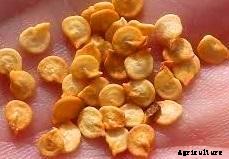
Treatment of Seeds in Capsicum Cultivation:- Seed treatment should be carried out to prevent any seed-borne diseases before sowing. Treat the capsicum seeds with Thiram or Captan @ 2 grams/ kg of seed before sowing.
Season for Capsicum Sowing:- It all depends on the method of cultivation. If it is rainfed crop, one should be ready just before monsoon. Capsicum can be grown throughout the year with abundant water facility or in controlled environment like greenhouse, polyhouse or shade net. Generally, in South Asian regions, capsicum crop is sown August for the autumn-winter crop and in November for the spring -summer crop.
Land Preparation in Capsicum Cultivation:- Plough the field till the soil obtains fine tilth stage. Make sure to remove any weeds from previous crops. Supplement well-decomposed farm yard manure (FYM) like cow dung of 20-25 tonnes/ha as basal before last ploughing. Commercial capsicum growers should consider soil test to fulfil any nutrient and micro-nutrient deficiencies.
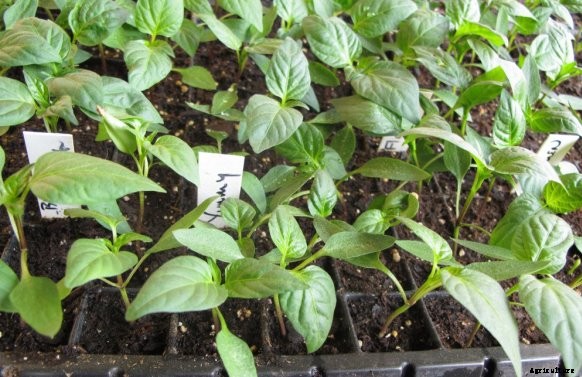
Planting in Capsicum Cultivation:-
Irrigation in Capsicum Cultivation:- Timely and uniform irrigation in any crop results in good quality of produce and high yields. For raising on nursery beds, sprinklers can be used to wet the beds for good germination percentage. After transplanting in the main field, consider drip irrigation for better use of water and fertilizers. The frequency of irrigation depends on plant age, crop stage, and soil type. The first irrigation should be given just after transplanting the seedlings in the main field for better root development. Subsequent irrigation should be provided as and when required. Irrigation is essential in arid and semi-arid regions. There is no need of irrigation in rainy season. However, in general, capsicum requires irrigation at an interval of 7-10 days.
Manures and Fertilizers in Capsicum Cultivation:- Well decomposed farm yard manure of 20 to 25 tonnes should be added as part of land preparation. In-organic fertilizers of N:P:K should be applied in the ratio of 40:60:30 kg/ha as basal application (Potassium and phosphate fertilizers should be mixed in the plant rows just before transplanting). Apply 40 kg of ‘N’ on 30, 60 and 90 days of planting as top dressing.
Weed Control in Capsicum Cultivation:- Weed control is a part of intercultural operation and should be practiced for quality produce and crop yield. These practices are similar to weed control methods in chilli farming. Two weedings 30 and 60 days after transplanting lead to high yield in green pepper. Earthing of plants may also be done after 2 to 3 weeks of transplanting. Earthing operation will also help in removing the weeds.
Pests and Diseases in Capsicum Cultivation:- The following are pests and diseases found in capsicum cultivation.
Pests: Thrips, Aphids, and Mites common pests found in capsicum cultivation.
Diseases: Damping off, Powdery mildew, Anthracnose, Bacterial wilt and Leaf curl disease are common diseases found in capsicum cultivation.
Note: Your local horticulture department is good source for finding suitable solutions for controlling pests and diseases in capsicum cultivation.
Harvesting in Capsicum Cultivation:- Harvest of capsicum depends on variety and the method of cultivation. Pick fully matured green fruits before ripening. Green capsicums will be ready for harvest is relatively firm and crisp. Capsicum fruits can be picked with an upward twist which leaves a piece of stem attached with the fruits.
Yield in Capsicum Cultivation:- Well, yield of any crop depends on many factors like farm management practices, cultivar (variety), irrigation, propagation method and agro-climatic conditions. On an average, one can expect 12 to 15 tonnes per hectare of quality fruits. More crop yield can be obtained, if capsicums are grown in greenhouse or polyhouse or under shade net.
Marketing of Capsicum:- Fresh produce can be transported in small trucks to local markets.


