
Welcome to Modern Agriculture!

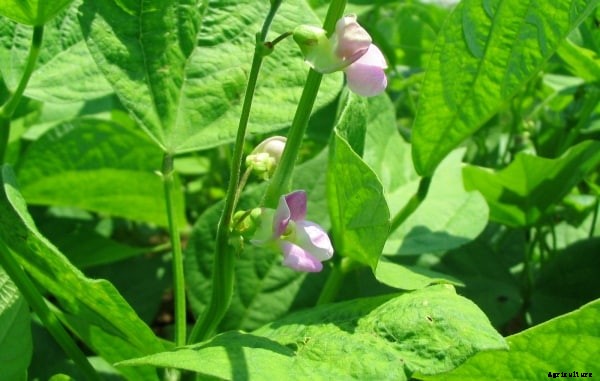
Introduction of French Beans Cultivation:- French beans or green beans are also known as ‘string beans’ and ‘snap beans”. French bean crop is very profitable cool season legume vegetable grown for its tender pods, shelled green beans and dry beans. French beans belong to the family of “Fabaceae and genus of “Phaseolus”. French beans are grown and consumed throughout the world. These green vegetables can be eaten fresh or canned, frozen. There are many varieties of French beans grown in all the regions. However, selecting high yielding, disease resistant variety is most important factor for successful commercial cultivation. Selected french bean varieties can be eaten at different stages as immature pods; fresh seeds removed from the pods and dried mature beans. French bean pods can be in many colours from yellow through to green and purple depending on the variety selected. China is number one production country of french or green beans in Asia. There is a very good demand for green beans in local as well as international markets. French beans can be grown in greenhouse, poly house, back yards and even pots / containers.
Health Benefits of French Beans:- The following are some of the health benefits of french beans.
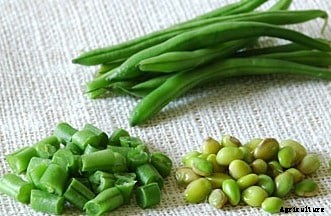
French Beans Varieties:- There are two categories of french beans; bush type and pole type. There are so many improved varieties fall under these categories and one of them is dwarf bean variety. One should make sure to select right variety for that specific region.
Local Names of French Beans in Other Parts of the World:- Französisch Bohnen (German), Sperziebonen (Dutch), Франц шош (Mongolian), Fasule frengjisht (Albanian), Faras Beans (Urdu), aeduba (Estonian), φασολάκια (Greek), Pónairí Fraince (Irish), Peulangseueo kong (Korean), Seemi (Nepali), feijão francês (Portuguese), француски пасуљ (Serbian), Habichuela (Spanish), فاصولياء فرنسية (Arabic), зелен фасул (Bulgarian), Sìjì dòu (Chinese), Pranses beans (Filipino), Fagiolini (Italian), Fransk bønner (Norwegian), ฝรั่งเศสถั่ว (Thai), Đậu vô ve (Vietnamese), サヤマメ (Japanese), Pupiņas (Latvian), Fasole franceză (Romanian), Francouzský fazole (Czezh), Haricots français (French), стручковая фасоль (Russian), Fazuľové struky (Slovak), Franska bönor (Swedish), Taze fasulye (Turkish), Franske bønner (Danish), საფრანგეთის ლობიო (Georgian), Kacang Perancis (Malay), لوبیا فرانسه (Persian), 菜豆 (Taiwanese), Квасоля (Ukrainian).
Local Names of French Beans in India:- Bakla / Pharasbeen / Sem (Hindi), Fansi (Gujarati), Beans / Anne Saango (Konkani), Farasbi (Marathi), French Beans (Oriya), Fras Bean (Punjabi), Fraa’Sh Bean (Kashmiri), Beans (Tamil, Malayalam, Bengali), French Chikkudu (Telugu), French Beans / Huruli Kayi (Kannada).
Climate Required for French Beans Cultivation:- French bean or green bean is a cool season crop and usually tolerates high temperature conditions when compared to peas. The ideal temperature for french bean cultivation is about 15 °C to 30 °C. French bean crop is sensitive to frost conditions, rainfall and high temperatures. Pole variety bean crop tolerates high rain fall when compared to bushy variety.
Soil Requirement for French Beans Cultivation:- French beans can be cultivated in wide variety of soils from sandy to heavy clay soils. However, this crop thrives best in well drained, loamy and light alluvial soil with pH 5.5 to 6.5. Soil fertility is main factor of achieving higher yields. Adding garden compost or well decomposed farmyard manure (FMY) at the time of land preparation will enrich the soil fertility. Soil micro nutrient deficiency should be taken care based on the result of soil test.
Season for French Beans Cultivation:- French beans can be grown throughout the year provided there is a sufficient irrigation.
Land Preparation in French Beans Cultivation:- Land should be brought to fine tilt stage by giving 3 to 4 ploughings with local tractor. Any weeds from previous crops should be removed and prepared for better germination of the seeds. Adding well decomposed farm yard manure or garden compost in the soil results in good yield. This can be incorporated during last plough.
Propagation and Seed Treatment in French Beans Cultivation:- Propagation in french bean farming is done by seeds. Seed treatment should be done to control any soil borne / seed borne fungal diseases. Trichoderma 4 grams / kg or Thiram or Carbandazim @ 2 grams / kg of seeds can used to treat the seeds just 1 day before sowing in the field. If the crop is grown for the first time it should be treated with Rhizobium as in cluster beans crop.
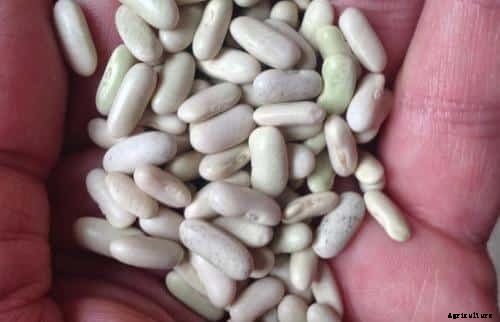
Seed Rate, Spacing and Sowing in French Beans Cultivation:- Generally, seed rate depends on the cultivar / variety and soil fertility. On an average, a seed rate of 50 to 60 kg for bush type and 30 to 35 kg for pole type is required to cover the 1 hectare land. Seeds should be sown at a row spacing of 30-40 cm keeping 15-20 cm distance from plant to plant when followed the flat bed sowing method. In case of raised bed sowing method, seeds should be sown on raised beds having 60-80 cm width and 20-30 cm height at a row spacing of 30-40 cm keeping 15-20 cm distance from plant to plant. The seeds may be sown by dibbling, drilling and broad casting method at a depth of 2 to 3 cm
Irrigation in French Beans Cultivation:- In order to achieve quality pods and higher yields, make sure to have enough moisture in the soil. Irrigation should be given right after sowing, just prior to blooming, during flowering and pod development stage. On an average, 6 to 7 irrigations should be given during growing season. If it is rainy season crop, no irrigation is required. Sprinkler or drip irrigation can be adopted in areas where water is a major concern.
Inter-crop in French Beans Cultivation:- To get extra income, farmers can choose to grow more than one crop in the same field. Intercropping french beans crop with maize, soy bean, groundnut / peanut crops is a good combination. Crop rotation is also achieved good results when french beans crop is rotated with maize and rice crops.
Manures and Fertilizers in French Beans Cultivation:- Organic fertilizers like farmyard manure of 10 to 15 tonnes per 1 hectare land should be added during land preparation. Chemical fertilizers like; N: P: K of 60:60:40 kg/ha should be applied in different forms like Urea, Single Super Phosphate and Muriate of potash. Nitrogen should be applied in split doses. Full dose of ‘P’ and ‘K’ and half dose ‘N’ should be applied in seed furrows below the seed at planting time. Remaining half dose of ‘N’ should be applied as top dressing at flowering stage.
Intercultural Operations in French Beans Cultivation:- Applying cultural practice to suppress the weeds is safest method. Weeds can be controlled manually or chemically. Shallow cultivation should be carried out without damaging plant roots to keep the bean crop field free from weeds. Herbicides such as dinitomaterial 2 – 3 kg / acre and sodium salt of pentachlorophenol @ 6 kg per acre as pre-emergence treatment have been effective in controlling the weeds. In case of pole type, plants should be supported by bamboo sticks of 2 meter height 2 to 3 weeks after sowing to increases pod yield as well as seed quality.
Diseases and Insects in French Beans Cultivation:-The following are the common pests and diseases and their management in green bean farming.
Note: Contact your local horticulture department center for disease symptoms and their control. They are the best source of pest and disease solutions in french Beans cultivation.
Harvest in French Beans Cultivation:- The green pods become ready for harvesting after 50 to 75 days of sowing depending on the variety grown. Green pods should be harvested at full grown stage but immature and tender. Pods are ready for harvest 8-12 days after flowering depending on cultivar. Generally, in bush type varieties, 2 to 3 harvests and in pole types 3-5 harvests can be carried out. If the purpose is dry beans production, wait until large percentage of pods are fully ripe and most of the remainder has turned yellow.
Yield in French Beans Cultivation:- Yield depends on many factors like variety, soil fertility, irrigation, climate and crop management practices. On an average, yield of 40 to 50 quintals of green pod per acre in bush type and 60 to 75 quintals of green pod per acre in pole type can be obtained. When it comes to seed yield, 10-12 quintals / acre in bush type and 12-15 quintals / acre in poly type can be expected.
Marketing of French Beans:- Harvested fresh pods can be packed and transported to local markets.
For Agriculture in India : Read here.
For Sheep or Goat Farming Business: Read here.


