Daylilies produce large, colorful flowers that will return year after year with minimal care—even in drought conditions. Here's how to plant, grow, and care for daylilies in your garden, including end-of-season cleanup and dividing after blooming.
About Daylilies
The daylily is an amazingly low-maintenance (almost no maintenance) perennial—easy to grow, virtually disease- and pest-free, and able to survive drought, uneven sunlight, and poor soil. Plus, there are thousands of beautiful daylilies to choose from. Combine early, mid-season, late blossoming varieties, and repeat bloomers to have daylilies in flower from late spring through the first frost of fall.
The daylily's botanical name, Hemerocallis, comes from Greek hemera ("day") and kallos ("beauty"). The name is appropriate, since each flower lasts only one day!
Despite their name, daylilies are not "true lilies" and grow from fleshy roots. True lilies grow from onion-like bulbs and are of the genus Lilium, as Asiatic and Oriental lilies are. In the case of daylilies, leaves grow from a crown and the flowers form on leafless stems—called "scapes"—which rise above the foliage. Each scape has 12-15 buds on it, and a mature plant can have 4 to 6 scapes, giving the plant a long bloom period.
If you see a height listed alongside a daylily variety, this refers to the length of the scape. Some can reach 6 feet tall!
Planting
When to Plant Daylilies
- Plant daylilies in the spring as soon as soil can be worked. Alternatively, plant them in early fall, at least 6 weeks before the first frost.
Choosing and Preparing a Planting Site
- Although daylilies will survive in less-than-ideal conditions, they will perform best if given full sun and a spot with well-drained, fertile soil.
- Don’t plant near trees and shrubs that will compete for moisture and nutrients.
- To increase organic matter, add aged manure or compost to the soil before planting.
How to Plant Daylilies
- Dig a hole wide enough for the roots to be spread out.
- The crown of the plant (where roots and leaves meet) should be buried about 1 inch deep.
- Fill in soil, lightly packing it down around the plant.
- Water until the soil is well saturated.
Care
How to Care for Daylilies
Daylilies require little to no care and can even survive with neglect but if you want these flowers to thrive and perform at their best, here's how to give them a little TLC.
- Water newly planted daylilies once a week until established.
- Daylilies are fairly hardy and drought tolerant so they can survive without watering. However, they prefer about an inch of water per week; normal rainfall will supply much of that amount. If you're suffering from a dry spell or live in a drier climate, water them and they will reward you with more blooms. Add mulch around the plant to keep it moist and to help minimize weeding.
- Daylilies do not require fertilization as long as the soil is reasonably fertile. However, you can encourage stronger bloom performance with a little general purpose fertilizer (10-10-10) once a year in early spring as new daylily top grow emerges. Spread a handful at the base of each daylily clump and water if dry. If you wish, you could fertilize daylilies a second time after they are finished blooming to help your plants multiply faster in the future.
- Deadheading is not necessary but you can remove spent blooms to prevent seed production and to encourage more blooming. Just snip off their blossoms as you see them wilting. Most daylilies do not self-sow; you need to divide daylilies to create new plants (see how below).
- Once all of the flowers have blossomed on a daylily scape, you can cut the entire scape back to the ground right away or in the fall or not at all. If you do not cut it back, it will simply turn brown and remain standing.
- However, in early spring, remove the dead foliage from the previous year’s growth before new growth resumes in the spring.
- Add aged manure or compost to the soil around the plants in the spring.
Dividing and Transplanting Daylilies
Daylilies can be aggressive spreaders and will likely require dividing at some point (usually every 3 to 5 years). In addition to controlling their spread, dividing will also reinvigorate plants, resulting in better and more frequent blooms.
Here's how to divide daylilies:
- Though dividing can be done any time the soil is workable, it is best done right after the daylily has finished blooming. Note: The plants need at least 6 weeks to get re-established before winter.
- Dig up the entire root clump.
- Remove as much soil from the roots as possible. Soaking the roots in a bucket of water helps to get rid of excess soil.
- Locate the crown of the plant. Starting from the outer edge, break it into smaller clumps (usually 3 to 4 per plant). Each clump should have healthy roots and at least a few leaves.
- Cut the leaves back to approximately one third of their original length (5 to 6 inches, generally).
- Replant and water thoroughly.
Pests/Diseases
Aphids and thrips occasionally feed on the flower buds. Use insecticidal soap or strong sprays of water to keep them at bay.
Recommended Varieties
There are thousands of beautiful daylilies to choose from! Combine early, mid-season, late blossoming varieties, and repeat bloomers to have daylilies in flower from late spring into fall.
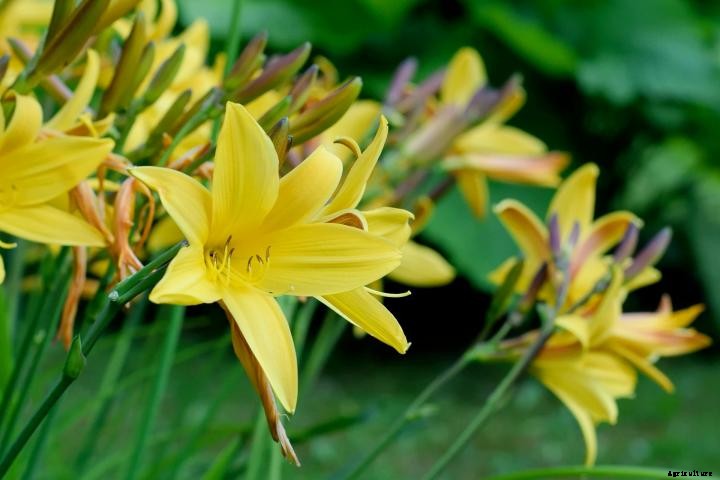
Daylily flowers may be fragrant and come in many colors, shades, and color combinations. Some flowers are full and round, others have wide petals with ruffled edges. Daylilies called "spiders" are spider-like in shape, while "doubles" have double the number of petals and sepals. Some new cultivars are even night-blooming and very fragrant.
Some of our favorite cultivars include:
- ‘Stella de Oro’ has numerous yellow flowers per scape and blooms all summer.
- ‘Little Grapette’ has small purple flowers and blooms early summer. This daylily is only 12 inches tall.
- ‘So Sweet’ has yellow flowers. Its leaves remain green over winter.
- ‘Ruby Spider' has large, up to 9-inches wide, scarlet-red flowers with golden throats.
- ‘Catherine Woodbury’ blooms in mid- to late-summer with fragrant lavender-pink flowers.
- ‘Indian Giver’ has large rich-purple flowers and blooms early to late summer. It's semi-evergreen.
- ‘Siloam Double Classic’ has fragrant, salmon-pink, double blossoms in early to mid-summer. It’s ideal for containers.
Reblooming daylilies have the ability to rebloom during the growing season:
- ‘Good Fairy’, ‘Mini Stella’, ‘Happy Returns’
Evergreen daylilies have leaves that remain green over winter:
- ‘Wind Frills’, ‘So Sweet’, ‘Joan Senior’
Looking for a specific color? No problem! Here are a few options:
- Pink: ‘Lullaby Baby’, ‘Chicago Candy Cane’, ‘Halls Pink’
- Lavender/Purple: ‘Mountain Violet’, ‘Velvet Shadows’, ‘Summer Wine’
- Red: ‘Hearts Afire’, ‘Oriental Ruby’, ‘Red Mittens’
- Orange: ‘Rocket City’, ‘Carrot Top’, ‘By Myself’
- Yellow: ‘Lemon Lollypop’, ‘Mini Stella’, ‘Paradise Prince’
- White: ‘Crispin’, ‘Ice Carnival’, ‘May May’, ‘So Lovely’
Harvest/Storage
Using Daylilies as Cut Flowers
Daylilies can make nice cut flowers, especially the heirloom types. Individual flowers last just one day, but buds will continue to develop and open for up to a week indoors.
- The trick is to cut daylilies with buds that are just about to open, with a bit of the flower color showing. The higher up buds will open as the bottom ones fade.
- As soon as you get the flowers inside, trim the stem ends an inch or so, making a diagonal cut with a sharp knife.
- Change the water every few days.
- Remove the faded flowers daily and new buds will open.
Wit and Wisdom
- Daylilies are not native to North America; they originally come from Asia. Explorers brought them to Europe and early colonists subsequently brought them to North America.
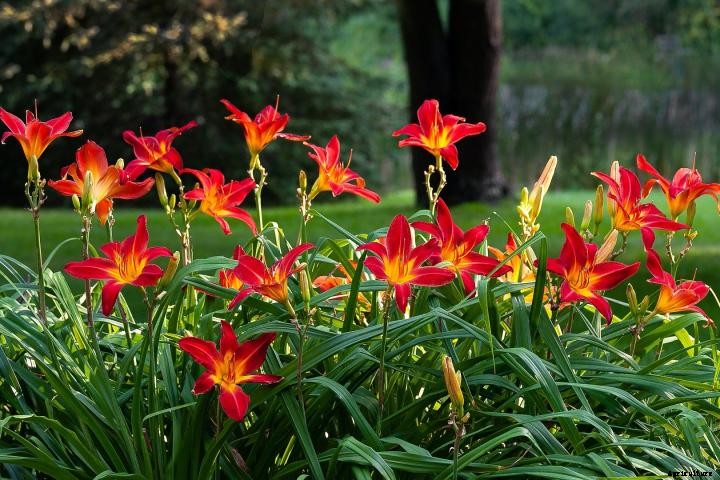
- The common orange-red daylily (H. fulva) that forms brilliant borders along country roads is also called roadside lily, outhouse lily, ditch lily, or tawny daylily.
- According to weather lore, if a daylily blossom opens later or closes earlier than its usual time (opens at 7:00 a.m., closes at 7:00 p.m.), watch for rain.
- All parts of the daylily are edible. The tender foliage can be eaten as a spring green. The buds and flowers can be eaten raw or in soups. The swollen portions of the root can be boiled and eaten. Read more about this below.
Cooking Notes
Daylilies are edible and have a long history in the kitchen. The tender foliage was eaten as a spring green, the buds and flowers were eaten raw and added to soups, and the swollen portions of the root were boiled and eaten. All parts have a mild peppery taste and act as a thickening agent when cooked in stews, soups, or sauces.
- Try sautéeing daylily buds in some butter and garlic. They taste like a cross between green peas and asparagus.
- Dip daylily buds in a light batter and deep-fry them. Sprinkle with salt and you have a special summer treat!


