Perennial Salvias (also known as "sage") are mainstays of the midsummer garden border—blooming summer to autumn! Planted in the spring, these aromatic beauties are great for cutting and beloved by bees and butterflies—plus, they're drought-tolerant! See how to plant, grow, and care for Salvia.
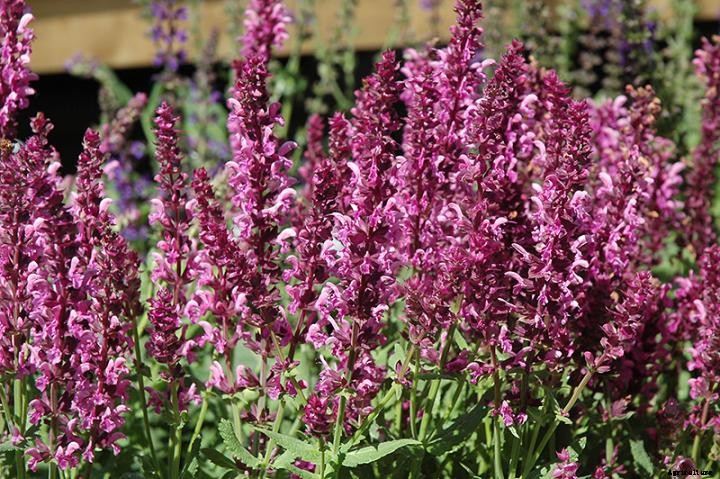
Part of the mint family (Lamiaceae), salvias appear as a colorful spike of densely-packed flowers with tubular blossoms atop square stems and velvety leaves.
The common kitchen herb garden sage—Salvia officinalis—is actually a type of salvia; it's a relative of the many ornamental species and has a few attractive ornamental varieties itself.
Hummingbirds and butterflies love salvia's tubular flowers and they're adored by bees, too, so plant them if you wish to attract these pretty pollinators!
Fortunately, salvia does not tend to attract deer or rabbits. It is the distinctive, pungent odor of their leaves that acts as a repellent to garden pests.
Salvia are heat- and drought-tolerant, making them survivors in the summer garden. They grow 18 inches to 5 feet tall, depending on the variety.
Salvias of all types can be grown in containers, too.
Take care when choosing salvias, because not all plants are hardy in all regions; some are best treated as annuals, but perennial varieties are also available.
Planting
When to Plant Salvia
- Plant salvia by seed outdoors after all danger of frost has passed in the spring. See local frost dates.
Choosing a Location
- All salvias thrive in full sun and well-drained soil.
- Many varieties (typically those with light-colored flowers) will also do well in part-shade, but flowering will be reduced.
- A south-facing location is ideal.
- Salvias look great when planted in groupings of three or more.
Preparing a Planting Site
- Loosen the soil to a depth of 12 inches, removing any large stones or roots.
- Mix in a 3-inch layer of compost to provide nutrients.
- If planting in a container, add some grit to the compost to improve drainage and feed in spring. Plants grown in a garden soil don’t need feeding.
How to Plant Salvia
- Dig a hole twice the diameter of the container the plant is in.
- Remove the plant from its container and place it in the hole so the top of the root ball is level with the soil surface.
- Space plants 1 to 3 feet apart, depending on the variety.
- Carefully fill in around the plant and firm the soil gently.
- Water thoroughly.
Care
How to Grow Salvia
- Add a 2-inch layer of mulch around the plant to retain moisture and control weeds.
- Water plants during the summer if rainfall is less than 1 inch per week. Salvia does not like excessive summer irrigation.
- Salvia really doesn't need feeding during the season.
- To encourage continuous blooms throughout the season, deadhead spent flowers periodically.
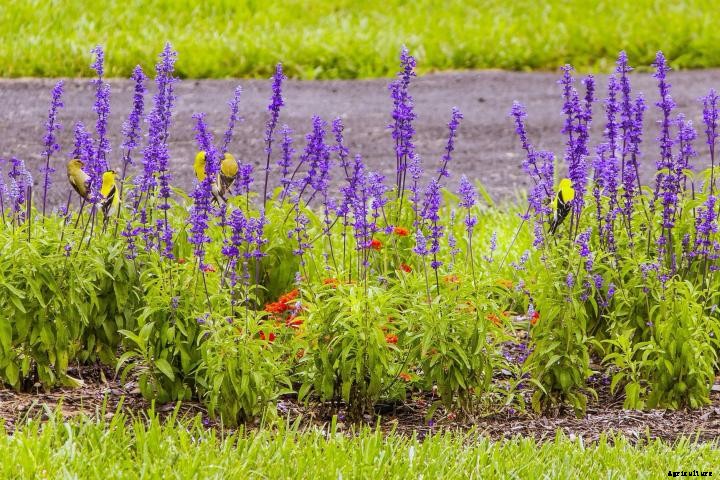
- At the end of the season, leave flowers on plants to encourage reseeding (and to feed the birds).
- Some develop woody lower stems with age; feel free to prune this.
- After the first killing frost, cut stems back to an inch or two above soil line.
- Divide perennial salvias every few years. The best time to divide is in early spring before new growth begins. Just lift, divide into clumps, and replant.
- Every spring, apply a new think layer of compost, and mulch again.
Propagating Salvia
For the adventurous gardener, salvia cuttings can be taken in the spring or early fall.
Some salvias often self-propagate, so you might find seedlings you can use in other parts of your landscape!
Before flower buds have developed, take cuttings (remove stems) from vegetative (non-flowering) branches that are about 3 inches long. Remove the lower leaves and trim each cutting just below a node.
Insert cuttings into a pot of pre-watered compost. Cover the pot with a clear plastic bag—try to avoid the bag touching the foliage.
Place cuttings in a cool greenhouse and put up shading to prevent scorching from strong sunlight. After three weeks, cuttings should be ready to pot on.
Pests/Diseases
Pests and diseases are rarely an issue for salvia growers. Here are possible issues:
- Powdery mildew
- Aphids
- Spider mites
- Whiteflies
- Root rot
- Botrytis blight
Recommended Varieties
There are over 900 species of salvias and many of the tender perennial species are popular as annuals in regions where they are not fully winter hardy.
The following common salvias are usually grown as annuals. They may be grown as perennials in warmer regions.
- Scarlet or Texas Sage (Salvia coccinea) – Scarlet sage has bright red flowers on 10-inch spikes. It is hardy in Zone 9 and higher.
- Pineapple Sage (S. elegans) – Pineapple sage has bright red edible flowers in late summer and the leaves have a pineapple fragrance.
- Bedding Sage (S. splendens) – The common bloom color is scarlet red but it also comes in purple, orange, lavender, yellow and white. Bedding sage has heart-shaped leaves.
The following salvias are usually grown as perennials.
- Azure Sage (S. azurea var. grandiflora) – Azure sage has aromatic foliage and sky blue flowers in late fall.
- Peruvian Sage (S. discolor) – The leaves of this sage are gray-green on the top and have white undersides. The flowers are dark purple.
- Autumn Sage (S. greggii) – Is drought tolerant and has brilliant colors. It blooms through the summer and into the fall.
- Hybrid Sage (S. x superba) – This group is perfect for colder areas. The plants are 12 to 24 inches tall and bloom in late spring to early summer. If faded blooms are cut back, they will re-bloom through fall. 'Rose Queen' has pink flowers.
Wit and Wisdom
- The ancient Greeks and Romans used salvia as a memory enhancer.
- The name Salvia comes from the Latin word salvere, which means "to heal." Salvia has been used for its herbal and medicinal qualities since ancient times.


