
Welcome to Modern Agriculture!

Crumbs moving independently across the kitchen floor? A line of small black things crawling in and out of your trash bin? Looks like you have an ant infestation. Here's how to get rid of ants in your home—and prevent them from returning!
Ants play an important role in nature, but most of us can agree that they don't belong in people's homes. Nonetheless, ants are among the most frequent household pests. There are about 1,000 known ant species in North America and over 12,000 species worldwide.
In the outdoor world, ants are generally beneficial insects. They mostly live in the garden and help aerate the soil. In addition, they are scavengers, helping to reduce the numbers of other insects—including those we consider pests. Ants are part of the insect order Hymenoptera and count bees and wasps among their relatives.
In the indoor world, there are only a few speces that come into people's homes. They're not generally dangerous—just annoying.
IdentificationThough ants are familiar insects, in the home, they are sometimes confused with termites. If you look closely enough, you can tell an ant by its slim middle and curved antennae. Termites have thick middles and upright antennae.
The body of an ant is divided into three sections: head, thorax, and abdomen. An ant's middle may have one or two segments, or "nodes." This feature divides ants into the aptly named groups of one-node and two-node ants.
As with bees, ants' colonies are largely female. Wingless adult ants are the colony's workers, who are in charge of gathering food, feeding larvae, sustaining the nest, and protecting the colony. The colony queen's only job is to lay eggs. Male ants have wings and mate with the queen.
Carpenter Ants
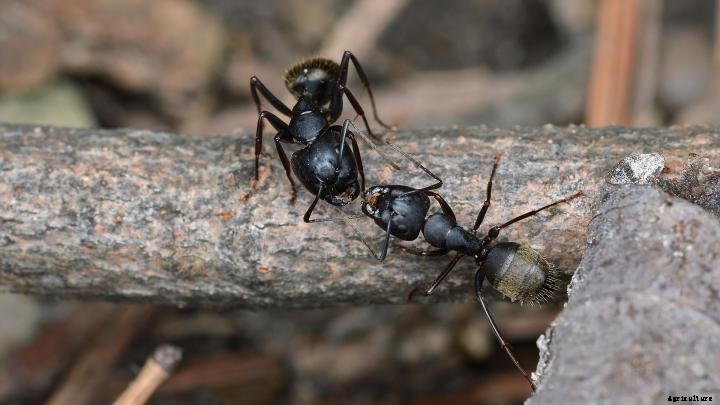
Carpenter ants are large, ranging from 1/4-inch to 5/8-inch long. They are dark brown or black, but some species may have red or yellow coloring.
When carpenter ants build their nests, usually in damp or decaying wood, they dig out tunnels which weakens the wood from the inside. You'll know you have these pests by the appearance of small holes on the surface of wood and by the debris they produce from tunneling.
Odorous House Ants
Odorous house ants are only about 1/8-inch long and have beehive-shaped abdomens. They are dark brown or black.
When threatened or crushed, odorous house ants give off a smell of rotten coconut, hence their name. While these ants do not pose a public health risk, they can contaminate food.
Little Black Ants
Little black ants are 1/16-inch long with two-segmented abdomens. They can be dark brown to black, but usually very dark black. These ants are shiny.
While little black ants don't pose a threat to our health, they can be a nuisance and contaminate food.
Control and PreventionThe most common reason for ants to venture inside is in search of food. They love it when you leave dirty dishes in the sink, don't wipe up sticky countertops, and leave crumbs on the floor. They also enjoy pet food as much as your dog or cat. What starts with a few ants feasting on the juice that never got wiped up off of the floor can turn into a real pest problem. It only takes one ant to discover a smorgasbord of crumbs and then ring the dinner bell for the rest of the colony!
Though most ants rarely cause significant damage or harm, their abundant numbers can become a nuisance.
The first step in stopping an infestation is to determine where the ants are invading from—perhaps a poorly sealed window, a crack in the baseboard, or a gap in the doorframe? When you see ants, don't squish them; let them lead you to their entry and exit point.
Once you determine how the ants are getting in, consider doing the following:
Once you've stopped an infestation, it's time to ensure that it doesn't happen again.
We hope you found this advice helpful.
See our related article on how to keep rodents (mice and rats) and squirrels out of the home.


