Japanese beetles (Popillia japonica) are iridescent green beetles that carry a big threat because they will feed on a wide variety of plants. You'll often be able to identify the damage because their leaf chewing leaves a lacy skeleton.
What Are Japanese Beetles?
These small insects do not discriminate when it comes to what types of plants they feed on, though they do have favorites (like roses). In fact, they are classified as a pest to hundreds of different species. They are one of the major insect pests in the Eastern and Midwestern United States, causing monumental damage to crops each year.
Prior to the beetle's accidental introduction to the United States in the early 1900s, the Japanese beetle was found only on the islands of Japan, isolated by water and kept in check by its natural predators. In 1912, a law was passed that made it illegal to import plants rooted in soil. Unfortunately, the failure to implement the law immediately allowed the Japanese beetle to arrive in this country.
Most entomologists agree that the beetles entered the country as grubs in soil on Japanese iris roots. In 1916, these coppery-winged pests were first spotted in a nursery near Riverton, New Jersey, and by 1920, eradication programs were dropped; the beetle proved to be too prolific and widespread.
Identification
How to Identify Japanese Beetles
Japanese Beetles are ½ inch in length with metallic blue-green heads. They have copper-colored backs, tan wings, and small white hairs lining each side of the abdomen. Japanese beetles usually feed in small groups.
Prior to becoming adult beetles in June, they are 1-inch-long, white, c-shaped grubs live in the soil and feed on the roots of many plants. Often, these grubs are a problem in lawns.
Once adults, they don't live long but they are voracious. They attack plants in groups, which is why damage is so severe. Although the lifecycle of the adult Japanese beetle is barely 40 days, it can cover a lot of ground. Even if you succeed in controlling your Japanese beetle population, your neighbor's Japanese beetles might come on over.
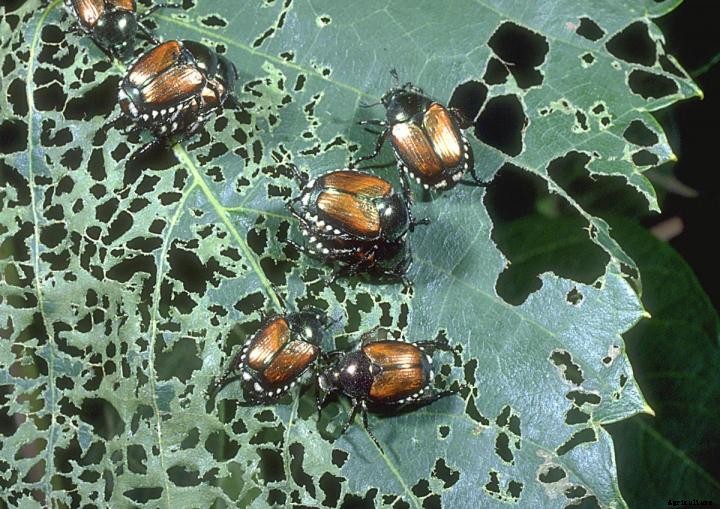
Photo Credit: Ohio State University. Japanese beetles cause leaves to appear skeletonized.
Signs of Japanese Beetle Damage
Japanese beetles feed on a wide variety of flowers and crops (the adult beetles attack more than 300 different kinds of plants), but in terms of garden plants, they are especially common on roses, as well as beans, grapes, and raspberries. Here's what to look out for:
Skeletonized Leaves and Flowers
Japanese beetles chew leaf tissue from between the veins, leaving a lacy skeleton. You'll know right away when you see leaves that are “skeletonized” (i.e., only have veins remaining). (Mexican Bean Beetles can also leave foliage skeletonized, though, so be sure to identify the beetle by their appearance as well.)
Japanese beetles are not usually far from damaged leaves, so inspect the plant thoroughly. Also keep an eye on the ground beneath the plant; the beetles may reflexively drop off the plant if disturbed.
Unhealthy, Brown Patches in Lawn
Japanese beetle grubs damage grass when overwintering in the soil, as they feast on the roots of lawn grasses and garden plants. This can cause brown patches of dead or dying grass to form in the lawn, which will pull up easily thanks to the weakened roots.
Control and Prevention
How to Get Rid of Japanese Beetles
Fortunately, good horticultural practices, including watering and fertilizing, will reduce the impact of the damage caused by these beetles, but often times you simply need to get rid of them. Here are some ideas:
- Hand Pick: Japanese beetles are easy to see and are fairly easy to knock into a can of soapy water. Yes, it's time consuming, but it's also the most effective way to get rid of these pests. Just be diligent. When you pick them off, put them in a solution of 1 tablespoon of liquid dishwashing detergent and water, which will cause them to drown.
- Neem Oil: We also deter feeding by adult beetles by spraying plants with Neem oil. Neem oil and sprays containing potassium bicarbonate are somewhat effective, especially on roses. The adult beetles ingest a chemical in the neem oil and pass it on in their eggs, and the resulting larvae die before they become adults. Note: Neem can be harmful to fish and other aquatic life, so don't use it near lakes, rivers, and ponds. It must be reapplied after rain.
- Row Covers: Protect your plants from Japanese beetles with row covers during the 6- to 8-week feeding period that begins in mid- to late May in the southern U.S. and in mid- to late June in the North. Row covers will keep the pests out, but they will keep pollinators out, too; be sure to remove them if your crops need to be pollinated.
- Use a Dropcloth: Put down a dropcloth and, in the early morning when the beetles are most active, shake them off and dump them into a bucket of soapy water.
- Insecticides: If you wish to spray or dust with insecticides, speak to your local cooperative extension or garden center about approved insecticides in your area.
- Or, try this homemade solution: Mix 1 teaspoon of liquid dishwashing detergent with 1 cup of vegetable oil and shake well; then add it to 1 quart of water. Add 1 cup of rubbing alcohol and shake vigorously to emulsify. Pour this mixture into a spray bottle and use it at ten-day intervals on pests.
Warning: Homemade sprays can run more of a risk of damaging plant leaves, so be careful and use sparingly. It's always a good idea to first test a little bit of your spray on a small part of your plant, wait 24 hours to see if there are any adverse reactions, and—if not—proceed with spraying the rest of the plant.
- Apply sprays in the morning, never in full sun or at temperatures above 90ºF. If your plants start to wilt, rinse the leaves immediately with clean water.
- Japanese Beetle Traps: Yellow target traps baited with a pheromone attractant work to control large numbers of beetles, but sometimes too well. Don't place one near your garden or you'll be pulling beetles in from all over town. If you want to try them, be sure to place traps far away from target plants so that the beetles do not land on your favored flowers and crops on their way to the traps.
- Fruit Cocktail Trap: You can buy Japanese beetle traps of all sorts, but most are no more effective than a can of fruit cocktail. Open the can and let it sit in the sun for a week to ferment. Then place it on top of bricks or wood blocks in a light-colored pail, and fill the pail with water to just below the top of the can. Place the pail about 25 feet from the plants you want to protect. The beetles will head for the sweet bait, fall into the water, and drown. If rain dilutes the bait, start over.
- Use parasitic nematodes in lawns and garden beds for grub control.
- Plant geraniums nearby: Japanese beetles are attracted to geraniums. They eat the blossoms, promptly get dizzy from the natural chemicals in the geranium, fall off the plant, and permit you to dispose of them conveniently with a dustpan and brush. Plant geraniums close to more valuable plants which you wish to save from the ravages of Japanese beetles.
- Nip rose buds and spray rose bushes: Note that insecticides will not fully protect roses, which unfold too fast and are especially attractive to beetles. When beetles are most abundant on roses, nip the buds and spray the bushes to protect the leaves. When the beetles become scarce, let the bushes bloom again. Timeliness and thoroughness of application are very important. Begin treatment as soon as beetles appear, before damage is done.
For rose growers, see our Growing Guide for Roses for more tips on caring for roses!
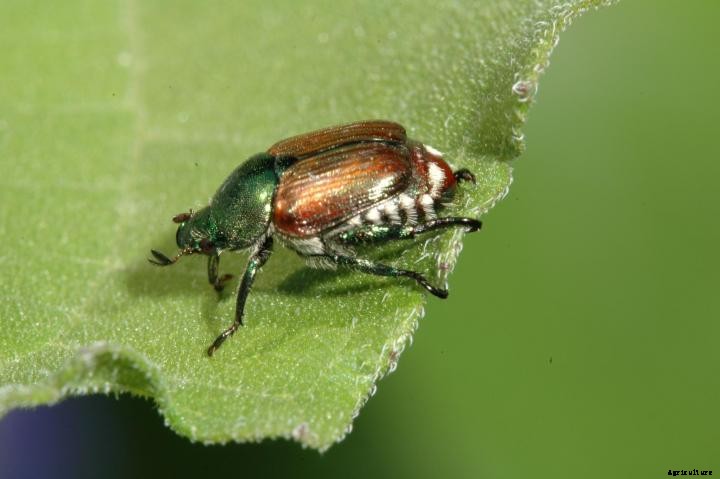
Photo Credit: Jeff Hahn, University of Minnesota. Sometimes the easiest way to get rid of Japanese beetles is to pick them off the plants before they do too much damage.
How to Prevent Japanese Beetles
Unfortunately, there is no magic potion to get rid of this pest. For general preventive maintenance, experts recommend keeping your landscape healthy. Remove diseased and poorly nourished trees as well as any prematurely ripening or diseased fruits, which can attract Japanese beetles. Try these tips:
- Choose the Right Plants: Select plants that Japanese beetles will not be attracted to. See our list of the Best and Worst Plants for Japanese Beetles. Dispersing their favorite plants throughout the landscape, rather than grouping them together, can also help.
- Get Rid of Grubs: In the grub stage of late spring and fall (beetles have two life cycles per season), spray the lawn with 2 tablespoons of liquid dishwashing soap diluted in 1 gallon of water per 1,000 square feet. The grubs will surface and the birds will love you. Spray once each week until no more grubs surface.
- Milky Spore: You can introduce the fungal disease milky spore into your lawn to control the Japanese beetle larvae population. The grubs ingest the spores as they feed in the soil. The spore count must be up for two to three years for this method to be effective. Fortunately, the spores remain viable in the soil for years. This is an expensive treatment, as all the soil within five-eights of a mile needs to be treated for good control.
- Beneficial Nematodes: You can also drench sod with parasitic nematodes to control the larvae. The nematodes must be applied when the grubs are small and if the lawn is irrigated before and after application. Preparations containing the Heterorhabditis species seem to be most effective.
- Plant Strategically: Companion planting can be a useful strategy in preventing pests. Try planting garlic, rue, or tansy near your affected plants to deter Japanese beetles.
- Parasitic Wasps: You can also attract native species of parasitic wasps (Tiphia vernalis or T. popilliavora) and flies to your garden, as they are predators of the beetles and can be beneficial insects. They will probably attack the larvae, but they are not very effective in reducing the overall beetle population.
WARNING: Many dusts or sprays are highly toxic to honeybees, native bees, and other pollinators. If application of these materials to plants is necessary during the bloom period, do not apply during hours when bees are visiting the flowers (late morning through mid-day). If more than just a few yard and garden plantings are to be treated, you may need to contact nearby beekeepers in advance so that they can protect their colonies.


![Where Do Japanese Beetles Go At Night? [And How To Keep Them Away]](https://modernagriculturefarm.com/article/uploadfiles/202211/2022111623301437_S.png)