
Welcome to Modern Agriculture!

Here are tips on how to identify and get rid of Mexican bean beetles.
Found throughout the United States except for the most dry areas, Mexican bean beetles do the same type of damage as Japanese Beetles, leaving skeletons of foliage up and down your garden. Mexican bean beetles look like yellow ladybugs that eat leaves, and they are in fact a relative of the ladybug. Don’t be fooled by the name—although they are partial to beans, they can also affect your pea, beet, squash and tomato crop.
Mexican bean beetles are laid sometime in late spring to early summer. Females will feed for two to three weeks before laying eggs, and they are capable of laying eggs as frequently as every two days. Eggs are generally laid in clusters of 30 to 40. Eggs will hatch one to three weeks later, and larvae will feed on foliage before the pupal stage.
Adult beetles overwinter by burrowing in the soil or leftover plant debris. They usually begin to emerge in early spring when the soil warms, but can also stay hidden and emerge at any time during the summer. Cocooning larvae will rest on the undersides of leaves for 5 days before emerging as an adult beetle.
Identification
Photo Credit: Barbara Pleasant. Mexican bean beetle larvae are yellow and spiny, and their eggs are tiny and yellow.
Mexican bean beetles skeletonize leaves by eating away at tissue from the undersides of the leaves. Usually damage is to the leaves only, but in some cases, Mexican bean beetle damage can result in lower crop yield, or even the demise of plants. Occasionally, larvae will feed on young bean pods.
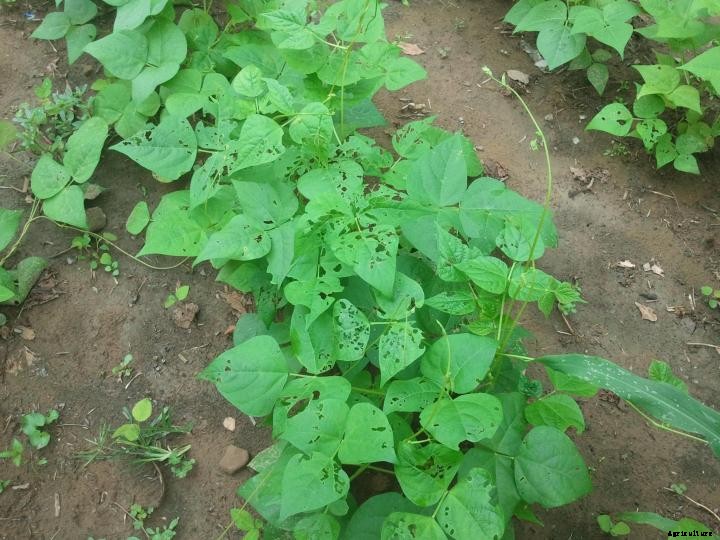
Photo Credit: Berea College. Mexican bean beetles can cause extensive damage to foliage.
Control and Prevention

