
Welcome to Modern Agriculture!

Muscadine grapes (Muscadinia rotundifolia; formerly Vitis rotundifolia) are truly a fruit for the South. Native to the Southeastern United States, they were discovered by the early colonists and have been a favorite fruit of Southerners ever since. Although muscadines can be grown successfully in most parts of the state, they are best adapted from the piedmont to the coastal plain. The severe winters of the mountains hamper production there.
When muscadines are harvested, or when they mature and fall from the vines, the stem separates from the fruit. As it separates, the skin of the fruit may tear causing what is called a wet scar on the fruit, or it may separate with little or no damage to the skin and is called a dry scar. With a wet scar, this tearing of the muscadine skin can allow for the entrance of mold, so these commercially grown fruits are processed quickly into jams, jellies, juice or wine. The dry scar cultivars are commercially grown for sale as fresh market berries for fresh consumption. They will keep longer without spoilage due to the dry scar.
However, for home fruit production, muscadine cultivars are typically chosen for a large berry size, sweet flavor, disease resistance, productivity, and possibly uniform ripening of the fruit on the vines. Generally, the self-fruitful cultivars will have higher productivity than will the female cultivars.
There are many cultivars of muscadines currently available, and some of the better-quality varieties are listed below. Remember, if only one vine will be grown, it must be perfect-flowered to produce fruit.
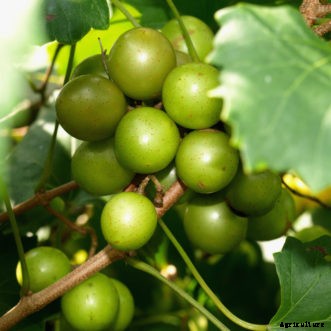
‘Scuppernong’ muscadine fruit become bronze at maturity.
Karen Russ, ©2015 HGIC, Clemson Extension
Perfect-flowered Cultivars: The following cultivars are perfect-flowered types (having both male and female flower parts). A single vine will be self-fruitful.
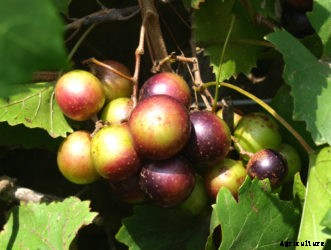
‘Polyanna’ muscadine is a self-fruitful, late season, black muscadine, but has uneven ripening within the clusters.
Karen Russ, ©2015 HGIC, Clemson Extension
Female-flowered Cultivars: The following cultivars are pistillate types (having only female flower parts). A single vine will not produce fruit (i.e., it is self-unfruitful). These varieties must be inter-planted with perfect-flowered cultivars for proper pollination and fruit set to occur.
Choosing a Location: Plant muscadines in a sunny, well-drained location. Muscadines do best when they are in full sun for most of the day. Avoid shaded areas. Fruit set and production will be reduced if the vines are shaded for more than several hours each day during the growing season.
Muscadines do fairly well on most soil types as long as the drainage is good. Plant failure can be expected in locations where water stands for even short periods after heavy rains. Soils with a hardpan are not suitable.
A soil test will determine the fertility and pH of the soil. Follow the recommendations on the report to correct any deficiencies. If lime is needed, use dolomitic limestone and incorporate it before planting to adjust the soil pH to between 6.0 and 6.5. For existing vineyards, apply lime evenly in and between the rows during the fall.
Planting the Vines: One-year-old container-grown plants are preferred. They are hardier and can be planted anytime during the year if irrigation is available. Containerized plants are easier to hold until planting, but bare-root plants are satisfactory if the roots are kept moist (not wet), and the plants are refrigerated until planting time. Bare-root vines should be set in late winter (February or March).
Holes for planting should be large enough to spread the roots without crowding. Plant the vines at the same depth as they grew in the nursery; partially fill the hole with topsoil. Water each vine as it is set. Fill loose soil around the roots and pack firmly as the hole is being filled. Mulch with compost or shredded leaves to retain moisture around the newly set vines.
Training the Vines: The basic framework of a vine consists of the trunk, permanent arms (cordons) and the fruiting spurs. Periodically tie the young cordons to the wire until each is 10 feet long, usually in the second year. To hasten the vines’ development, pinch back the lateral growths on the cordons. Once the framework of trunk and cordons is established and the cordons have developed to full length, the side shoots can be allowed to develop. To maintain this framework, the vines must be pruned each dormant season.
Fertilizing:
First Year: Apply fertilizer three times:
Broadcast each application in an 18-inch circle centered on the vine but keep all fertilizer 6 inches from the stem or trunk. Young vines are very sensitive to excessive nitrogen and will die if the roots take up too much nitrogen at one time. A one pint jar holds one pound of most fertilizers.
Second Year: Timing and method are the same as the first year. Double the rate of fertilizer for each application. Increase the diameter of the broadcast circle to 2 or 3 feet.
Third year: If the vine has grown well the first two years and a crop is expected, apply 2 pounds of 10-10-10 or equivalent per vine in March. Apply 1 pound of 10-10-10 per vine in May. Broadcast in a 6-foot circle. If plants have not grown well, fertilize as instructed for the second year.
Established Vines: Apply 3 to 5 pounds of premium quality 10-10-10 per plant in March of each year. Apply ½ pound of 34-0-0 or 1 pound calcium nitrate around the first of June. Check the soil pH about once every three years through your county Extension office.
Special Fertilization: Muscadine grapes have a relatively high requirement for magnesium. A shortage of magnesium shows up as yellowing between the veins of older leaves. This yellowing progresses up the shoots as the leaves grow older. Premature fruit fall may also result. To prevent or correct magnesium deficiency, apply Epsom salts at the rate of 2 to 4 ounces for 1 and 2 year-old vines. For older vines, apply 4 to 6 ounces. Be sure to broadcast Epsom salts evenly over a 3- to 6- foot area and water it into the soil well.
Irrigation: Muscadine grapes are quite drought-tolerant but should be watered regularly during dry periods the first two years. After this time the vines can usually obtain adequate water from the soil even during dry periods. A coarse, non-nitrogen releasing mulch, such as bark, will also help control weeds and reduce moisture loss from the soil.
Once the vines become established, water requirements are highest from bud-break until flowering. After flowering, watering should be limited to maintain the plant and maturing the fruit without stimulating vigorous vegetative growth.
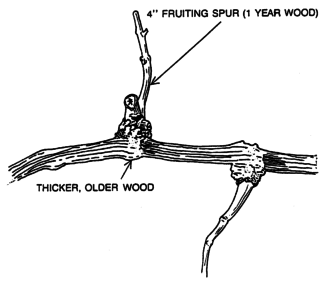
Muscadine fruiting spur
SC Nursery and Landscape Association Certification Manual ©2001. Reprinted with Permission
Pruning: Annual pruning must be severe to keep new fruiting wood coming and to prevent vines from becoming tangled masses of unproductive wood. The basic framework of a vine consists of the trunk, two or four permanent arms (cordons), and the fruiting spurs. Vines must be pruned each dormant season to maintain this framework. Current-season shoots bear the fruit. To be productive, these shoots must arise from buds set on last season’s growth, since shoots from older wood are generally sterile. It is important to leave the correct amount of fruiting wood.
Cut back all of the lateral shoots produced during the previous summer to retain two to four buds or up to six buds on vigorous shoots. Bleeding at pruning wounds may occur, but this has not been shown to harm the vine. Buds on these short shoots, or spurs, will produce new fruit-bearing shoots the following season.
As new shoots are pruned back to spurs in successive years and the spurs give rise to more shoots, a growth which was originally a single spur becomes a many-branched spur cluster. Unless some of the spurs or entire spur clusters are removed, the muscadine vine may become an entangled, unmanageable fruitless mass of shoots and leaves. Remove every other spur cluster on the cordon, or a part of all of the clusters, each year.
Over time, strong new shoots growing from the cordon can be developed into new spurs to replace the older ones. Look for tendrils that have wrapped around the cordons and arms. These tendrils become extremely tough and wiry. Unless they are removed, the tendrils will girdle and kill shoots or cordons.
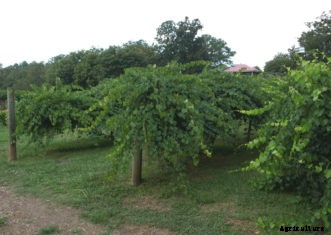
Muscadines growing on a one wire trellis system.
Karen Russ, ©2015 HGIC, Clemson Extension
Muscadine vines may live for decades. Therefore, a strong supporting structure made of materials that will last for many years should be constructed. Wooden posts should be pressure-treated with wood preservatives. The type of trellis selected will often determine where the plant(s) can be established. The goal for either trellis system should be to get the vine on the wire the first growing season and to full length in the second season. A space at least 20 feet long by 6 feet wide should be provided for each vine.
Many types of trellising have been used successfully, but an equal number have been designed by gardeners that have been impractical for long-term management of vines. For example, while growing muscadine vines over a garden arch or a pergola can be aesthetically pleasing and provide shade, management will be difficult, neglect is likely, and fruit production will decline. The one-wire trellis and the double-curtain trellis are the two most common trellises used by gardeners.
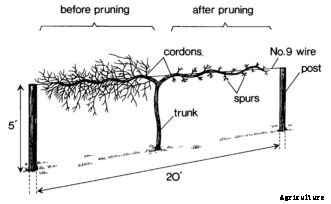
Unpruned (left) and pruned (right) cordons of a mature muscadine grape trained to a one-wire vertical trellis.
SC Nursery and Landscape Association Certification Manual ©2001. Reprinted with Permission
One-Wire Trellis: Use the single-wire trellis system in the lower part of South Carolina because of fruit disease problems. End posts should be 5-or 6-inch pressure-treated, 8-foot long posts. Set them 3 feet deep and angle them slightly away from each other. Line post(s) should be 4 inches in diameter and 7 feet long. Set them 2 feet deep in a vertical position. Use no. 9 galvanized wire to support the vines. Wrap the trellis wire around one end post near the top. Staple it securely several times. Then, run it across the top of the end post and staple it loosely. Next, run the wire over the tops of the line posts. Staple the wire loosely to the tops of these posts. Staple the wire loosely to the top of the other end post. Then, pull the wire tight. Wrap it around the end post and staple it tightly several times. The wire should be 5 feet above and parallel to the ground.
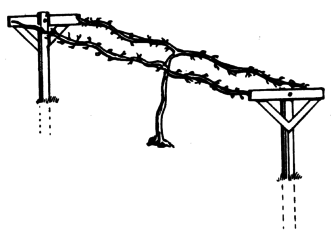
The double-curtain trellis with established vines.
SC Nursery and Landscape Association Certification Manual ©2001. Reprinted with Permission
Double-Curtain Trellis: The double-curtain trellis has two wires 4 feet apart and 5 feet above ground. This permits each vine to produce 40 feet of fruiting arm rather than the conventional 20 feet with the one-wire system. Pressure-treated wood with 4-inch galvanized pipes welded to form the “T” shaped end posts can also be used. The wires should be parallel to the ground.
Occasionally, disease and/or insect infestations may be severe enough to warrant spraying. The most common insect pests are the Japanese beetle, grape berry moth and the grape root borer. There are numerous diseases that can affect muscadines, but the most common are bitter rot, Macrophoma rot, angular leaf spot, ripe rot, powdery mildew, and the leaf spot phase of black rot. Fungal disease severity is increased by dense leaf canopies which maintain high humidity. Canopy modification using proper pruning and fertility management can reduce disease problems. Sprays of captan during May, June, and July should control all diseases except powdery mildew, which can be controlled with sprays of wettable sulfur.

