
Welcome to Modern Agriculture!

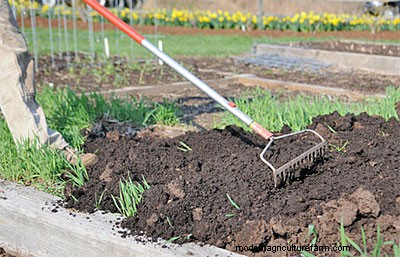
A raised bed being amended with compost in spring. The grassy plant is a cover crop of winter rye, planted in fall, which will be turned in with the compost.
When I think about being a gardener, I usually think about the plants I tend - the flowers, fruit and foliage that delight my eyes and my tastebuds. But plants are really only half the story. As an organic gardener, I also tend an entire world of bacteria, fungi, protozoa, worms, beetles and millipedes.
I once read that a pea-sized clump of soil can contain a billion bacteria. A shovel-full of good garden soil may contain more microscopic organisms than there are people on the earth! As a gardener, I want to do whatever I can to keep this unseen world of organisms happy. When there are a lot of them and they're doing their thing down in the soil, they keep my garden free of disease and pests, and give my plants exactly what they need to be lush, beautiful and abundant.
Are all microbes beneficial? No. There are "bad" bacteria and fungus that cause root rot, damping off, wilt and blights. But I've found that if you do everything you can to encourage the good guys, they'll win out.
Fungi help decompose organic matter and feed on insects and other soil organisms. They also improve soil structure by binding soil particles with multi-celled "webs" called mycelium. Some fungi form a symbiotic relationship with plant roots, called mycorrhizae. Many kinds of plants require mycorrhizae in order to absorb the nutrients they need for healthy growth. These relationships between fungi and plant roots have developed over millions of years. There are hundreds of different kinds of mycorrhizae, each specially adapted to a certain type of plant. A rich diversity of microbes ensures the right ones are there to get the job done.
Bacteria are single-celled organisms. Some play in important role in decomposing organic matter, and others produce natural antibiotics that inhibit disease organisms. Many types of beneficial soil bacteria are able to absorb nitrogen from the air and when they die, they make the nitrogen available to plants. Some "nitrogen-fixing" bacteria form a symbiotic relationship with plants, living in tiny nodules attached to the roots. Peas and beans are two of the many kinds of plants that require nitrogen-fixing bacteria for healthy growth.
So what can you do this spring to nurture this mind-boggling population of beneficial organisms in your soil?
As you head out into your garden this spring and stick your spade into the soil, think about the billions of microorganisms waking up beneath your clogs. Take a minute to fluff up the soil, give them some compost and some organic fertilizer. Treat them right and they'll make you look like you've got the greenest thumb in town!


