Persimmons are yellow to deep orange fruits — berries, in fact — that people all over the world value for their sweet but mild and pleasant taste. These fruits grow on trees of the Ebenaceae family and Diospyros genus. While this same genus, which has over 700 known species, also counts heavy timber trees most commonly called ebony trees among its members, those species that produce persimmons are typically simply called persimmon trees.
More than 400 persimmon cultivars are currently being grown. The most well-known persimmon trees are, on the other hand, Diospyros kaki (also called the Asian persimmon tree, Oriental persimmon tree, or Japanese persimmon tree) and Diospyros virginiana (more commonly called the American persimmon tree or common persimmon tree).
Adding a new tree can truly make your garden come to life — and the fact that persimmon trees bear pleasant, sweet, fruits makes the thought of growing your very own persimmon tree all the more exciting! Nonetheless, persimmon trees have special care requirements, and they do not tolerate all climate conditions.
Persimmon trees are slow-growing trees. If you’d like to be rewarded with beautiful fresh persimmons, which can be dried for later consumption, you will have to wait as long as seven to 10 years if you have decided to add a cutting to your garden.
Thankfully, their fruit is not the persimmon tree’s only appeal — these trees are also attractive as ornamental elements in any garden.
About the Persimmon Tree
- Both of the most popular species of persimmon trees, Diospyros kaki and Diospyros virginiana are beautiful deciduous trees with rounded crowns. American persimmon trees are, on the whole, slightly taller than Asian persimmon trees.
- Persimmon fruits are packed with nutrients and antioxidants. This has, in combination with their taste, made them a popular treat in their native regions, leading cultivators to create brand new variations. Today, there are many variants of the persimmon tree, some of which include the Saijo, which produces especially sweet permissons, and the chocolate persimmon tree, which is darker than other persimmons and tastes slightly like cocoa.
- The Diospyros kaki tree is native to Asian countries like Korea, Japan, and China. However, an American varient of the persimmon tree known as Diospyros virginiana can be found in the eastern and northern regions of America, and is much less common than the Asian persimmon tree.
- This slow-growing tree takes a surprising amount of time to mature — keen gardeners will have to be patient for up to 10 years before their persimmon tree is able to grow fruits! In the meantime, they can simply enjoy the view and the love and care they pour into their tree.
- Just like a lot of other fruit trees, for your persimmon tree to thrive it will need to receive full sunlight.
- Persimmon trees do best with slightly acidic soil and they love loam soil, though they can do well in a variety of conditions. However, one type of soil that this tree definitely does not like is soil that is salty soil.
- Wild persimmon trees have a long lifespan and can survive for around 70 years.
- Persimmon trees can be both astringent and non-astringent. The Diospyros kaki species is astringent, which means that the fruit it bears tastes sour until it is fully ripened.
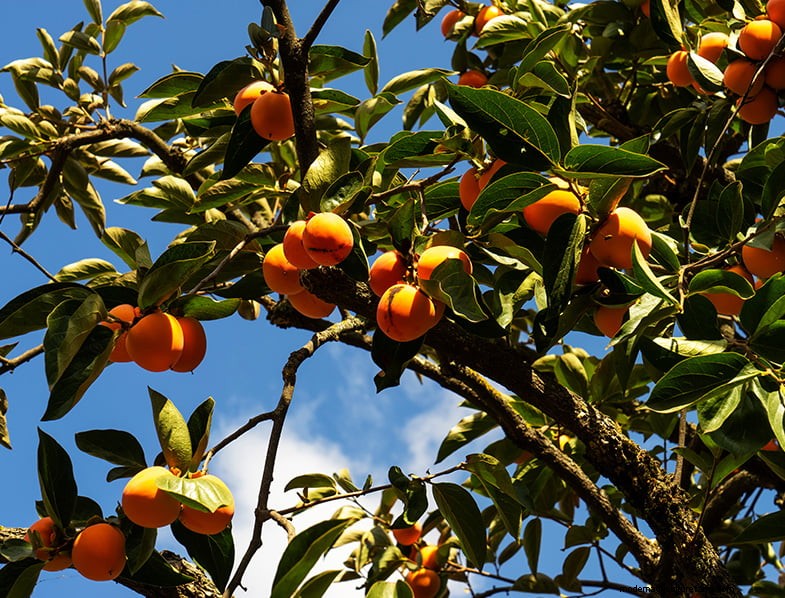
- Once mature, a persimmon will begin bearing fruit. The fact that persimmons can remain on the tree well into the fall period, long after the leaves have shed, make it especially festive.
- The genus persimmon trees belong to, Diospyros, combines the two Greek words dios (“God”) and “fruit”. As such, Diospyros roughly translates to “divine fruit”. Whether or not you personally love the taste of persimmons, you’ll be able to agree that the trees from which these fruits come are beautiful.
Persimmon Tree
Persimmon Tree Features: An Overview
- The genus that persimmon to Diospyros, counts many members. It’s no surprise that persimmon trees, which are deciduous, can vary widely in appearance, then. American persimmon trees have a characteristic dark gray bark that divides into squares. Asian persimmon trees are diverse; their bark can range from light gray to deep brown, as well as black.
- The leaves of the persimmon tree are known to be glossy and have a dark, rich, green color during the spring and summer. However, when the fall rolls around, persimmon trees undergo a dramatic transformation as their dark green turn to a beautiful deep orange and yellow tones. Not only do these leaves look pretty, but they are non-toxic and can even be used to make tasty tea that is incredibly rich in vitamin C!
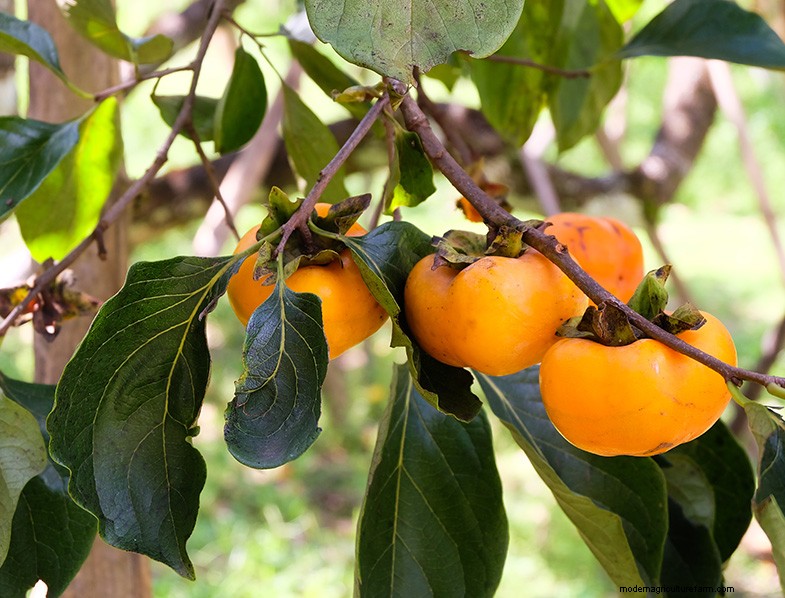
- The persimmon tree is unquestionably an aesthetically-pleasing one. Its best feature, however, is unquestionably the fact that it gives rise to persimmon fruits — which are small fruits that visually stand out for their bright orange color and beautiful flavor. The persimmon fruit is a berry. It is usually orange, but some species of persimmon trees produce yellow persimmon fruits. While mostly small, the persimmon can come in larger sizes too. When this fruit is ripe, it is described as having an especially sweet and rich taste. Many people describe the taste of persimmons as similar to honey, with a fibrous texture which is similar to apricots. Persimmon is also very nutritious, making it a fruit you’ll definitely want to grow.
- The Asian persimmon tree (Diospyros kaki) can grow to be around 25 to 30 feet tall. The American persimmon tree (Diospyros virginiana) doesn’t typically grow to be taller than 30 feet, but can be as tall as 80 feet in the proper environment!
- The persimmon tree itself, which is a member of the Ebony family, has rather strong and dark wood that can be used for in a variety of practical applications, like flooring and furniture. The bark has a very pretty shade and the texture itself looks rather nice.
- The persimmon tree will reward you for your care with pretty flowers that can have a creamy yellow, pink, orange, or white color in the springtime, depending on the precise species of persimmon tree you have in your garden. These flowers also attract bees!
- While some people might want to grow a persimmon tree for its fruits, these trees also make for an amazing decorative element, with its pretty leaves, flower, and bark. Although fairly unusual, some people opt to grow persimmon trees in pots indoors. This is challenging but possible if you are committed to providing the best possible environment, and are willing to prune your persimmon tree regularly.
Growing Persimmon Trees
Growing persimmon trees is a rather time-consuming process that comes with a hefty learning curve — but the love and care you shower on your persimmon tree is absolutely worth your while. That is not just because a persimmon tree that receives the right care will eventually bear tasty fruit, but also because a persimmon tree will instantly make your garden look prettier, even when it is young and small.
To successfully grow a persimmon tree in your garden, it is essential to select the right species. Asian persimmon trees do not tolerate temperatures below 10 °F (-12 10°C), while American persimmon trees are hardier and easily withstand freezing conditions of up to -25 °F (-31 10°C), as well as much warmer temperatures. American persimmon trees can even grow in desert conditions, although they are sadly unlikely to offer you tasty fruits in that case.
Like most fruit trees, persimmon trees need full sun to thrive. Partial afternoon shade won’t harm your persimmon tree one bit, but do keep in mind that persimmon trees bear fruit in the fall period — and will need plenty of bright sunlight during the late summer.
As you are choosing the right area to plant a persimmon tree, try to pick a spot that drains well where water will not build up. Persimmon trees do find in most types of soil but if you want to ensure your persimmon tree grows the best it can, you would be advised to pick loamy and moist soil.
SaleBestseller No. 2
Perfect Plants Fuyu Asian Persimmon Tree, Live Plant (3-4 ft.)
- The Fuyu Persimmon is a non-astringent, sweet, delicious treat
- This Persimmon will bear fruit within 1-2 years of being planted in the ground.
- The fuyu persimmon is easy to care for onces established, so it is a perfect choice for any sunny yard
- This persimmon is self-pollinating, and gets an acorn shaped red-orange fruit that can be eaten right off the tree.
- The tree itself gets beautiful green leaves during the spring and summer, and loses its leaves during the spring/fall.
Last update on 2025-11-30 / Affiliate links / Images from Amazon Product Advertising API
When it comes to fertilizer, your persimmon tree will generally be able to grow into a strong and healthy tree even if it is not fertilized. To help your young persimmon tree grow, you may wish to feed it fertilizer around three times a year during its first two years. After that, you will want to fertilize your persimmon tree only once a year with a low nitrogen fertilizer, unless your garden’s soil is especially nutrient-poor.
In terms of other required care, you are also recommended to prune your persimmon tree when you notice that your tree is getting messy and untidy. It’s best to prune persimmon trees during the winter months, between December and February, at which time you will not be interfering with their growth. Pruning a young persimmon tree regularly gives the tree the best possible chance of growing into a strong and healthy mature tree. If you already have a mature persimmon tree, meanwhile, you will need to remove dead branches, primarily for your own safety.
If your persimmon trees do bear fruit — exciting! — it is best to harvest the persimmons they produce during the months of September and November. Make sure to refrain from harvesting your persimmon trees while their fruits are not ripe yet. Though you may be tired of waiting and tempted to get your hands on a reward you may have been waiting for a whole decade after planting your persimmon sapling, it’s worth it waiting for these fruits to ripen as they taste rather bitter and unpleasant in their unripe state.
Watering Persimmon Trees
Young persimmon trees, and saplings that were recently transplanted, will need moderately moist soil to be able to grow. They will usually have to be watered at least weekly.
Mature persimmon trees tolerate dryer climates well. After your persimmon tree is planted and doing well, it usually will not need extra watering. However, if you are attempting to grow a persimmon tree in a desert climate, or you are experiencing an unusually dry summer, you may have to consider water your persimmon tree weekly. Other than that though, persimmon trees will not need watering after they are planted.
Propagating Persimmon Trees
It is technically possible to propagate persimmon trees from seed. Because the results of this endeavor are unpredictable, experienced gardeners generally strongly recommend that you don’t do this; the persimmon tree you end up with will differ significantly from the parent tree.
The best and most reliable approach to propagating persimmon tree is through stem cuttings or through grafting, which will offer you a clone of the parent tree.
To propagating a persimmon tree using the stem cuttings method, follow these steps:
- Water the persimmon tree from which you are intending to take a cutting two days beforehand to ensure that the cutting has the best chance.
- Cut a five to six inch stem from a one-year stem with sharp pruning shears. The stem you take the cutting from should be fairly hard. After taking the cutting, make a one-inch vertical cut at the base.
- Place the cutting in a container that can drain well. Water it so the rich soil you have chosen for your cutting is moist, and cover the persimmon cutting with a plastic covering.
- Cuttings need plenty of light, and a grow light will assist your cutting as it takes root.
- Once roots start growing, your persimmon cutting can be transplanted.
Persimmon trees
In Conclusion
Persimmon trees will brighten your garden, attract bees and other insects, and reward you with tasty fruits. Although adding a new tree to your garden, especially from a cutting, can be daunting, the right species of persimmon tree will do well in your garden. So long as you choose wisely, you can look forward to a tree that is likely to stay with you through countless seasons.
96