
Welcome to Modern Agriculture!

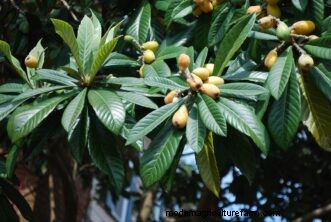
Loquat (Eriobotrya japonica) bears handsome, textured leaves and edible springtime fruit.
Robert F. Polomski, ©2025 Clemson Extension
Loquat (Eriobotrya japonica), also called Chinese plum and Japanese plum, is a large subtropical evergreen shrub or small tree in the rose family (Rosaceae) that is native to China. It has been cultivated for over 2,000 years for its delicious fruits, and its dried leaves and flowers have been used in traditional Chinese medicine.
Introduced from China, loquats have been bred and cultivated in Japan for over 1,000 years. Loquat was first sold in the U.S. in Philadelphia in 1824 by nurserymen David and Cuthbert Landreth, listed as Mespilus japonica in their 1824 Catalogue of Garden Seeds.
From October 1859 to March 1863, Pomaria Nurseries in Pomaria, South Carolina, grew and sold loquats. Perhaps its wrinkled, tropical-looking leaves, extremely fragrant mid- to late fall flowers, tasty spring fruit, and year-round exfoliating bark contributed to its popularity among gardeners.
Loquat trees are cold hardy to 12 °F, but flowers and developing fruit can be killed when temperatures drop to 27 °F. Winter survival is affected by the cultivar, its provenance or origin (birthplace), and its location in the landscape. Expect increased tolerance to low temperatures in well-established, acclimatized trees that are well-watered in the fall and sited in areas protected from winter morning sun.
Loquat is an evergreen shrub or small tree that can grow typically 10 to 20 feet tall but can grow up to 30 feet. Depending on its location, it may develop a narrow, upright crown in the shade, or a round to vase-shaped canopy equal to its height in full sun. Loquat produces multiple flushes of new wooly leaves and twigs, averaging about 2 feet of growth per year.
The broad, tropical-looking loquat leaves grow 6 to 12 inches long and 3 to 5 inches wide with a coarsely toothed margin. The shiny green leaves have deeply impressed veins that give them a quilted look. The light green undersides have soft, whitish or rust-colored hairs, especially pronounced on the veins.
Loquat trees flower in the fall, bearing clusters of white, fragrant flowers. After fertilization, fruit takes four to five months before ripening in the spring. Loquat fruits, called pomes, may be yellow to orange with white, yellow, or orange pulp. Some fruit may contain one or more large seeds. Harvest ripe fruit, as no further ripening will occur after it is picked. Consume the raw fruit or process it into jellies, jams, preserves, and pies.
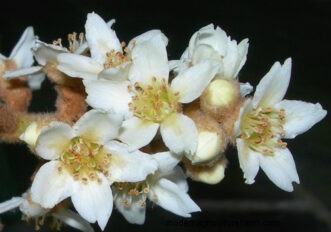
Loquats produce panicles of 6 to 20 flowers at the ends of their branches in the fall. Each self-fertile, bisexual flower measures 0.5 to 0.75 inch in diameter.
Susan James ©2016, Clemson Extension
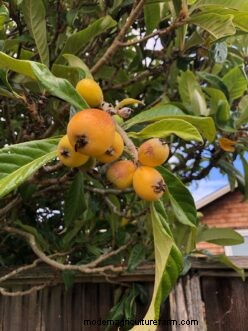
The ripe yellow to orange plum-like loquat fruits ripen in April and May.
Justine A. Polomski, ©2025 Used with permission
Loquat can be used as a stand-alone specimen, perhaps near a patio or an outdoor entertaining area where it functions as an evergreen privacy screen. Loquat will accentuate flower borders comprised of woody and herbaceous plants. It can also be trellised or espaliered against a wall.
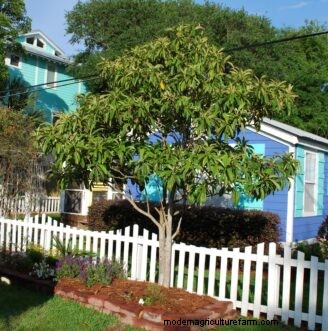
With selective pruning, loquat can be limbed up into a tree form and used as an accent in a border.
Robert F. Polomski, ©2025 Clemson Extension
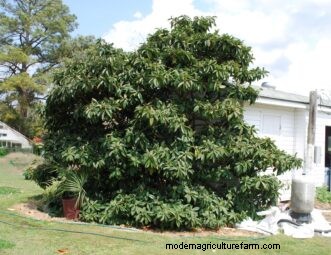
An unpruned loquat becomes an informal evergreen screen.
Robert F. Polomski, ©2025 Clemson Extension
Loquat prefers full sun to part shade and well-drained soil. Fertilize based on need and according to soil test results. For more information on fertilizing, refer to HGIC 1000, Fertilizing Trees & Shrubs.
Care Tip: Summer temperatures above 95 °F and prolonged periods of limited rainfall may cause leaf scorch, branch dieback, and other heat- and drought-induced injury. Maintain a two- to three-inch layer of organic mulch and water when drought stress occurs.
Most loquats are self-fertile and produce fruit without a pollenizer, but cross-pollination with a different cultivar will result in improved fruit quantity and quality. To increase flower production, train loquats to a modified central leader, similar to apples and pears. Refer to HGIC 1351, Pruning & Training Apple & Pear Trees. Alternatively, consider the open-center system to admit more sunlight inside the canopy. Refer to HGIC 1355, Pruning Peaches & Nectarines.
Cold Weather Care: In growing areas where cold temperatures damage loquats, postpone pruning until new shoots emerge. Remove dead and injured wood by cutting just above the young growth.
Loquat can be reproduced from seed, but it must be sown immediately after harvesting the mature fruit. The resulting seedlings will not come true to type (similar to the parents), and their landscape performance and fruit quality will be unpredictable. Finally, it often takes seed-grown loquats six to eight years to flower.
Loquat cuttings are difficult to root. Collect semi-hardwood cuttings when the new green growth begins to harden and turn brown, typically in June and July. When the twig is snapped, bark often clings to the stem. Alternatively, graft desirable cultivars onto seed-grown loquat rootstocks.
Loquats are susceptible to fire blight (Erwinia amylovora), a bacterial disease that infects flowers in the fall or young succulent shoots in the spring. It spreads by rain and insects, such as bees, ants, flies, aphids, and beetles. Manage this disease by promptly removing and discarding the diseased parts by pruning 12 to 18 inches below any infected tissue. Disinfect pruning tools between cuts to discourage the spread of the disease. Avoid excessive nitrogen fertilization that encourages succulent, fire blight-susceptible new growth.
For more on fire blight, see HGIC 2208, Fire Blight in Fruit Trees.
The following list comprises a few commercially available cultivars for home landscapes.
Originally published 10/16
If this document didn’t answer your questions, please contact HGIC at hgic@clemson.edu or 1-888-656-9988.


