Quick Guide: South Carolina Persimmons at a Glance
Native Persimmons (Diospyros virginiana)
- More cold-hardy than Oriental persimmons
- Survive –20 °F to –25 °F
- Fruit: Smaller, seedier, more astringent until soft
- Many trees are seedlings; fruit quality varies
- Typically dioecious (need male + female trees for fruit)
Oriental Persimmons (Diospyros kaki)
- Introduced to U.S. ~100 years ago
- Generally superior fruit quality
- Survive to about 10 °F
- Astringent types must be soft before eating
- Non-astringent types can be eaten firm
- Fruit size: Often peach-sized
- Usually self-fruitful; does not need cross-pollination
- Best cold-hardy cultivars for SC above the Fall Line:
Great Wall, Korean, Sheng
Fruit Notes
- Persimmons continue to ripen after picking
- Frost is not required and can ruin immature fruit
Tree Size & Care
- Native trees mature to 30 to 40 feet
- Oriental varieties are slightly smaller
- Minimal fertilization needed
- Minimal pruning: remove dead, injured, or crossing branches
Common Pests
- Scale
- Persimmon psyllid
- Leafrolling caterpillars
- Defoliating caterpillars
- Persimmon borer (monitor closely)
Common Diseases
- Fungal leaf spot
- Twig dieback
- Powdery mildew
Important Note
- Chemical control on large trees is usually not feasible due to limited spray coverage.
Native vs. Oriental Persimmons
Persimmons can be divided into two distinct groups: the native persimmon (Diospyros virginiana) and the Oriental persimmon (D. kaki). The fruit from native varieties tends to be smaller, seedier, and more astringent until it is ripe.
Many native persimmons are seedling trees, and as a result, the quality of the fruit may vary widely. However, several native persimmons have been selected, named and are available for purchase.
Oriental persimmons were introduced into the United States about a hundred years ago. As a general rule, their fruit is superior in quality to native persimmons.
Native persimmons are more cold hardy than Oriental varieties. The native varieties may survive temperatures of 20 to 25 °F below zero. In contrast, Oriental varieties may be killed or injured when temperatures fall below about 10 °F, especially after a warm period in the winter.
Growers above the “fall line” in South Carolina (the border between the Piedmont and the Sandhills and Ridge) should select the varieties Great Wall, Korean or Sheng when planting Oriental persimmons (see table, next page). These are the most cold-tolerant of the Oriental varieties.
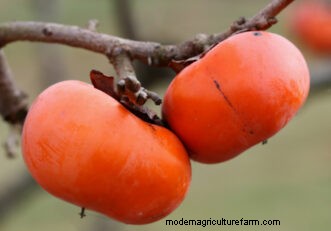
Oriental persimmons (Diospyros kaki) are ready for harvest.
Joey Williamson, ©2015 HGIC, Clemson Extension
Astringent vs. Non-Astringent Persimmons
Oriental persimmons are subdivided into two classes: the astringent and the non-astringent. The astringent type should be completely soft before eating. The non-astringent types are firmer and can be eaten prior to softening.
Oriental persimmon fruit may reach the size of a peach. The native varieties produce fruit that is closer to the size of a plum.
Most native varieties must be completely ripe and soft before they lose enough astringency to be eaten. Persimmons will continue to ripen after they are picked from the tree.
It is a misconception that frost is required for persimmons to be edible. In fact, frost will ruin immature fruit on the tree.
Pollination and Flower Types
Native persimmons are typically dioecious, meaning they produce either male or female flowers. Rarely are native persimmons self-pollinating. Both male and female trees are required to produce a full crop.
Oriental persimmons may produce male, female and/or perfect flowers on the same tree and do not need cross-pollination to set fruit.
Native and Oriental persimmons will not cross-pollinate.
Persimmon Tree Size, Fertilization, and Pruning in South Carolina
Tree Size
A mature native persimmon tree may reach a height of 30 to 40 feet. Oriental varieties will be slightly shorter.
Fertilization
Little fertilization is required. Normal lawn fertilization is usually adequate if the tree is growing in the landscape.
Pruning
Pruning is also minimal. Remove dead or injured branches and any branches growing in a crossing pattern.
Common Persimmon Pests and Diseases in South Carolina
Common Insect Pests
Insect pests of persimmons include:
- Scale
- Persimmon psyllid
- Leafrolling and defoliating caterpillars
- Persimmon borer
It is important to monitor the persimmon borer. If borer damage is noted on the trunk or exposed roots, treatment may be required.
Common Diseases
Persimmon diseases include:
- Fungal leaf spot
- Twig dieback
- Powdery mildew
Note: Chemical control of diseases and insects on large trees is usually not feasible since adequate coverage of the foliage with a pesticide cannot be achieved.
Recommended Persimmon Cultivars for South Carolina
Native Persimmon Cultivars for South Carolina
Variety
Characteristics
Early Golden
Productive with medium-sized fruit containing 3 to 8 seeds. Excellent quality, firmness.
John Rick
Productive, excellent flavor and firmness with 2 to 8 seeds.
Killen
Good flavor and firm fruit. Medium-sized and moderately productive.
Miller
Productive, good flavor. Large, firm fruit.
Garretson
Productive, seeded. Excellent quality.
Oriental1 Persimmon Cultivars for South Carolina
Variety
Characteristics
Eureka
Heavy producer with flat, quality, red fruit. Self-fruitful, making a small tree. Astringent until ripe.
Fuyu
Medium-sized, red, somewhat square fruit. Non-astringent while firm; self-fruitful.
Great Wall
Vigorous trees with flat, small, orange-red fruit. Astringent until ripe.
Hana Fuyu
Large, round, yellow-orange-red fruit. Non-astringent with good quality. Moderately vigorous trees and productive.
Jiro
Large, round, yellow-orange fruit. Non-astringent with good quality. Moderately vigorous trees and productive.
Korean
Trees are vigorous and moderately productive. Astringent until ripe.
Sheng
Moderately vigorous and productive trees with flat, large, orange fruit. Astringent until ripe.
Tanenashi
Large, cone-shaped, orange-yellow fruit without seed. Trees are moderately vigorous. Fruit ripens early and is astringent until ripe.
¹Non-astringent varieties may suffer cold injury north of the fall line (the border between the Piedmont and the Sandhills and Ridge).
References
- Excerpted from the South Carolina Master Gardener Training Manual, EC 678.
- https://plants.ces.ncsu.edu/plants/diospyros-virginiana/
- https://plants.ces.ncsu.edu/plants/diospyros-kaki/
- https://fieldreport.caes.uga.edu/publications/C784/home-garden-persimmons/
Document last updated on 12/25 by Jordan Franklin.
Originally published 09/99
If this document didn’t answer your questions, please contact HGIC at hgic@clemson.edu or 1-888-656-9988.