![Silver White Garlic: Planting, Growing & Care Guide | [Your Brand/Website]](https://modernagriculturefarm.com/article/uploadfiles/202605/2026050823273596_S.jpg)
Welcome to Modern Agriculture!

Hi GPODers!
Summer’s peak color season is upon us, but rising temperatures can turn gardening into a tedious task. Tingshu Hu, a seasoned gardener in Dunstable, Massachusetts, demonstrates how a vivid, low‑maintenance landscape can thrive with minimal effort.
With over a decade of hands‑on experience, Tingshu has shared a series of vibrant photo essays on GPOD—such as “Tingshu’s Back Garden in Late Summer,” “Tingshu’s Low‑Maintenance Garden in Massachusetts,” and many more. In this post, she highlights the specific flowers that keep her garden radiant from late spring through early summer.
I would like to share some pictures of some low maintenance flowers in late spring and early summer in my garden.
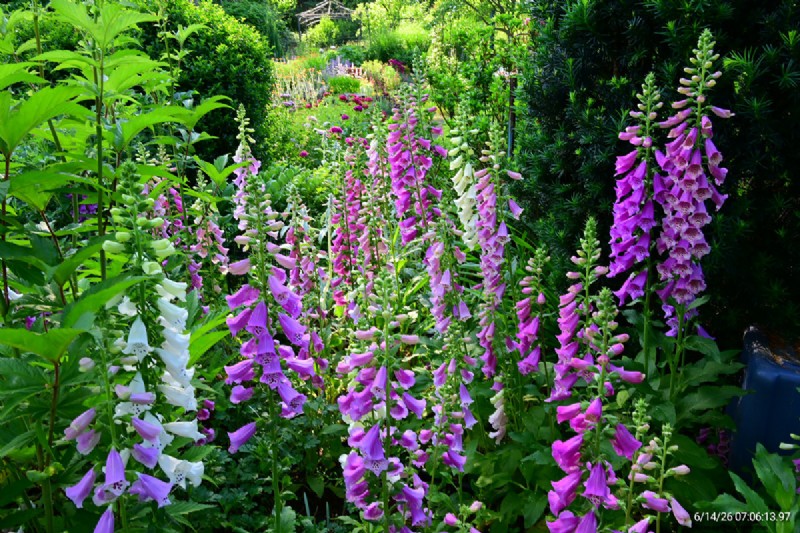 Foxglove (Digitalis purpurea, Zones 4–9) are biennials that persist year after year through self‑seeding. I prune spent spikes early, leaving a few blooms at the top, to reduce seed spread and encourage smaller, secondary flowers. The taller plants to the left are queen of prairie (Filipendula rubra, Zones 4–7), which will begin blooming shortly after the foxgloves.
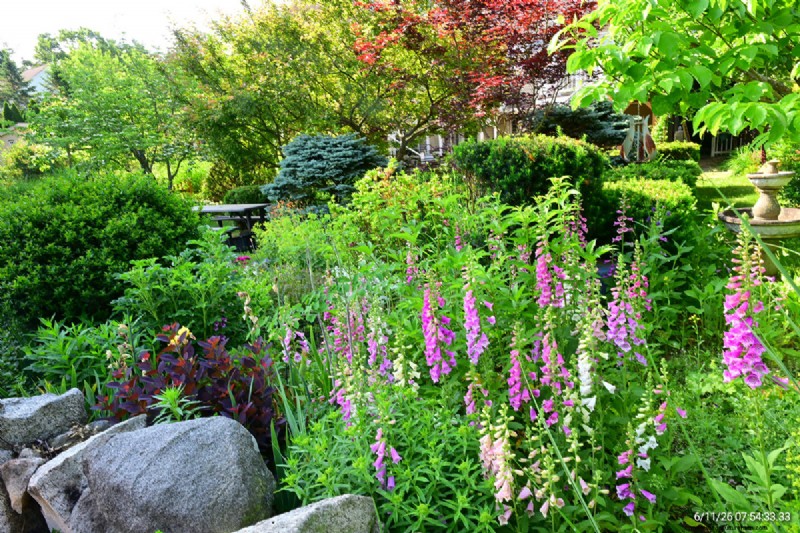 Alongside the foxgloves grow queen of prairie, meadow rue, tall phlox (Phlox paniculata, Zones 4–8), orange milkweed (Asclepias tuberosa, Zones 3–9), and hardy chrysanthemum. After the foxglove flush ends, these companions keep the palette lively. The purple smoke bush (Cotinus coggygria ‘Royal Purple’, Zones 4–10) delivers constant bloom, and the corner of the heritage stone wall anchors the composition.
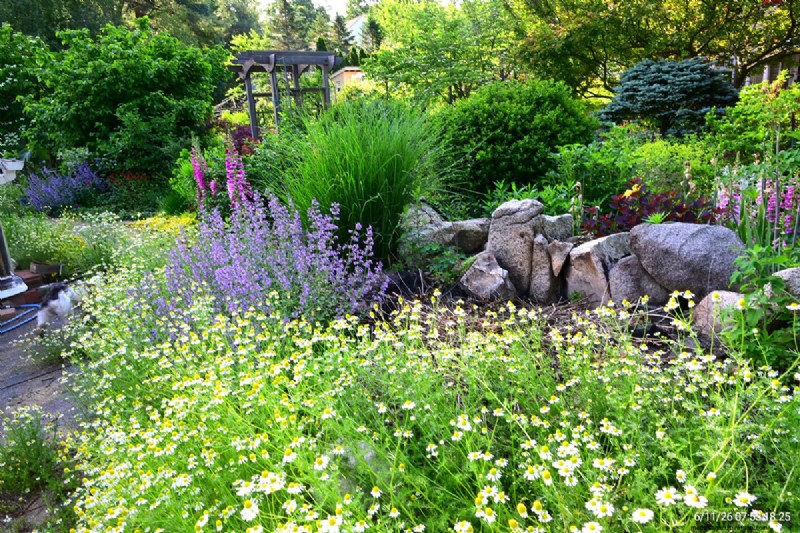 Across the stone wall, German chamomile (Matricaria chamomilla, annual) mixes with catmint and more foxglove. I sowed chamomile seeds three years ago; self‑seeding obligates them to return annually. I harvest the blossoms for tea and prune stems to stimulate further flowering. Notably, Toby’s butt—our resident Havanese dog—can be spotted on the left.
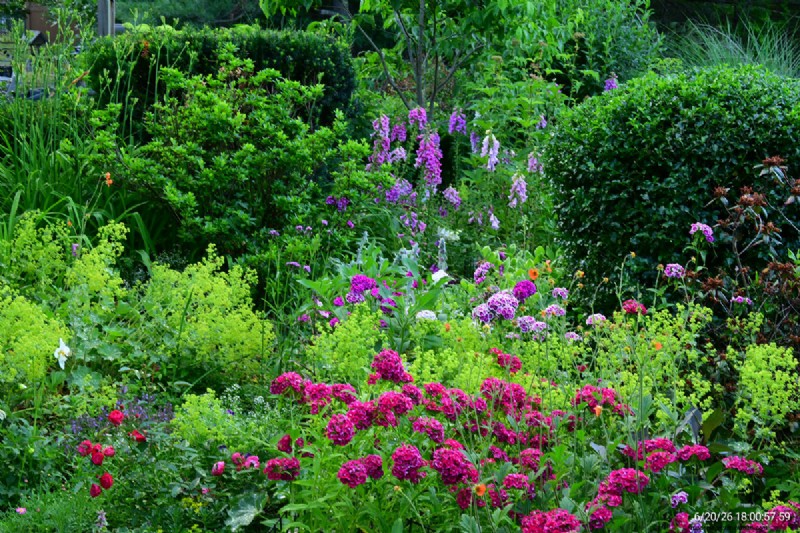 From a different angle, a cluster of foxgloves showcases several sweet William (Dianthus barbatus, Zones 3–9) varieties mingling with lady’s mantle (Alchemilla mollis, Zones 3–8) and a few remaining Totally Tangerine geum (Geum ‘Totally Tangerine’, Zones 5–7). The lower corner features a small rose bush, a white‑flowered dahlia, and a pink argyranthemum that has just begun blooming. Centrally, tall verbena (Verbena bonariensis, Zones 7–11) bursts with purple flowers.
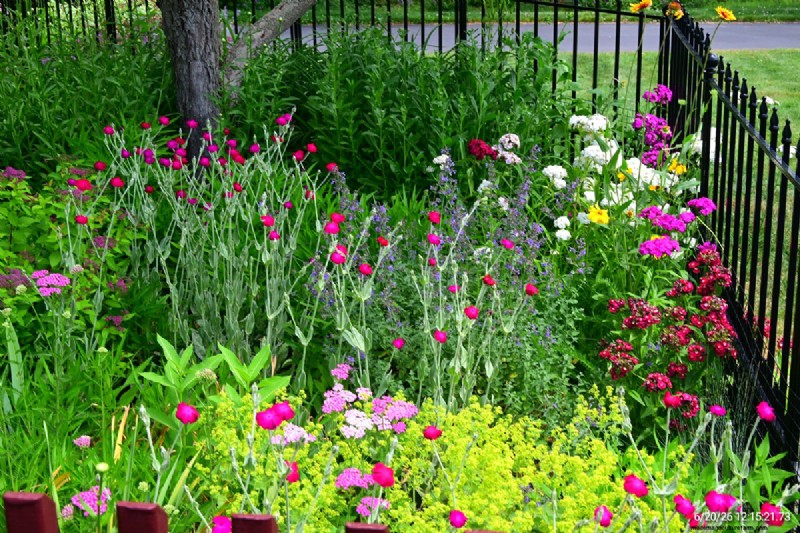 Rose campions (Silene coronaria, Zones 4–10) just started to bloom. They are also biennials that persist through self‑seeding. On the right side by the fence, several sweet William varieties and yellow coreopsis are displayed, while pink yarrow, surrounded by lady’s mantle, adds a touch of elegance.
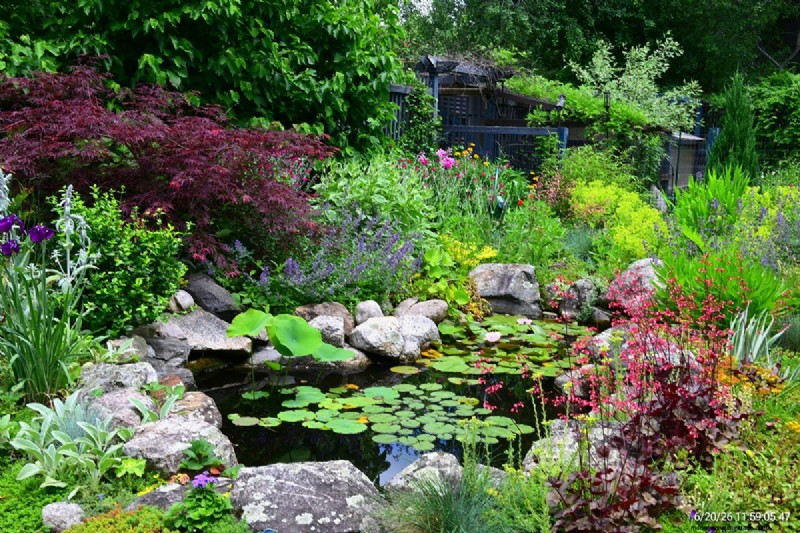 A Japanese iris (Iris ensata, Zones 4–9) with purple flowers stands by the left side of the fish pond. The pond’s perimeter hosts euonymus, a Japanese maple tree (Acer palmatum, Zones 5–8), catmint, red twig dogwood (Cornus sericea, Zones 3–7), peony, rose campion, coral bells, lamb’s ear (Stachys byzantina, Zones 4–8), blue fescue (Festuca glauca, Zones 4–8), floss flower (Ageratum houstonianum, annual), black‑eyed Susan (Rudbeckia hirta, Zones 3–8), northern sea oats (Chasmanthium latifolium, Zones 4–9), and several sedum ground covers. Beyond the blue fence lies the chicken yard.
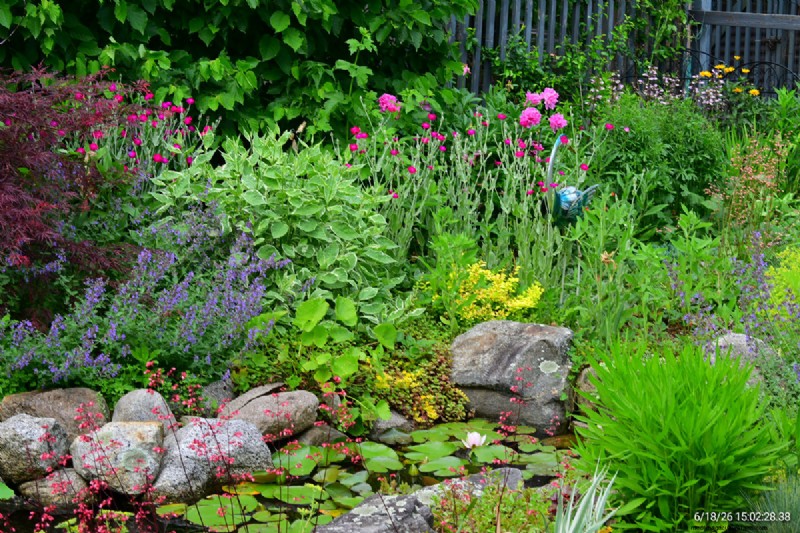 A close‑up of the previous scene shows, in the foreground, purple penstemon and orange false sunflowers (Heliopsis helianthoides, Zones 3–9) beyond the blue fence.
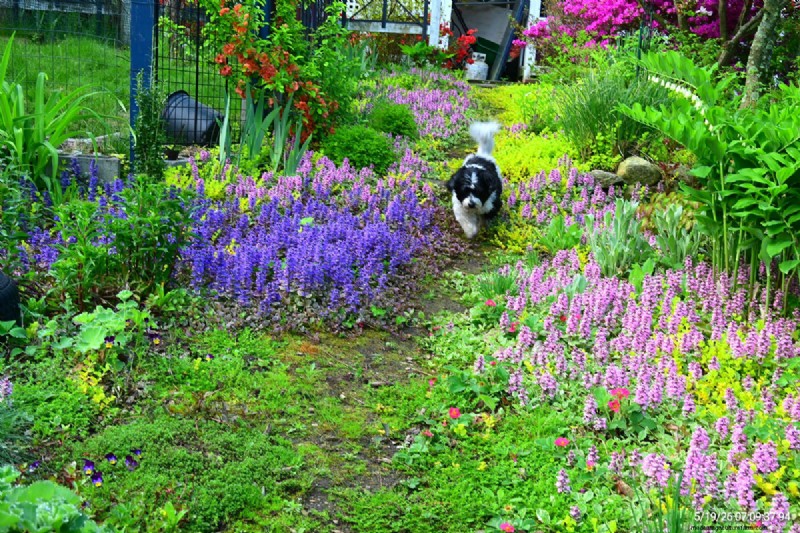 Luke walked down a gentle slope covered with ajuga and creeping Jenny (Lysimachia nummularia, Zones 3–8). Random bursts of cheerful red strawberry flowers appear. The fenced lawn on the top left belongs to the chickens. Luke, a Havanese dog, was diagnosed with diabetes a year ago and went blind shortly after. After half a year of treatment, he regained his vision and has been diabetes‑free for nearly seven months. A story about Luke’s recovery was posted on GPOD on 1/6/2026 (Luke and Toby in Tingshu’s Garden).
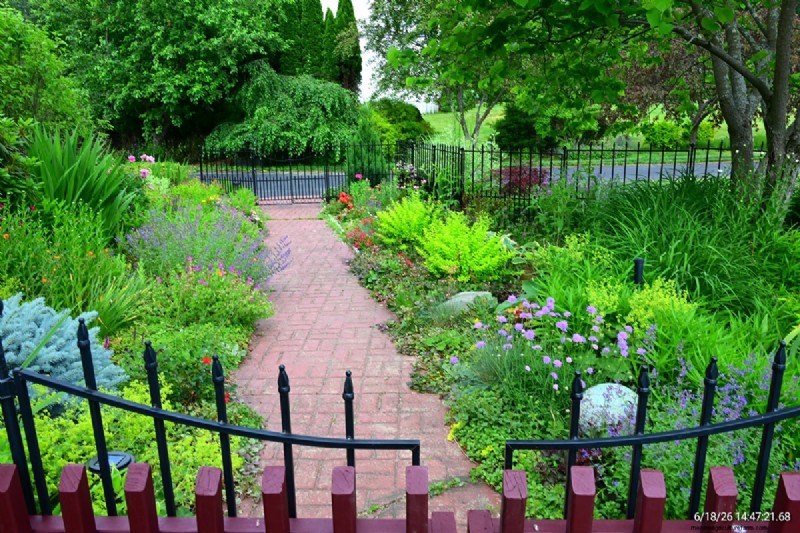 The front garden is less wild than the back. The picture shows plants along a front garden walkway. To the left, lady’s mantle, blue spruce (Picea pungens, Zones 2–7), low‑growing roses, hardy geranium, catmint, and peony. To the right, catmint, coral bell, purple pincushion, yellow barberry (Berberis thunbergii ‘Aurea’, Zones 4–7), and low‑growing roses fill the space. Ground covers such as ajuga, several sedum varieties, and creeping potentilla fill the gaps. This area was outside the fence until we installed a metal fence three years ago, as rabbits began eating our rabbit‑resistant plants.
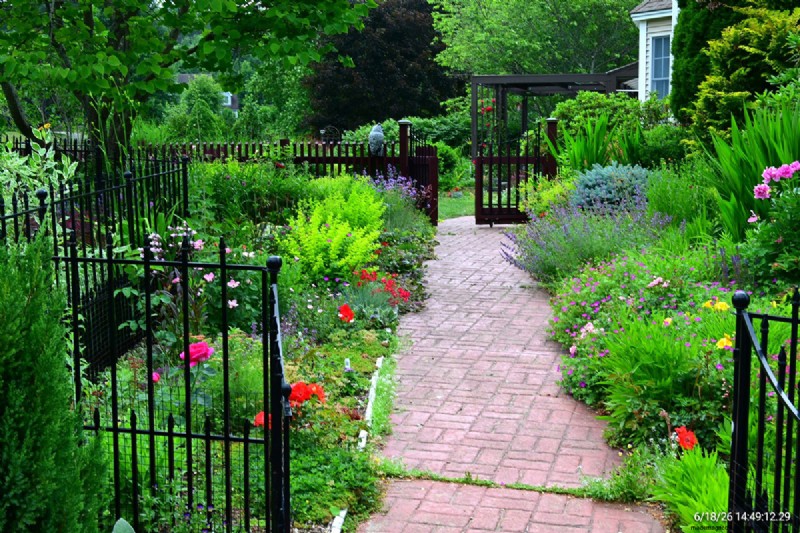 Same walkway viewed from the opposite side.
Thank you so much for another colorful update from your garden, Tingshu! Your vibrant designs always look incredibly high‑maintenance, yet it is remarkable to see how effortlessly such beauty can be maintained.
Do you prefer your flowers unfussy, or are you willing to put in extra work if the blooms excite you enough? Let us know in the comments, or please consider sharing photos of your favorite flowers with the blog. Follow the directions below to submit your photos to Garden Photo of the Day!
Have photos to share? We’d love to see your garden, a particular collection of plants you love, or a wonderful garden you had the chance to visit!
To submit, fill out the Garden Photo of the Day Submission Form.
You can also send 5–10 photos to [email protected] along with some information about the plants in the pictures and where you took the photos. We’d love to hear where you are located, how long you’ve been gardening, successes you are proud of, failures you learned from, hopes for the future, favorite plants, or funny stories from your garden.
Do you receive the GPOD by email yet? Sign up here
Fine Gardening Recommended Products
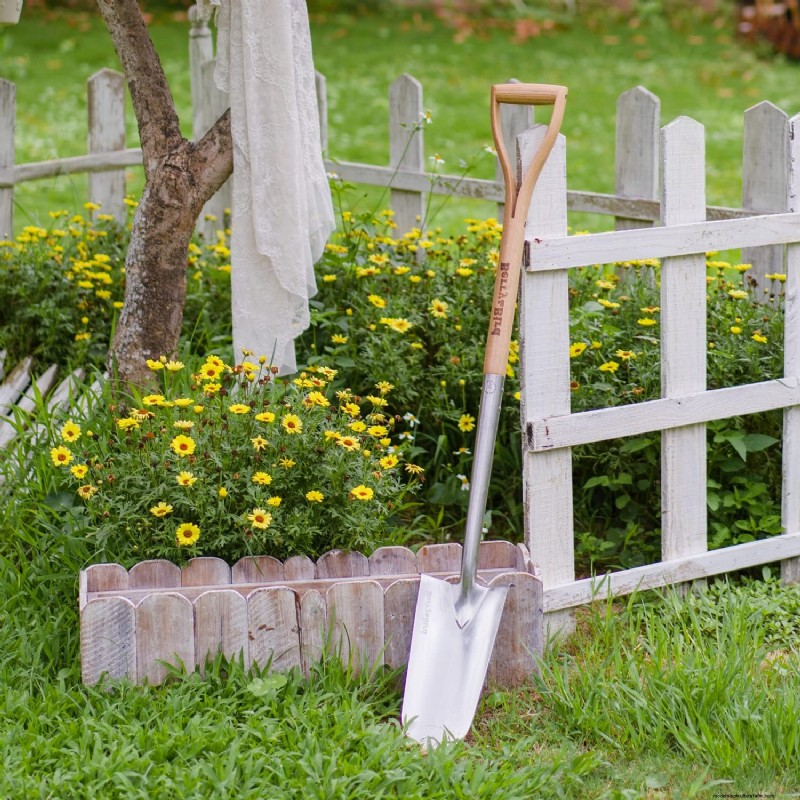
Berry & Bird Rabbiting Spade, Trenching Shovel
Fine Gardening receives a commission for items purchased through links on this site, including Amazon Associates and other affiliate advertising programs.
Ideal Tool for All Gardeners: Our heavy‑duty trenching shovel is designed by a professional gardening tool designer. Lifetime durability: This heavy‑duty drain spade is made of high‑quality stainless steel, strong and durable, even for high‑strength work, it will not bend. Ergonomic wood handle: The handle of this planting spade is made of ash hardwood harvested from FSC‑certified forests and has an ergonomically streamlined design, making it very suitable for everyone's hands. Multi‑use: This digging shovel is generally used for digging trenches, digging holes, transplanting, edging, moving compost, cutting thick turf and furrowing. The sharp blade allows you to cut, scoop, dig, lift and dice in hard soil.


