
Welcome to Modern Agriculture!

Introduction: Greenhouse agriculture farming in India is gaining popularity fast. The greenhouse is made of some type of transparent material to create a microclimate inside the house. Different materials like glass, wood, polyethylene, etc. are used as a greenhouse cover to generate the microclimate.
A Greenhouse is a framed structure covered with a transparent material to grow crops under partial or fully controlled environmental effects to get optimum growth. Greenhouse agriculture in India is the method of providing favorable environmental conditions to the plants.
Greenhouse structures can make an adequate growing temperature in summer and winter alike. They often are used for growing plants and trees that need strictly regulated climatic conditions. While these structures differ in terms of size and purpose, commercial greenhouses can be significantly larger and boast high-tech equipment designed to boost lighting, cooling, heating, and different types of screening installations. The purpose of having a Greenhouse structure is to shield different crops from excess cold or heat and unwanted pests and diseases. A greenhouse makes it possible to grow definite types of crops year-round, and fruits, vegetables, and flowers are what a greenhouse most normally grows.
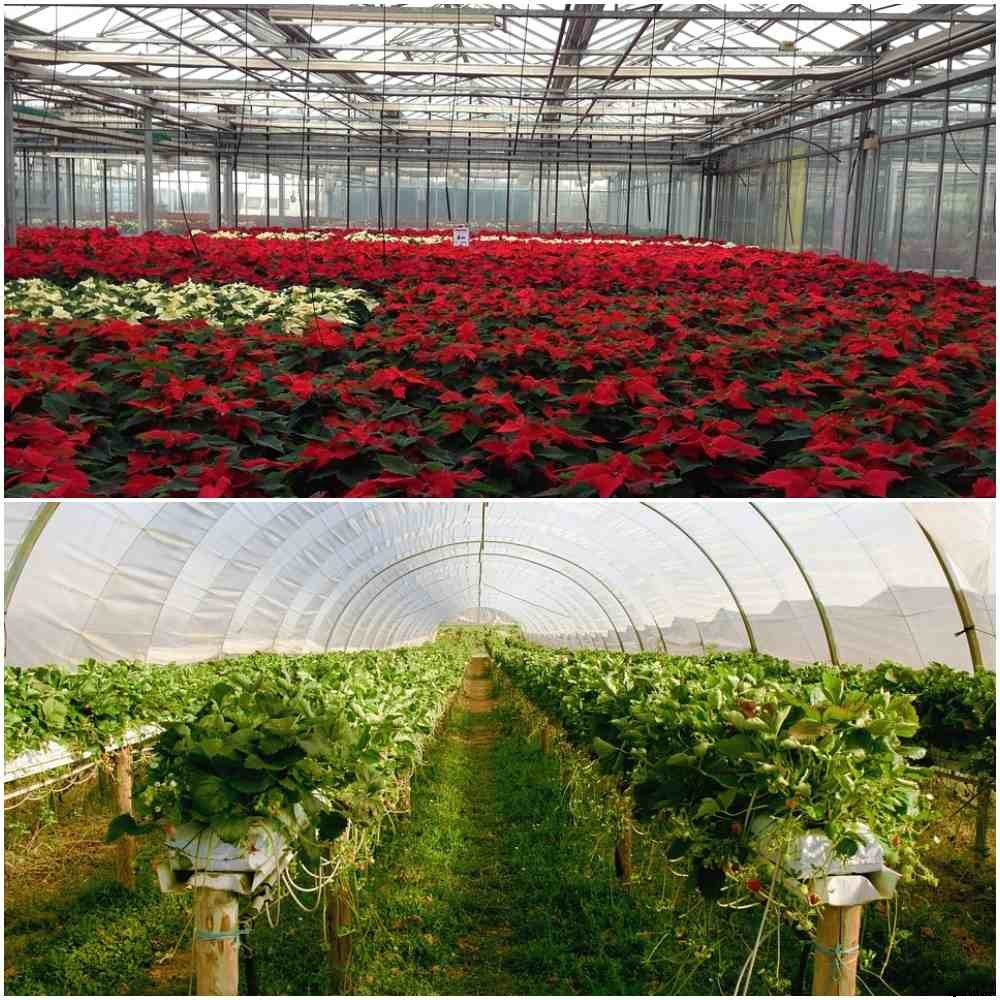
Greenhouse technology is a method of providing favorable environmental conditions to plants by growing them a greenhouse, a structure with walls and roof made mainly of transparent material, such as glass.
The different components of a Greenhouse are given below;
You should not miss the Agri Insurance Schemes in India.
Here we discuss the advantages of Greenhouse farming;
There are several advantages to utilizing Greenhouse agriculture technology.
To star Greenhouse farming required high investment hence though the crop is having high commercial value and sustainable market demand this crop cultivated in the Greenhouse. Floriculture crop like all cut flower and vegetable is mostly grown in the greenhouse.
The demand for crop cut flowers such as Gerbera, Dutch rose, carnation, lily, and vegetables like color capsicum, tomato, cucumber, exotic vegetables increasing day by day so there is a bright future for Greenhouse. Some of the important vegetables and fruits suitable for Greenhouse farming are Ginseng, Mushrooms, Bamboo, Leafy Greens, Spinach, Cucumbers, Peppers, Tomatoes, Swiss chard, Squash, Lemons, Oranges, Grapes, Cilantro.
A Greenhouse structure reduces the rate at which thermal energy flows out of its structure, and it does this by impeding heat that has been absorbed from leaving its confines through convection. The material for agriculture Greenhouse construction is typically glass or plastic so that sunlight can pass through it. This sunlight is integral to the Greenhouse becoming warm since it heats the ground inside the Greenhouse structure. In turn, the warm ground then warms up the air in the Greenhouse structure, which keeps on heating the plants inside since it is confined within the structure of the Greenhouse.
You may also like the Bayleaf Cultivation Income.
The different types of Greenhouses are explained below;
Wooden framed Greenhouse structures – In general, for the Greenhouses with a span less than 6 m, wooden framed structures are used. Side posts and columns are constructed of wood without the use of a truss is commonly used as it is inexpensive and possesses the required strength. Timber locally obtainable, with good strength, durability can be used for the construction.
Lean-to type Greenhouse – A lean-to type design is used when a greenhouse is placed against the side of an existing building. It is built against a building, using the existing construction for one or more of its sides. It is generally attached to a house but may be attached to other buildings.
Pipe framed structures – Pipes are used for the construction of these Greenhouses when the clear span is around 12m. In common, the side posts, columns, cross ties, and purlins are constructed using pipes. In this type, of Greenhouses, the trusses are not used.
Even span type greenhouse – The even-span is the standard form and full-size structure, the two roof slopes are of equal pitch and width. This type of design is used for the Greenhouse of small size, and it is constructed on level ground. It is attached to a house at one gable end.
Polyhouse – The polyhouse is a type of greenhouse across the globe. It is prepared of the frame (usually metal) of the desired size and covered with polyethylene film. Unlike glasshouses; polyethylene will be used as the glazing material. The polyhouse is not recommended at all in hilly regions because of poor temperature retention, low crop yield, and high installation cost.
Ridge-and-furrow Greenhouse – Two or more even-span Greenhouses connected at the eaves is called as a ridge-and-furrow greenhouse. It contains supports but no inner walls dividing the greenhouses. This allows for the making of horticultural crops requiring the same growing environments.
Even-span greenhouse – This is a self-supporting commercial greenhouse and is the most general type of greenhouse. It is named an even-span as the distance from the ridge to the eave is equal on both sides.
Truss framed structures – If the greenhouse span is greater than or equal to 15 meters, truss frames are used. Flat steel, tubular steel or angular iron is welded joints to form a truss encompassing rafters, chords, and struts. Struts are supporting members under compression and chords are maintaining members under tension. Angle iron purlins running during the length of the greenhouse are bolted to each truss. Columns are used in very wide truss frame houses of 21.3 m or more. Most of the glasshouses are of truss frame type, as these frames are best suitable for pre-fabrication.
Glass greenhouses – Only glass type greenhouses with glass as the covering material existed before 1950. These greenhouses have a higher air infiltration rate, which leads to lower interior humidity and improved disease prevention.
Plastic film greenhouses – Flexible plastic films, including polyethylene, polyester, and polyvinyl chloride are used as covering material in this type of plastic film greenhouses. Plastics as covering material for greenhouses have become popular, as they are cheap and the cost of heating is less when compared to glass type greenhouses. The major disadvantage of plastic films is its short life. For example, the best quality ultraviolet (UV) stabilized film can last for 4 years only. Quonset design, as well as gutter-connected design, is appropriate for using this covering material.
Net house – The net house is a simple kind of greenhouse; here, a net is used as the glazing material, thereby, reducing the adverse effects of the sun and heavy rain.
Following are the drawbacks or disadvantages of Greenhouse farming:
You may be interested in Polyhouse Plant Nursery.


