
Welcome to Modern Agriculture!

Greenhouse Ginger Farming
Hello friends, we are here with a new topic of Greenhouse Ginger Farming. Ginger belongs to the Zingiberaceae family, it is a bulbous plant and it has been cultivated for a very long time. Ginger is used as a spice and flavor agent for food. Ginger is a delicious ingredient and that can be used in a wide range of recipes. It is a perennial plant that is grown for its swollen underground stems or rhizome. This is between 1.5 and 2.5 cm thick. The Ginger plant grows to about 30 to 100 cm in height, and in optimal conditions can grow to form clumps of around 1.5 meters x 1.5 meters. Ginger cultivation is a great method to save money and to assure quality. A greenhouse is an area where crops are grown in a controlled atmosphere. By using a greenhouse system, humidity, temperature, and sterility are all environmental conditions kept at a constant. It is an indigenous plant and it is an important spice crop of the world.
India is the leading producer of Ginger. The major Ginger producing states in India are Karnataka, Orissa, Assam, Meghalaya, Arunachal Pradesh, and Gujarat. India holds the 7th position in Ginger export worldwide; however, is the “largest producer of Ginger in the world”. Some regions in the southwest and Northeast India are most suitable for Ginger production in India due to their warm and humid climate conditions, average rainfall, and land space. Now, let us get into the details of planting for Greenhouse Ginger Farming.
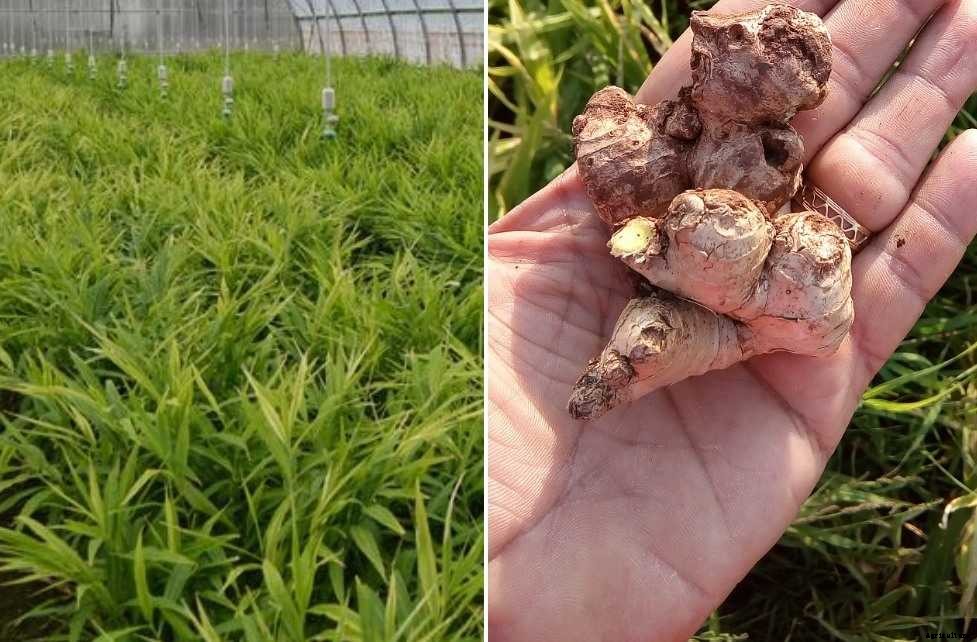
Several Ginger cultivars are grown in different growing regions in India. Some of the examples of prominent indigenous Ginger cultivars are Maran, Kuruppampadi, Ernad, Wynad, Himachal, and Nadia. Some exotic Ginger cultivars are Rio-de-Janeiro have also become very popular among cultivators. Some other Ginger varieties are IISR Varada, IISR Mahima, Karthika, Suprabha, and Suruchi.
Green Ginger variety – Rio-De-Janerio, china, and Varadha. Dry Ginger varieties are Maran, Nadia.
Before you plan for a commercial ginger production, you must be aware of the conditions required for Greenhouse Ginger Farming. A greenhouse system is an area where plants are grown in a controlled atmosphere. A greenhouse environment is necessary for plants to grow year-round. Humidity, temperature level, and sterility are all environmental conditions kept at a constant by a greenhouse.
Plants of edible Ginger from the different starting material (seed rhizomes, or micro-propagated plantlets planted on two different dates), planted in two container sizes, and grown under natural photoperiod or long days with night interruption lighting under greenhouse system conditions.
Generally, rhizome-grown plants and early planting in container sizes had similar rhizome fresh mass under natural or long days. Though some plants grown from tissue culture had thin rhizomes and that not be ideal for sale as fresh produce. So, micro-propagated plantlets can be effective as clean stock material to produce seed rhizomes for 2nd-year production. Rhizome moisture content was high compared with plants grown under natural days, and high moisture content can be preferable for the fresh market under long days.
The greenhouse should be clean and disease-free, with a clean source of water, and located well away from any Ginger processing activities. The floor must be covered with rock or gravel. Then, the benches should be clean and at least 12 inches off the ground (the requirements for certified seed production specify benches 3 ft from the floor). At planting time clean 15-gallon plastic grow-bags about 16 x 16 x 30 inches are filled with a growing medium. Then, the top of the grow-bag is rolled downed to 2 inches above the top of the planting medium. Use a commercial potting medium for topping off the bag as the plants grow, which simulates hilling three times during the season. Our irrigation system consisted of three emitters placed in each bag. After that, each Ginger plant was irrigated 4 times a day for 10 minutes per session to provide 2 gallons per bag per day.
Ginger can be grown under greenhouse conditions, where day length and temperature levels can be manipulated to produce a locally grown superfood. The main objectives of greenhouse Ginger farming;
(a) To evaluate plant cultivars and plant materials for the greenhouse system and field production of Ginger as superfoods, and
(b) Identify environmental conditions that extend the growing plant season by avoiding dormancy during short days, and also improve rhizome production for an increased crop yield.
Some heated greenhouse space for a few weeks, and then moved the Ginger warming chamber into the greenhouse. Since the nighttime temperature in the greenhouse was normally 10°C, price plugged an electric heater into a thermostat. Put the heater in the bottom of the warming chamber to keep the Ginger seed stock at 23°C and the Ginger stayed toasty in the incubator for 4 weeks. Other Ginger seedlings required a bench larger than the pre-sprout box that was moved back into the greenhouse.
Greenhouse farming is providing favorable environmental conditions for growing plants. It is used to protect the Ginger plants from adverse climatic conditions like wind, cold, precipitation, extreme temperature, insects, and diseases. It is of vital importance to create an ideal microclimate around the Ginger plants.
The greenhouse is controlled environment plant production is associated with the off-season production of ornamentals in cold climate areas. The primary environmental parameter traditionally controlled in the greenhouse is temperature level. Some environmental control parameters are cooling to mitigate excessive temperature levels, light control, carbon dioxide levels, relative humidity, water, plant nutrients, and pest control. Other advantages of greenhouse farming are given below;
Ginger is vegetatively propagated from small sections of the rhizome and it is called sets. Sets are produced by cutting a small about 3 to 6 cm from a living rhizome. Each piece possesses at least one living bud which will produce shoots. The Ginger sets can be pre-sprouted in pots or nursery seedbeds by covering with a soil layer or they can be planted directly at the final planting location. The bed must be prepared for planting by digging into the soil to a fine tilth and removing any weeds that are present. The addition of lime to the soil adjusts the pH level while helping to provide the calcium required by the plants during their growth. Lime must be added to the soil in appropriate amounts in the fall before planting. The sets must then be planted in early spring at a depth of 5 to 12 cm, leaving 15 to 35 cm between plants and 25 to 30 cm between rows. For optimal growth, the soil temperature level at planting should not fall below 25°C.
Planting materials for Ginger;
Every beginner should be aware of steps involved in Greenhouse Ginger Farming.
Stem borer – Stem borer causes the most damage in the Ginger plant. If the insect-infested Ginger plants become the yellow color of the leaves, stems drying. It is controlled using sprays the pesticide monocrotophos 0.1% (1 liter of water 1 ml) and infected plants should be removed.
Leaf roller – Leaf roller pest attacks the leaves and leave are rolled, which are found in large numbers in August and September. To control this problem, spray carbaryl 0.1% (1g per liter of water) or dimethoate 0.05%.
Tuber scales – Tuber scales attacks the tuber in the field. To control the tuber scales, thrips, and other sucking insects, spray by using phosphamidon 0.05% (5 ml with 10 liters of water).
Root or Rhizome Rot – To prevent the crop from root rot, drench the crop with Mancozeb by 3 gm/Ltr or Metalaxyl by 1.25 gm/Ltr at 30, 60, and 90 days after planting.
Bacterial wilt – To prevent the crop from bacterial wilt; drench Ginger plants with Copper oxychloride by 3 gm/ltr of water immediately after the disease is seen in the field.
Anthracnose – To prevent the crop from Anthracnose take spray of Hexaconazole by 10 ml or Mancozeb 75WP by 25 gm/10 ltr of water+ 10 ml sticker.
Leaf Blotch – To control this problem take spray of Mancozeb by 20 gm or Copper oxychloride by 25 gm/10 ltr of water.
Rhizome fly – To control this problem take a spray of Acephate 75SP by 15 gm in 10 ltr of water. Repeat the spray with 15 days interval.
Shoot borer – If infestation of shoot borer is observed to control take spray of Dimethoate by 2 ml/Ltr or Quinalphos by 2.5 ml/ltr of water.
Sucking pest – To control sucking pests take spray of neem-based pesticide like Azadirachtin 0.3EC by 2 ml/Ltr of water.
Rhizome scale – This problem infests rhizomes in the field (at later stages). It can be controlled by treating the seed rhizomes by using quinalphos (0.075%) (for 20-30 minutes) before storage and also before seed sowing in case the infestation persists.
Larvae of leaf roller – It cut and folds leaves of the Ginger plant, and are generally seen during the monsoon season. The control measures undertaken against the shoot borer or spraying of Malathion 0.1% is adequate for pest management.
Root grubs – This is controlled by drenching the soil around the rhizomes by using chloropyriphos (0.075%).
Slugs and snails – They eat fresh leaves plus the tips of adult plant leaves. To protect facing slugs and snails the fields by keen sand or bark mulch.
Mites – This infestation generally happens in the early stages. Insecticidal soap shower can fairly useful against Mites.
Soft rot – This is the most destructive disease, results in the total loss, caused by Pythium spp. The infected crop must be eliminated from the bed. Registered chemicals should be practiced.
Damping-off – This problem could be avoided by overwatering. The infected crop must be eliminated from the bed.
Rust – reddish-orange spots develop on the bottom of plant leaves. It infects plants throughout the buried rhizomes and infected plants must be extracted and driven out.
In case if you miss this: Growing Beans At Home.
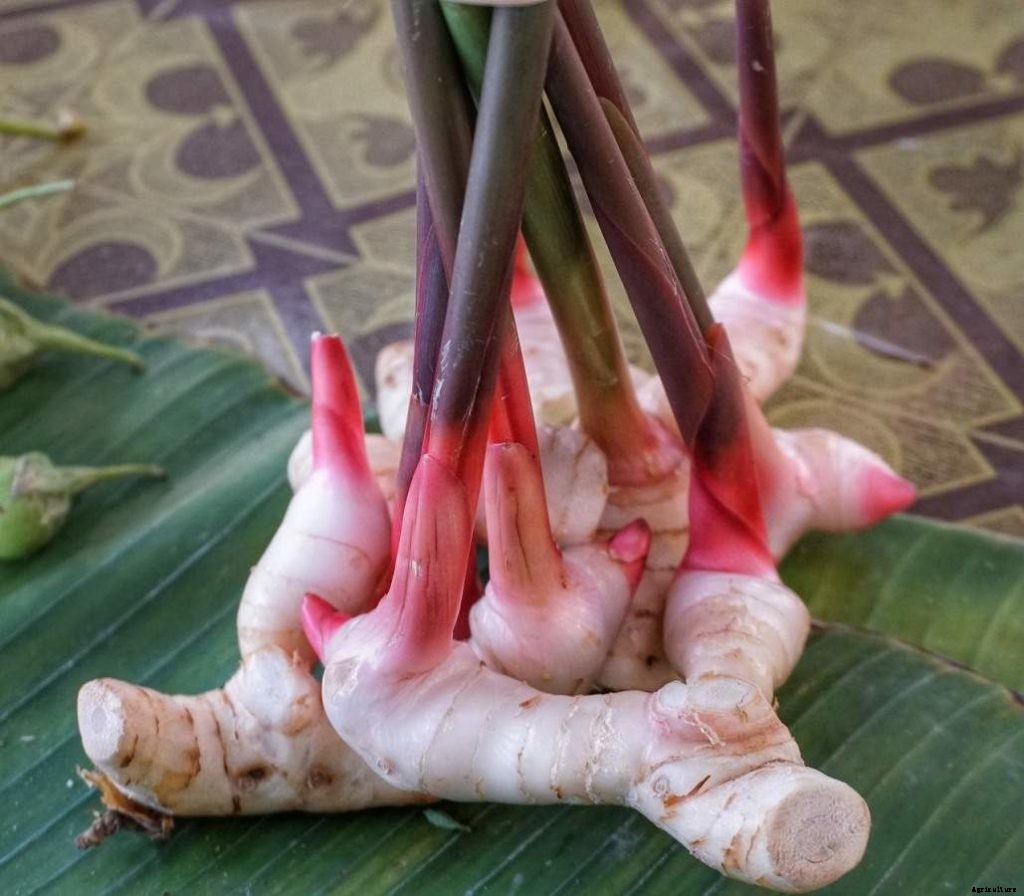
Ginger crop generally takes 8 months for harvesting. It is ready when the plant leaves start yellowing and gradually drying. The rhizomes are separated from the leaves and the plant roots and soil adhering to it is cleaned. The duration of the Ginger crop is 6-8 months. In the case of vegetable Ginger, harvesting is done after 6 months while harvesting is done after 8 months of planting for dry Ginger.
After harvesting the Ginger rhizomes are washed in water and sun-dried for one day to obtain fresh vegetable Ginger. For obtaining dry Ginger, the process is;
That’s all folks about Greenhouse Ginger Farming, hope this information may help you.


