
Welcome to Modern Agriculture!

The following content is about Greenhouse farming practices, types of greenhouses for growing vegetables, herbs flowers and fruits.
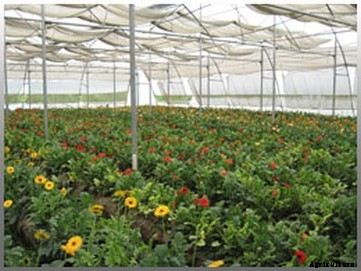
Agriculture is the backbone of India’s economic activity and our experience during the last 50 years has demonstrated the strong correlation between agricultural growth and economic prosperity. The present agricultural scenario is a mix of outstanding achievements and missed opportunities. If India has to emerge as an economic power in the world, our agricultural productivity should equal those countries, which are currently rated as the economic power of the world. We need a new and effective technology which can improve continuously the productivity, profitability, sustainability of our major farming systems. One such technology is the greenhouse technology. Although it is centuries old, it is new to India.
Growing plants is both an art and a science. About 95% of plants, either food crops or cash crops are grown in an open field. Since time immemorial, man has learned how to grow plants under natural environmental conditions. In some of the temperate regions where the climatic conditions are extremely adverse and no crops can be grown, man has developed methods of growing some high-value crop continuously by providing protection from the excessive cold, which is called as Greenhouse Technology. So, Greenhouse Technology is the technique of providing favorable environment condition to the plants. It is rather used to protect the plants from the adverse climatic conditions such as wind, cold, precipitation, excessive radiation, extreme temperature, insects and diseases. It is also of vital importance to create an ideal microclimate around the plants. This is possible by erecting a greenhouse/glass house, where the environmental conditions are so modified that one can grow any plant in any place at any time by providing suitable environmental conditions with minimum labor.
You may also check the Cherry Tomato Farming in India.
Greenhouses are framed or inflated structures covered with transparent or translucent material large enough to grow crops under partial or fully controlled environmental conditions to get optimum growth and productivity.
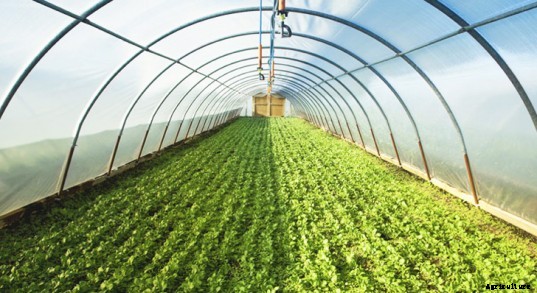
You may be interested in the Polyhouse Subsidy, Cost, Profit, Project Report.
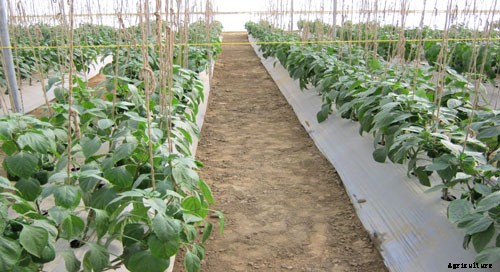
The yield under poly house cultivation can be achieved to the level of 5-8 times as compared to the open crop cultivation. Various trials conducted at agro-research centers in northern India indicates that capsicum ( planted in mid-September), cucumber (planting –mid-October) and tomato (November planting) under poly house produced 1060 kg, 1460 kg and 1530 kg per 100 square meters. The duration of these crops were 4- 9 months and more than 90% of total yield were obtained during the off-season (during winter before the start of summer) which fetches significantly higher market price (2-4 times than normal season). Further, the crop duration can be extended up to July –August with the application of micro irrigation and fertilization and yield can be achieved to the level of 20-25 kg/m2. Therefore, it is possible to harvest a single crop round year with minimum additional inputs and higher income can be generated. Further, cut flowers like Carnations, Gerbera, Lilly, Rose, orchids, anthurium etc.can be grown under poly houses/ net houses giving high returns and top quality produce. The potential of floriculture under protected cultivation is huge for Indian and global markets.
You may also like Groundnut Farming, Planting, Care, Harvesting.
The cost of construction of poly house depends on the location of the site, size, and shape of polyhouse, poly house structure (wooden or GI/ Steel) and types of polyhouse (naturally ventilated or environmental controlled). The cost of the bigger naturally ventilated poly house (1000 m2) ranges from Rs.800 to 900 per square meter whereas the environmental controlled polyhouses require 2 to 3 times investments over previous one depending on the automation gadgets installed. The per unit area construction cost of smaller size poly houses are more as compared to the larger poly house. Similarly, the cost of cultivation in a larger poly house is significantly lower than the smaller poly house.
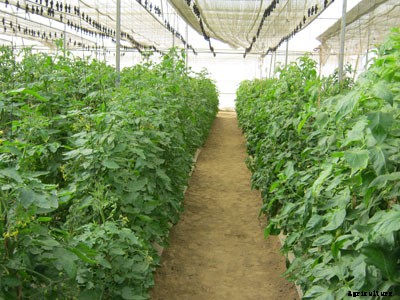
It is possible to get back the investment on polyhouse within a period of 3 to 5 years period. If a entrepreneurs /cultivator go for polyhouse for nursery production of high yielding vegetable plants in an area where large scale vegetable cultivation is done, in such condition he can get back his investment within 2-3 years by providing quality planting materials to vegetable or flower growers.
The success of the Polyhouse/net house Project depends upon the scale of the project.
The minimum recommended project with the right economic viability and long term sustainability is around 1 to 2 acres.
You may also like Growing Hydroponic Cauliflower.


