
Welcome to Modern Agriculture!

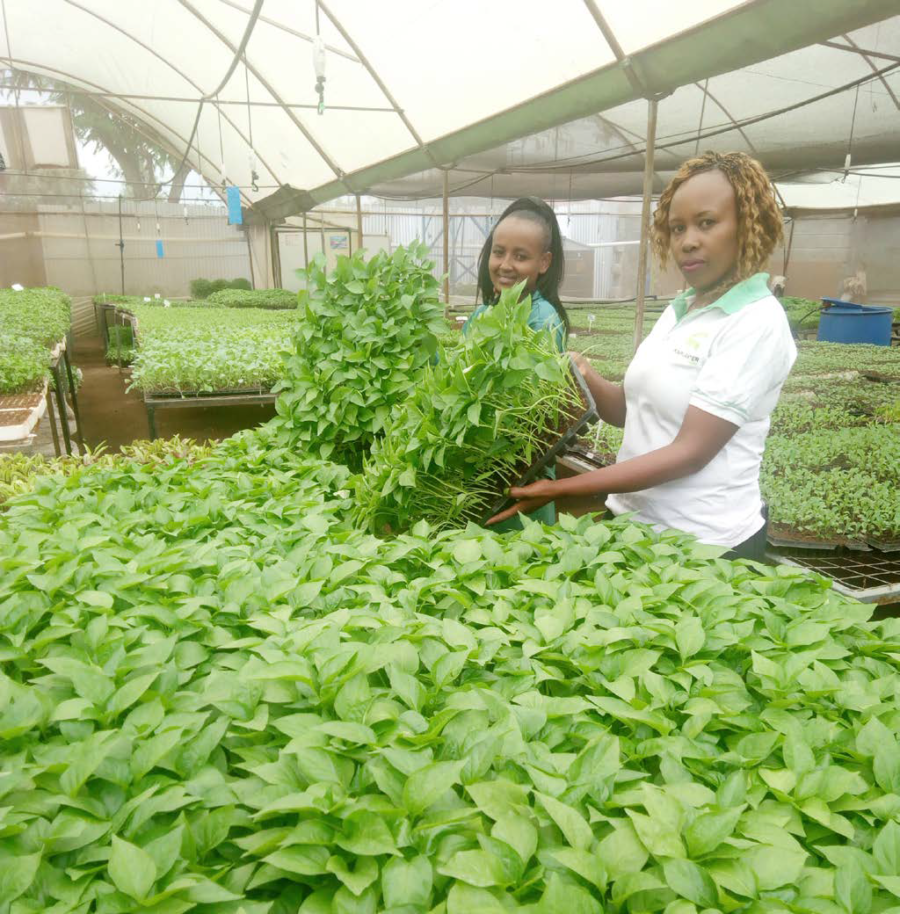
Carolyne Mwangi was determined to make her 100 x 100 piece of land in Ruiru, Kimbo, in Kiambu County, more profitable.
“Despite being employed, I constantly felt the push to pursue a greater ambitions and in 2017, I decided it was time for me to get into self-employment,” says Ms Mwangi.
The move awakened her passion in agribusiness and unbeknown to her, would turn out to be the best way to change her fortunes.
She resigned, leased a quarter acre of land in Ruiru using her savings, and plunged into full-time crop farming.
She began growing passion fruits and vegetables, but despite her best efforts, her expansion was slow, hampered by the poor germination of seeds that she planted. Three years down the line, her rate of growth was not as she had earlier anticipated.
At about the same time, Ms Mwangi got a notice to vacate her plot immediately. The owner wanted to develop the land and she had no idea what her next move would be. Her father, upon seeing her predicament, offered her a quarter acre piece of family land that was under subsistence farming, and this saved her day.
Down but not out, she put up her greenhouse again and began growing passion fruits and vegetables. “I would plant in seedbeds on the ground only to lose a quarter of them. This frustrated me and slowed down my progress,” says Ms Mwangi.
While searching on the internet, she discovered that farmers in India were using seedling trays and achieving over 90 per cent germination. “This was a great discovery for me and I ordered one tray from Amiran Kenya for trial. After seeing the impressive results, I adopted the technology completely. We now use them to propagate all our seedlings and 1 have seen the difference,” she adds.
Thanks to the trays, the survival rate of Ms Mwangi’s seedlings was almost 98 per cent, and they were strong and healthy, too. Her neighbours noticed her attractive seedlings and soon started buying from her.
“In 2014, I spotted a gap and established Kimplanter Seedlings & Nurseries, a seed raising business, on a 100×100 acre piece of land in Ruiru-Kimbo and began producing seedlings professionally.”
Today, she earns good returns and employs five workers. The investment provides for all her household expenses and pays her bills.
Her modest greenhouse holds about 2,000 seedling trays, which lie on metallic stands. With each tray holding 200 seeds, she has about 400,000 seedlings growing at any given time. Ms Mwangi, also the MD for Kimplanter, notes that one should classify one’s target market when venturing into propagation via seedling trays, that is whether for greenhouse or open field farming.
“The best growth conditions for seedlings propagated in trays is in a controlled environment such as a greenhouse. This is due to the warmth, water, nutrients, careful seedling handling and pest-free environment synonymous with greenhouses,” she advises.
A variety of seeds do well in seedling trays. They include those for tomatoes, onions, pepper, lettuce and eggplant, capsicum, watermelon, courgettes, cabbages, spinach, kales, cauliflower, beetroot, mint, basil, rosemary, pawpaw, and indigenous Kenyan vegetables.
Below is a guideline for farmers on the type of seedlings, target market, consumer price for seedlings from seedling trays, duration in the trays, target market and expected profit to reap for each seed that is planted in a seedling tray.
Seedlings receive better care and protection (from animals, weeds, and pests) in the nursery. At an early stage of development, most vegetable crops require special attention that is not possible in the main field.
Fewer seeds are used for raising seedlings in the nursery than when sowed directly in the field where seedlings often have to be thinned to one, which is wasteful.


