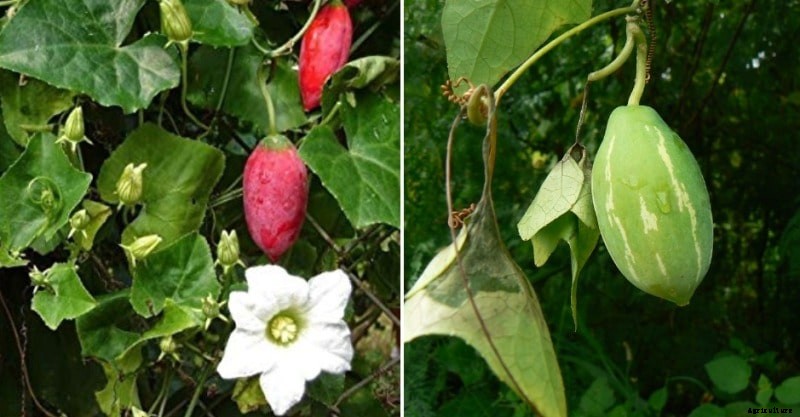
Growing Tindora (Ivy Gourd) from Cuttings and Seeds
A step by step guide for growing Tindora (Ivy gourd) from cuttings, planting, care, and harvesting
We learn growing Tindora from cuttings in the home garden. We cover from planting to harvesting of Ivygourd. Ivy gourd which is scientifically called as Coccinia Grandis is a vegetable which belongs to the family of Cucumber. The fruit of Ivy gourd will be similar to cucumber in terms of taste. The one and the only difference you can find between an ivy gourd and cucumber is their size as the ivy gourds are just 2 inches in length and are very small than the cucumbers. The ivy gourd leaves when young can be consumed and these are considered to be a wonderful substitute to spinach in countries like Thailand. Ivy gourd is a native of India and is generally grown as a vegetable in tropical and subtropical climatic conditions of South-East Asia, Africa, and South Asia.
Ivy gourd is considered to be an aggressive grower. This is also declared as a weed in locations like Hawaii, Australia, Texas, Western Australia and Florida as this is a vegetable which grows rapidly and this will cover up everything starting from trees, fences, and shrubs to any other types of supports which are closer to it and it finally smothers them with its growth which is vigorous. In climatic conditions which are favorable, ivy gourd is the easiest to grow and is also very productive.
Ivy gourd has many common names and some of those are mentioned here. Tindora, Kundutu, Little gourd, Kovai, Thai Spinach, Kowai fruit, Tela Kucha, Small gourd, Scarlet gourd, Calabatica, Coccinia Cordifolia, Baby watermelon, Tondli, Phak Khaep, and Tendli, etc. What are we waiting for? let’s get into growing Tindora on your own.
Required conditions for growing Tindora:
Climatic conditions:
Ivy gourd is a tropical perennial vine. So, this would be good to grow when the climatic conditions are warm. The humid climatic conditions are also beneficial for complete growth. So, if you are residing near a sea-shore, then you are lucky. Ivy gourd also has the capability to sustain climatic conditions which are dry and cold. But it will not be able to thrive in climatic conditions which are extreme like heavy rainfalls and too much frost and cold.
Area of plantation:
Choose an area which is receiving full sun. Ivy gourd will also be able to grow well when planted in a spot which receives partial shade. In the starting stages i.e., when the establishment of roots is taking place, make sure that you are protecting the ivy gourd plant from the afternoon sun. The plant will also be able to grow when placed in shade but do not expect production of fruits.
Soil requirement for growing Tindora in the Garden:
Ivy gourd is a vegetable which has no demands. This will be able to grow in any type of soil, both poor and heavy. If you are growing ivy gourd in the ground present in your garden, you should choose a soil which is little sandy and also rich in terms of manure or compost. Make sure that you are avoiding soil with poor drainage. When you are growing Ivy gourds in containers, then you will have to choose a soil medium which is porous, loose and well-drained.
Fertilizer requirement of Ivygourd plants:
You will be able to provide sufficient nutrients to the plant by mixing plenty of manure which is well-rotted and compost at the time of plantation. Moreover, side-dressing the ivy gourd plant by making use of the compost one time or two times a year will put an end to the requirement of extra fertilizer.
Varieties of Ivy gourd:
Ivy gourd is especially classified from its appearance.
Fruits which are having stripes will come under the category of striped Ivy.
The fruits which are green and plain skinned will come under non-striped Ivy.
Propagation of Ivy gourd (Tindora):
There are two methods for the propagation of Ivy gourd. One is by seeds and the other is by cuttings.
You may also check Growing Beetroot Hydroponically.
Growth of Tindora from seeds:
For growing ivy gourd from seeds, you will have to purchase the seeds online and get a tindora fruit which is scarlet-colored and ripe for the removal of seeds from it for the purpose of sowing. You can go ahead and start the seeds anytime irrespective of the climatic conditions if you are residing in the tropical or subtropical climatic conditions. Make sure that you are not sowing the seeds at the time of peak summer. If you are considering to grow ivy gourd from seeds in cold climatic conditions, you can do this at the time of summer or spring, when the climatic conditions are warm. The best temperature for germination of seeds is between 15℃ to 27℃.
Transplantation of seedlings of Ivygourd:
If you are residing in the climatic conditions which are hot, you will have to consider transplantation of the seedlings when the temperature is perfect, except at the time of hot summer. In the localities which have cooler climates, you will have to be patient until the last frost passes before you go with the transplantation.
Select a spot which will receive full sun. The soil has to be tilled well and make sure that you are adding plenty of compost or manure which is well-rotted at the site of the plantation.
After that, go with the plantation of young plants the same way you generally do. Each of the seedlings should be placed at a sufficient distance from each other.
It would be better if you consider installing a trellis or pole closer to the plant at the time of transplantation. This will help the ivy gourd plant to grow in an organized manner, else it will trample your most favorite shrubs or there are chances that it covers most of the trees. The ivy gourd vine will grow very tall, almost huge if you are not trimming it. It would be able to grow up to a length of 40 feet. If you are residing in a locality which is free of frost, then you can use this as a pergola plant.
Disadvantages of growing Tindora or Ivy gourd from seeds:
One of the biggest drawbacks which are present in the growth of ivy gourd seeds is that it may not be able to grow true and starts to grow as a dioecious plant. In this case, there will not be any chances for the ivy gourd plant to fruit unless you start growing a female and male plant together.
Moreover, it would take time for the ivy gourd plant to start the production of it is grown from seeds. Vines of ivy gourd might take one more year for fruiting.
Propagation of Tindora from Cuttings:
Growing ivy gourd from ivy gourd cuttings is very simple. Moreover, this will assure you that there would be fruiting for your ivy gourd. That is the reason why it is more successful and mostly seen.
All you have to do is to remove a semi-hardwood cutting from a stem which is healthy and belongs to a self-fertile ivy gourd plant, which is having a length between 6 to 8 inches. Also, ensure that you are choosing a sturdy cutting which is trimmed in a good manner.
The best and simple way to search for the ivy gourd cuttings for sale or ivy gourd plant root for sale in your locality or ivy gourd plant online or at your local nursery or gardening center, purchase them and go ahead with the plantation.
You may also read Growing Beans Hydroponically.
Care and maintenance of Ivy gourd plant:
Ivy gourd is a plant which can survive with low maintenance and which does not need much care. But, to get a good harvest, consider following the below points:
Watering has to be done on a regular basis as the ivy gourd plant loves the soil which is moist than dry. When the climatic conditions are hot or dry and the ivy gourd plant is young, you will have to maintain the soil in moist conditions and this has to be in a uniform manner.
Ivy gourd is a plant which overgrows and will become invasive if it’s left without careful monitoring. So, it is essential that you are pruning off the stems which are growing by exceeding the limits which you have set. Also, ensure that the gardening shear which you are using for the purpose of pruning is well-oiled and most importantly sharp. After the process of pruning is done, make sure that you are disposing of all the stems which have fallen or they might start to root.
Once the production of the ivy gourd plant is stopped after the season of fruiting, you can consider pruning it off by leaving behind only 2-3 feet of the bottom stem which is thick. In this way, there would be fresh growth starting from it.
You can also skip the process of pruning the ivy gourd plant if you are residing in the climatic conditions which are warm or if you are growing it for the purpose of privacy or as an ornamental plant.
Generally, ivy gourd is a climbing vegetable which is strong and tough and does not have any effect from dangerous pests and diseases. But, you will have to monitor the plant closely for common pests of the garden like spider mites, whiteflies, aphids, and thrips. If you see that there is a severe infestation, you can make use of pesticides or choose any herbal remedies to get rid of these.
Ivy gourd vine is invasive. Even if the branches of ivy gourd plant touch the ground, they might start to root and give rise to a new plant. Seeds which fall on the ground will undergo the process of germination in an aggressive manner. You will have to keep monitoring this to make sure that this situation is avoided. Keep in mind to remove the fruits which have fallen, pick up the stems which are trimmed and make sure that you are not letting the branches to come closer to the soil. As an alternative, you can consider growing Tindora in pots.
Growing Tindora in containers:
Container gardening Ivy gourd is a very good idea if you are residing in a locality where the climatic conditions are cool. You can consider planting it if you are a balcony gardener staying in urban locations or if you do not want it to get spread in your garden or backyard.
You can start the plantation of ivy gourd in a pot which is of medium size and has a capacity of 5 gallons with a depth of at least 10 inches.
Once the seedlings start growing, you can transplant them to a much larger container. Generally, ivy gourd plants will grow for about 4 inches in a day.
Select a sunny spot. The shade which comes in the afternoon is good for ivy gourd plant.
You can make use of potting soil which is regular and you can add ¼ of the aged manure or compost to it.
Make sure that you are watering it on a regular basis and keeping the soil moist in a uniform manner in the starting stage. It also prefers the growing medium which is slightly moist.
Make sure that you are side-dressing the plant by making use of cow manure which is aged or compost. If it is not growing well, make sure that you are feeding the plant with a liquid fertilizer which is balanced.
Also, ensure that you are feeding the plant in an occasional manner with a fertilizer which is rich in the content of potassium.
Also, keep in mind to give support to the plant so that it will be able to climb. It will make use of your vertical space.
The height of the plant has to be maintained between 6 feet to 10 feet.
You should not miss the Growing Zucchini in Containers.
How to harvest Ivy gourds:
In perfect climatic conditions, that is after around 12 to 14 weeks after plantation, it will start producing set fruits and flowers. Production of fruits will be so high that you will be required to harvest them on a daily basis. You can either consider snipping off the fruits by making use of a sickle or even handpick them. Make sure that you are not waiting for too long. You will have to harvest the fruits when they are still young, green and bulbous.
The fruits of ivy gourd plant are generally harvested when they are young, that is when the fruits are crunchy, firm and at a size of 2 inches. You can also taste them raw for the identification of the right time for harvest. If you leave them for over riping for a long time, then their appearance will be beautiful whereas the taste will be bad.
Growing ivy gourd will not only provide you with fruits. You will also be able to harvest the leaves which are young and tender and top shoots. You can make use of them as a side dish with soups, bread, rice or naan or try for the preparation of Indian curry or a gourmet Thai.
Storing of Ivy gourd seeds:
For obtaining seeds, you will have to cut open the unblemished scarlet which is overripe or the red colored fruit and take out the seeds. Place the seeds on a paper towel in a uniform manner and make them dry. The seeds have to be cleaned and dry will be ready for storage.
Facts about growing Tindora (Ivy gourds):
It is better to plant the ivy gourds in the outdoor locations where there is full sunlight with a lot of space to sprawl.
Though these can be grown in containers, this will slowly limit the size of the plant and the complete production. If you are planting ivy gourd in the outdoor location without making use of a pole or trellis, select a spot with a lot of square footage for their growth.
Ivy gourds will love to grow in full sun and the soil which is rich in terms of organic matter and well-drained. The seeds have to be sown in the outdoor locations after all the danger of frost has passed and the climatic conditions are warm. The seeds have to be sown at a depth of 1-2 inches per 4 seeds at a place. They should be placed at a distance of 5 feet from each other and when placed in rows, they have to be placed at a distance of 8 feet from each other.
Ivy gourds are the vegetables which grow well when the climatic conditions are warm. Growing ivy gourd vines on a fence or trellis is a possibility to save the space.
The climatic conditions which are damp or humid will lead to the promotion of rot. A dry period of 10 days is enough to cure the gourds. Small gourds will need at least three weeks for the process of curing. Mold will not cause any damage to gourds.
If you have any questions of growing Tindora indoors or outdoors let us know by commenting below. Hope you enjoyed the article. Keep growing veggies!.
You may be interested in Natural Pesticides Preparation.