
Welcome to Modern Agriculture!

Let us learn today about “Polyhouse Vegetable Gardening”. The polyhouse vegetable gardening business is very much profitable as it has its own benefits. As one can grow the vegetables throughout the year, polyhouse vegetable gardening is the most successful business in India.
Nowadays, polyhouse vegetable gardening is becoming popular as there are many benefits of growing vegetables in polyhouse.
What is a polyhouse? A polyhouse or polytunnel is commonly made of transparent, tight, cheap and flexible polythene. In this method vegetables can be grown in any season of the year, depending on their requirement, because temperature and humidity can easily be controlled in polyhouses. Polythene conserves the thermal radiation, which increases the temperature and provides sufficient energy for the process of photosynthesis.
For the production of vegetable availability of suitable temperature and relative humidity is a must. These conditions are created in a polyhouse particularly for the production of off-season vegetables and fruits in sufficient quantity. The importance of the polyhouse is further enhanced due to the possibility of creation of creeper vegetables.
A polytunnel is also known as a polyhouse, hoop greenhouse or hoop house is a tunnel normally made from steel and covered in polythene, usually semicircular, square or elongated in shape.
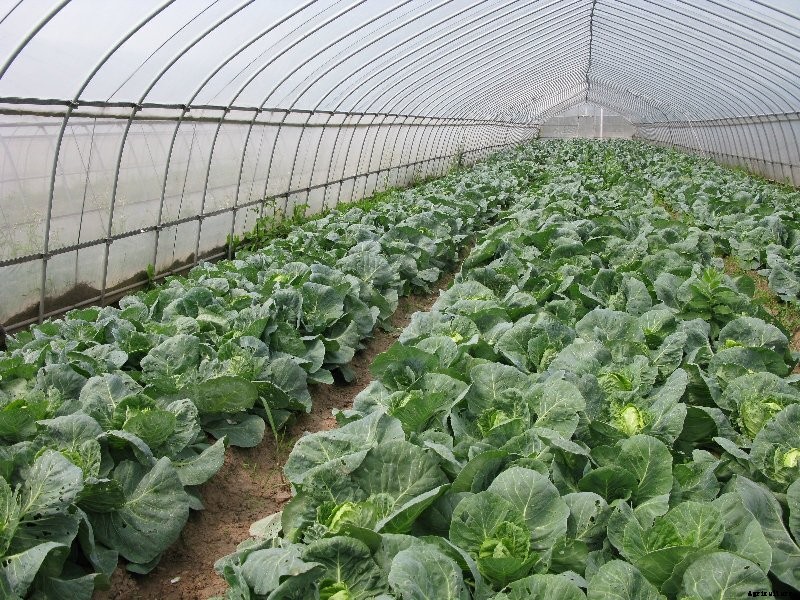
In India traditional farming is common, but now new farming method like polyhouse farming provides better income in a short period of time with less labor. Polyhouse or hoop house farming is an alternative new method in agriculture gaining a foothold in rural India. It reduces dependency on rainfall and makes the possible use of land and water resources. Polyhouse farming can help the farmer generate income around the year raising multiple crops.
Polyhouse farming is a system of protected cultivation in agriculture. The polyethylene plastic is used to cover the polyhouse structure. Protected cultivation under Polyhouse is gaining very important these days. It proves to be useful to the farmers since it enables. Off Season cultivation of vegetables which enables the farmer to have a better price realization. Which vegetables are grown in Polyhouse? Vegetables that can be grown in polyhouse include Cabbage, Bitter Gourd, Capsicum, Radish, Cauliflower, Chili, Coriander, Onion, Spinach, and Tomato, etc.
Types of polyhouse are given below;
In the polyhouse design, the poly-houses are constructed with the help of ultraviolet plastic sheets, which last for more than five years. The basic structure of the polyhouse is prepared with bamboos or iron pipes.
Site selection is a very important factor in polyhouse design. A good site selection can make all the difference in the functional and environmental operations of a polyhouse. The soil pH level for the polyhouse is 5.5 to 6.5. Availability of a continuous source of quality water will be very important.
Read: Surprising Gardening Tricks.
Iron pipe structure in polyhouse is costly but durable than bamboo. The structure is fully covered with 1501-micron thick plastic sheet. Normally, the length of the polyhouse is 25-30 feet and width 4-5 feet. The direction of the poly-house is always East to West so that the maximum sunshine is available. The house must not be constructed in the shade. The size of the polyhouse can differ depending on the necessity. And they can be kept cold or hot depending upon the season.
In the daytime, solar energy helps in increasing the temperature of the polyhouse. Less energy is lost from the many parts of the polyhouse. Heating is essential in the winter season. Normally, the solar energy is sufficient to maintain the inner temperature of polyhouse, but sometimes a micro temperature is required to be supplied to some crops. For this reason, a few methods may be followed:
(i) Constructing a tunnel below the earth of the polyhouse.
(ii) Covering the northern wall of the polyhouse with jute clothing.
(iii) Covering the entire polyhouse with jute cloth during night time.
(iv) Fitting solar energy driven device in the polyhouse.
In the summer season when the ambient temperature rises above 40°C during day time, cooling of the polyhouse is required, which may be achieved by the following methods:
(i) Removing the internal air of the polyhouse.
(ii) Sucking external air by putting a fan on.
(iii) Installation of coolers on the eastern or western wall not keeps the temperature low but maintains proper humidity also.
(iv) The temperature of the poly-house can be restricted from running a water-misting machine.
Some of the polyhouse design tips are given below;
Read: Bonsai Gardening Ideas.
In this technique, crops can be grown in pots or in the soil. For growing various vegetable crops, their nursery is grown first. Before sowing the seeds, rotten manure is filled in polythene bags of 10 x 15-centimeter size, along with the same quantity of soil and sand. After that, water is sprinkled on the bags and seeds are sown in the bags. Small holes are produced in the bags for easy aeration. These bags are kept inside the polyhouse till the plants develop to about 10-15 centimeters and are then transferred to pots or earth. These plants must be given manure and water from time to time. Generally, the disease does not spread, if at all, a little spray can be required.
For earning a maximum profit during maximum production of the crops grown in the polyhouse. It is not necessary to pay proper attention to the supply of manure and water to the plants and protects them from disease but their cleanliness and pruning is very important. Luxuriantly growing tomato crop requires sticking or else their plants will fall on the ground and get spoiled.
Initially, polyhouse farming was introduced with an aim to grow species in colder regions that require a warmer climate. Some of the factors that require to be considered are as follows.
The point of the polyhouse is to be efficient and provide the best suitable environment for the growth of crops hence it should be away from pollution. Away from pollution basically implies that there shouldn’t be any industrial plants and farming must be done little outside city limits to also avoid vehicular carbon emissions.
The area where the polyhouse is built should not be in any case be a low-lying area which will pave way for waterlogging through the monsoon and water release. This will be destroying the crops. Extra care must be taken in areas that receive heavy rainfall.
Though the polyhouse must be located in an area where it is away from pollution and the harmful gases emitted from industries and vehicles, it must be easily accessible and road connectivity should be good. Considering these factors, a good location of the polyhouse can be selected and the construction can begin.
These are the simplest form of polyhouses and require the least amount of money to be constructed. They are made of easily and locally obtainable products like bamboos as supporting materials and the construction is done using these. In this method, we will use a simple UV film for cladding and do not have high tech, temperature adjusters.
However, low-grade temperature and humidity controllers are there which serves the purpose. The light entering the polyhouse is restricted using shades on the transparent roof to modulate the intensity. They do not want much expertise and can be built in a very short span of time. They are generally used as shelters for crops during heavy rains and snow.
These types of polyhouses are more durable than the other types since they are constructed using galvanized iron rods which are sturdier and offer additional resilient to natural conditions. The arrangement is screwed and grounded firmly and offers improved protection against high winds and harsh climate.
Thermostats are present in the polyhouse which accurately can manage temperatures. They are fitted with an exhaust which helps in controlling temperature and humidity. These are most suitable for areas that have a rather dry climate. They need a lot of care and regular maintenance and repairs.
This is referred for the more technologically advanced polyhouses that are equipped with the latest technologies and have an automated method for everything.
These polyhouses do not pay much attention to an environmental control system and adequate ventilation is supplied in the polyhouse. Adequate ventilation and a fogger structure make sure that the crops are protected from other pests and diseases. This kind of polyhouse is built when the main aim is to prevent the crops from adverse weather and harsh climatic conditions.
This polyhouse believes in artificial methods of environment, manage and is used to extend the growth period of the crops. They use environmental control systems to manage the temperature of the room, controlling the light intensity in the room and to control the carbon dioxide levels and humidity. This is essentially misguiding the plant mechanism to believe into the suitability of the environment and achieve growth of the seasonal plants even during their offseason.
That’s all folks about Polyhouse Vegetable Gardening.
Read: Training Centers of Polyhouse in India.


