
Welcome to Modern Agriculture!

Introduction: Hello gardeners we are going to present mushroom spawning methods and mushroom spwn types.Mushrooms are very high protein low-fat fungi of great economic value. In modern times when the human being is concerned about cholesterol and coronary health conditions mushrooms serve as a good diet supplement. Mushroom spawn is simply any substance that has been inoculated with mycelium and the vegetative growth of a fungus. What are we waiting for? Let’s jump into the details of mushroom spawning methods.
The spawn is used to transfer mycelium onto any material from which mushrooms will produce, called a substrate. There are different kinds of substrates, with straw, cardboard, logs, and wood chips just being a few examples.
Spawn is the living fungal culture that is called mycelium, grown onto a substrate. It gives the backbone to any mushroom growing operation. Think of it as the equivalent of seeds for mushroom farming. Unlike seeds, the mushroom spawn is grown from selected genetics and cloned for consistent production of a particular cultivar of mushroom.
Any material with mycelial growth used to propagate mushrooms is considered as ‘spawn’. However, you’ll generally find that spawn comes in one of these forms;
Sawdust spawn is sterilized sawdust that has been inoculated with mycelium, often by grain spawn and the sawdust is usually made out of some type of hardwood with pieces neither too large nor too fine (a few mm in diameter). Sawdust spawn can be used to inoculate logs, outdoor mushroom beds, pasteurized straw, cardboard, and a different variety of other substrates. It’s used to inoculate wooden dowels to create plug spawn.
Sawdust spawn is cheaper than plug spawn, it is more reliable, and colonizes faster. This is the spawn type used by most small farms and people looking to inoculate more than a couple of logs outdoors. If you plan on inoculating logs for consecutive years, tool costs are made up for by the cheaper cost of the spawn.
One of the major advantages of mushroom spawn in the form of sawdust is the size of the particles. Because they are small and numerous, there are many more inoculation points for the mycelium to grow into the substrate. This will results in faster mycelium colonization with less time for contaminants to take hold.
And the disadvantage of sawdust spawn is that, on its own, it’s not as nutritious for mushroom growing as one would like. Thus you can be disappointed with your yield if you try to grow mushrooms from straight sawdust. Mushroom growing kits made from sawdust are generally enriched with bran or some other source of nitrogen to increase yields.
You should not miss the Best Manures for Vegetables.
Grain spawn is used for commercial indoor mushroom growing. This Grain spawn is sterilized grain that has been inoculated with spores or a sterile culture of mycelium. Many types of grain could be used with rye and millet being some of the most common. And the other choices are corn, wheat, and different cereal grains. Grain spawn can be used to make sawdust spawn, more grain spawn, or inoculate all sorts of pasteurized substrates such as straw.
A big advantage of using grain spawn is that it’s much more nutritious than sawdust, making it ideal to create more spawn or to inoculate indoor substrates.
A disadvantage of Grain spawn is that it’s not as good a choice for inoculating outdoor beds and the yummy grains are a big target for birds and rodents.
Plug spawn or dowel spawn is a collection of small wooden dowels that have been inoculated with mycelium and this can be done with sawdust spawn, or even with stems of live mushrooms.
Plug spawn is mycelium grown into hardwood dowels which can be simply tapped into holes drilled into a log. It’s a natural selection for small projects because it is easy to use, requires no special tools and is available in small quantities.
The main advantage of plug spawn is that it’s very effective for inoculating substrates made from wood or fibers. It can easily colonize cardboard, wood chips, paper, stumps, and logs.
A disadvantage of plug spawn is it’s not always the best choice for straw or grain-based substrates.
Other types of Mushroom spawn are;
Woodchip spawn – Made from woodchips of different hardwoods
Straw spawn – Pasteurized straw inoculated with mycelium
Sawdust spawn plugs – Sawdust spawn in the shape of a plug with Styrofoam on the end
Liquid spawn – Water enriched with mushroom spores or mycelia slurry
Mushrooms are the fruits of the mycelium fungus, and the spores formed by the mushrooms are a kind of seed. Scattered spores often don’t produce any fungus because they require ideal conditions to grow. To make mushroom spawn, the ideal conditions necessary by the spores have to be created in a controlled setting. Once the spores have produced a well-established growth of fungus, the fungus culture can be transferred to grains.
Placing mushroom spores onto a sterile medium to start the fungal growth and transferring the culture to millet seeds are a good way to make oyster mushroom spawn. Gelatin with a small amount of sugar boiled for sterilization and poured into small, sterile jars makes an excellent starting medium. Spores from the inside of the cap of an oyster mushroom placed on the gelatin with sterile tweezers will make mycelium growth within about a week.
You may also like the Potting Soil Mix for Vegetables.
Once the mycelium culture is established in the jars, the culture can be cut into pieces by using a sharp, sterile knife. Millet seeds have to be soaked overnight and boiled for an hour to sterilize them. After they are cool, they are placed in sterile mason jars together with the pieces of the mycelium culture, and jars are well-shaken to mix the seeds and the culture. Jars must be kept in the dark at room temperature for 10 to 20 days until the mycelium has completely penetrated the millet seeds. Therefore, these seeds are the mushroom spawn seeds used for growing mushrooms in organic material.
The gelatin medium and the millet grains are fertile environments for the growth of all kinds of fungi and bacteria. Contaminating spores and organisms from the surroundings in the home can simply come into contact with the spawn production materials. Mushroom spores will grow in the absence of competing organisms so the maintenance of a sterile environment is essential.
For the production of mushroom spawn at home, the main techniques for sterilizing tools and growth media are disinfectant, boiling, and flames. Some of the tools such as knives and tweezers can be sterilized by placing the tips or blades into the flame of a Bunsen burner or a similar clean heat source. Jars and growth media can be boiled for at least an hour to sterilize them and the work environment can be cleaned with a 70 percent solution of ethanol to remove contaminants. When everything is clean and sterile, the mother culture prepared from spores and the mycelium in the millet grains will exhibit very strong, healthy growth for high-quality mushroom spawn.
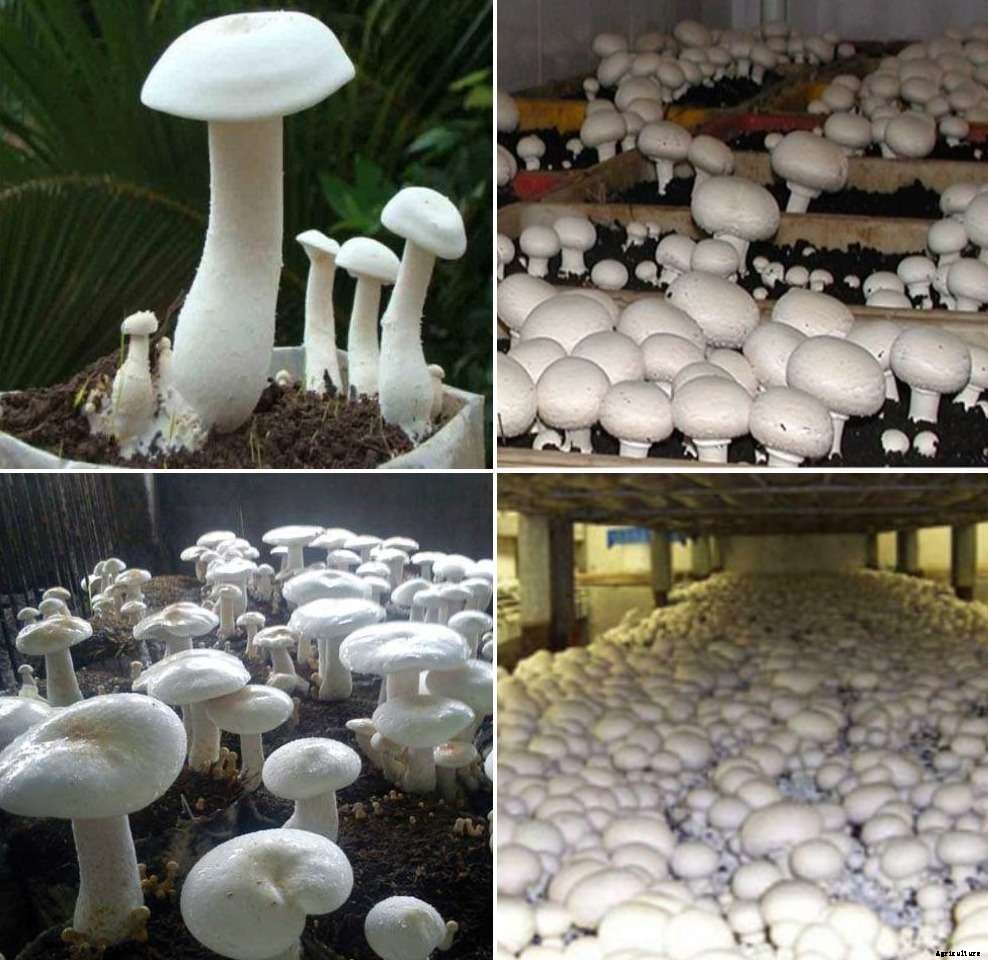
The starter or mother culture can be formed from a fresh and healthy fruiting body or obtained from a spawn producer or laboratory. More agar cultures are then made from starter culture. These serve to inoculate larger containers such as bottles with mother spawn, which can be used to inoculate the final spawn substrate.
The requirements for a spawn production unit are;
And the raw materials include;
There are three steps involved in spawn production;
Incase if you miss Growing Hydroponic Microgreens.
Pure culture of mushrooms can be prepared by multi-spore or by tissue culture. Multi-spore culture is formed from spore print that can be obtained by hanging alcohol sterilized fresh fruit body on a loop of wire above a Petri plate or sterilized paper. Spores are serially diluted and then transferred to sterile potato-dextrose-agar (PDA) or malt-extract-agar (MEA) culture slants. These slants are then incubated at 25°C ± 2°C for 2 weeks to get pure culture. For tissue culture, mushroom after alcohol sterilization is cut longitudinally into two halves and bits from collar region (i.e. junction of cap and stalk) are transferred to pre-sterilized PDA or MEA culture medium, which is, incubated at 25°C ± 2°C in BOD incubator for one week. Mycelium from growing edges is carefully transferred to MEA/PDA slants and again incubated for 2 to 3 weeks to obtain pure cultures.
Mushroom spawn can be prepared on any kind of cereal grains such as wheat, jowar, bajra or rye and agricultural wastes such as corn cobs, wooden sticks, rice straw, sawdust and used tea leaves, and etc. Spawn substrate that is cereal grains should be free from diseases and should not be broken, old and damaged by insect pests.
The environmental conditions necessary for successful spawn-run are;
Well, you should be aware of mushroom spawning methods for better mushroom farming. Spawn is prepared on sterilized wheat grains which want regular quality check and is produced only in well-established spawn laboratories by concerned specialists.
The success of mushroom farming and its yield depends on the purity and quality of the spawn used. Spawning is the method of mixing the spawn with compost. Spawn is added to compost at the rate of 0.5% by weight and mixed. Depending upon the growing system employed spawning is done by several methods.
Double layer spawning – Spawning is done in two stages, the first stage by scattering the spawn on beds when half-filled with compost and then after the complete filling of containers. The spawn is pressed and containers covered with newspaper sheets.
Top layer spawning – In this case, the spawn is planted just on the surface after filling the container with compost up to the brim and then a thin layer of compost is spread out over the spawn. This method is preferred if compost is wet.
Through spawning – In this, the spawn grains are mixed throughout the compost.
Shake up spawning – In this compost is thoroughly shaken up after one week of spawning and replaced in containers. After that either it is cased at once or a few days later.
Spot spawning – The grain spawn is placed in the holes at a certain distance with a pointed stick or fingers. Care is taken to ensure the close contact of inoculums with the surrounding compost so that mycelium develops rapidly.
That’s all folks about mushroom spawning methods and mushroom spawn methods. You may be interested in Integrated Pest Management in Gourds.


