
Welcome to Modern Agriculture!

Today, we go through the topic of growing microgreens indoors at your home. The definition of gardening has changed thanks to several methods that enable as to have our own gardens and even gardening is not only limited to the soil now. The biggest problem in today’s era is to obtain true nutrition in our plates half of the world is facing the demon of malnutrition due to poor food habits and majorly poor availability of nutrient-rich vegetables.
We always aim at waking people about various cultivation processes on their own and we are constantly working to enrich you with the right knowledge about gardening at your own place so that you can have your share of nutrition and healthy veggies in your own space. So let’s decide to quit bargaining and stop stressing you about freshness and price of vegetable at the store, no long queues rather spend time watering your own herbs and vegetables.
So a way different from conventional indoor home gardening, today we will discuss another technique for having a perfect mix of nutrients complete guide on growing microgreens indoors.
Well, some of you might be unaware of word microgreen, microgreen as the name implies it is a new, tender shoot of a vegetable plant. Also known as “vegetable confetti,” microgreens are at times confused with sprouts that are germinated seeds which are consumed wholly, root, seed, and shoot. Microgreens, however, include a variety of edible immature greens, harvested with scissors less than a month after germination, when the plants are up to 2 inches tall. The stem, cotyledons (or seed leaves) and the first set of true leaves are all edible. These are the immature greens, harvested following their sprouting stage, typically within 10-15 days when the first two seed leaves, also known as cotyledons, have appeared.
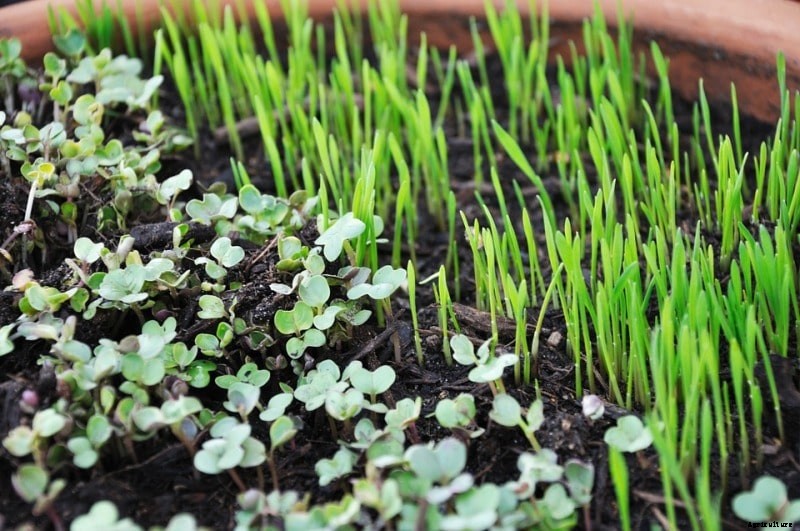
Microgreens are raised when you let a sprouted seed go a little bit further into growing, but don’t let it completely mature. These greens are tender, sweet, and insanely good for you—they are literally one of the healthiest veggies.
Newly sprouted, tiny microgreens are known to have a high nutrient impact as compared to their mature plant counterparts. Research shows that microgreens have far more nutrient density than mature leaves, although this varies from species to species, and of course depends on the growing conditions, like soil and nutrients.
An experiment assayed about 25 microgreen varieties of different crop and found that red cabbage (Brassica oleracea L.), cilantro (Coriandrum sativum L.), garnet amaranth (Amaranthus hypochondriacus L.) and green daikon radish (Raphanus sativus L.), had the maximum concentrations of biochemicals such as ascorbic acids, carotenoids, phylloquinone, and tocopherols, respectively. Another remarkable experiment specifically observed vitamin and mineral levels of buckwheat (Fagopyrum esculentum), which was grown under different color LED lights. They established that vitamin C content was considerably higher when grown under white lights, compared to red or blue lights or in a dark.
Read: How to Make Liquid Organic Fertilizers at Home.
Extreme winters and summers make your garden almost barren and left your field with almost null vegetation but our demand for fresh veggies and herbs remains the same. Microgreens can be grown indoors all winter long or even all year long if you don’t have an outdoor space to raise fresh veggies for yourself.
They traditionally were used as a flavourful edible dress or garnish for a dish, but now it’s not uncommon to find them as the dish.
You can use almost any vegetable seed to grow microgreens Salad greens, leafy vegetables, herbs, and even edible flowers can be grown as microgreens, though some varieties are better suited than the others. Beginners often begin by growing one type of seed, among the easiest-to-grow varieties of microgreens, are Kale, Basil, broccoli, cauliflower, cabbage, mustard, chia, sunflower or buckwheat they can be grown in a single container. You can also easily raise different seeds in several containers, and mix your microgreens after harvesting.
You can also start with seeds for salad mixes and specially selected microgreen mixes available in online stores that combine greens with similar growth rates, compatible flavors and beautiful coloring including reds, purples, and greens. Since they are specially created keeping growth success in mind, they offer a great variety of tastes, textures, and nutrition hence they are the best choice for first-timers.
Microgreens are grown on soil based system preferably indoor. If your climate is suitable, microgreens can be also be grown outdoors in the garden, under shade but indoor cultivation of microgreen is more awarding and preferred. Like all fragile seedlings, you will have to guard them against weather extremes and drying winds and all time ready hungry garden pests are the biggest threat when growing outdoors.
Here’s how to grow your own: Always keep in mind that you will need a sunny windowsill for cultivating your microgreens or at least some good LED grow lights.
Read: Techniques of Indoor Gardening.
That’s all guys about Microgreens Growing Indoors.
Read: How to Identify a Sick Rabbit.


