
Welcome to Modern Agriculture!

Over the years, potato has become an important crop for both farmers and consumers in Pakistan. It is the fourth most important crop by volume of production; it is high yielding, having a high nutritive value and gives high returns to farmers.
The recent large increase in acreage was reached by an intensification of the cultivation in existing potato growing areas, as well as by introduction of the crop in new areas and to inexperienced farmers. Hence, many problems, like diseases and pests, became more hazardous and a large number of farmers are lacking knowledge of the right cultivation technique. These include pests and disease control, land preparation and irrigation, fertilizer application, crop rotation and multi-cropping techniques. The lack of credit facilities to purchase inputs creates difficulties, in particular for small farmers, inhibiting their effort to raise productivity.
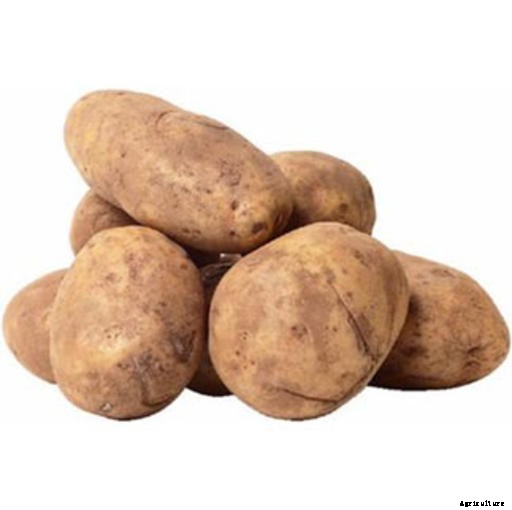
Punjab, Sindh, KPK and Baluchistan respectively account for 86, 0.5, 9 and 4.5 percent of the total area and 88.3, 0.3, 7.2 and 4.2 percent of the production of potatoes in the country.
The shares of autumn, spring and summer crops in the annual production are estimated at 75, 10 and 15 percent, respectively.
Punjab: Okara, Sahiwal, Kasur, Sialkot, Sheikhupura, Jhang, Lahore, Narowal, Pak pattan, Gujranwala, T.T. Singh and Khanewal.
KPK: Nowshera, Dir, Swat, Balakot, Sakardu and Mansehra.
Baluchistan: Pishin, Killa Saifulla and Kalat.
Gilgit Bultistan: Gilgit
These are the important potato growing districts, accounting among themselves for 78 percent of the total production of the crop.

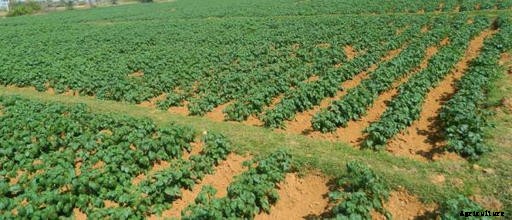

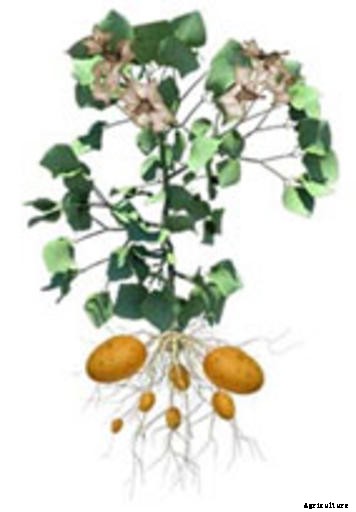
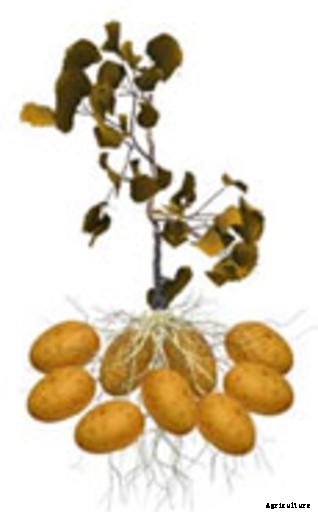
Potato is grown under temperate, subtropical and tropical conditions. It is essentially a “cool weather crop”, with temperature being the main limiting factor on production. Optimum temperature for germination, vegetative growth and tuber formation in potato is 25°C, 20°C and 16-24°C respectively. Tuber growth is sharply inhibited in temperatures below 10°C (50°F) and above 30°C (86°F); while optimum yields are obtained where mean daily temperatures are in the 18 to 20°C (64 to 68°F) range.
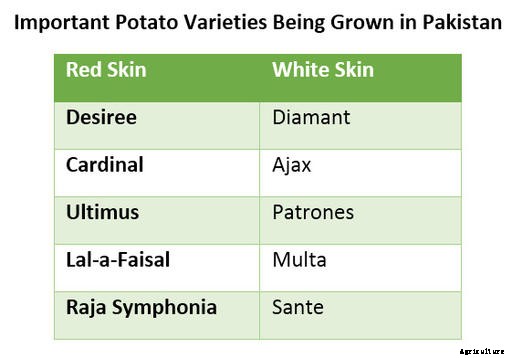
Red and white skin potato varieties are cultivated in the country. The white skin varieties are Santé, Multa, Diamant, Hermes, Lady Rosetta, Ajax and Patrones while the red skin varieties include Lala Faisal, Ultimas, Desiree, Cardinal, SH – 5, Kuroda, Oscar and Symphonia.
The potato can be grown almost on any type of soil except saline and alkaline soils. Naturally loose soils which offer the least resistance to enlargement of the tubers are preferred and loamy and sandy loam soils that are rich in organic matter with good drainage and aeration is most suitable. Soil with a pH range of 5.2-6.4 is considered ideal. To prevent the build-up of pathogens in the soil, farmers avoid growing potato on the same land from year to year. Instead they grow potato in rotations of three or more years, alternating with other dissimilar crops such as maize, beans and alfalfa.
Potato is propagated vegetatively. Well decomposed farm yard manure at 200-250 maunds per acre is recommended to be incorporated in the soil before land preparation. Field is given a soaking irrigation nearly two weeks before sowing to provide seed tubers with ample moisture for germination. Good water penetration and aeration is must for proper growth and tuber formation. Excessive tillage and land preparation causes compaction and should be avoided. To be effective the soil should be plowed below any compacted layer within the normal root zone and then disk harrowed before planting. Spike-tooth harrowing to break clods and level the soil may be needed just prior to planting.
For autumn and summer sowing potatoes complete potato is used. Potato tubers about one week before sowing are taken out from cold storage and spread at a cool and ventilated place usually under the shade of a tree. It starts bud development in 7-9 days and is sown when the sprouts are 1cm long. Potato seed remains dormant for 12 – 16 weeks so the tubers obtained from autumn crop and spring crop tubers is not used. Seed tubers are treated with fungicides like dithane-M, captan or Benlate to protect them from fungal infections. Potato tubers can be planted either on flat beds, in the furrows or on the ridges; however ridge sowing is the most preferred method. Ridges are 30cm high and 60cm wide. Ridges are marked at 2 to 2.5 feet apart and the seed tubers are kept at 6 – 7 inches distance and at the end, the ridges are made using a tractor drawn ridger to cover the seed with soil.
Potato accomplishes its growth very speedily and has high nutrient requirements. There are several types of planters available that place the seeds in the soil and apply fertilizer and systemic insecticides in one operation. Seed depth should be about 4 inches below the top of the planted bed. Soil is ridged over the row by throwing soil to the plants during early cultivation, so that about 6 inches of soil cover the seed tuber when tuber formation occurs. For spring sowing potatoes tuber can be cut into pieces before sowing but the weight of each piece must be nearly 50g possessing 2-3 eyes. However, the cut pieces are more vulnerable to diseases. Sowing of sprouted seed is preferred which results in higher yields than the un-prouted ones.
The seed contributes about 35-40% of the total cost of production in Pakistan. Formal certified seed production is limited and faces technical, economical and managerial problems. Lack of availability of sufficient quantities of good seed and low purchasing power of the farmers, forces them to rely on seed sources of doubtful quality or own production for which most of them do not have the proper skills. For acquiring optimal potato yield certified, healthy, vigorous and disease-free seed tubers are indispensable. Seed tubers must be of uniform size and shape without any sign of infection. Use only certified seed tubers. Seed required to plant an acre depends upon seed size and seed spacing. Potato seed tubers required 25 – 35 maunds per acre and it should be medium in size.
Potatoes are easy to grow, but they prefer cool weather so you should try to get them into the ground at the right time. The time for plantation of autumn crop, which contributes more than 70% of the total yield, starts in early October and ends in mid-November. Spring crop contributing less than 10% to the total yield, can be sown from mid-December to mid-February while the summer crop contributing more than 15% is sown in early April up to mid-May.
Before planting for the Punjab autumn crop, pre-irrigations may be required twice. The first one is required about 15 to 20 days before planting. It will allow annual weeds to germinate. Soil preparation should resume some 7 – 10 days after the first pre-irrigation. If there have been rains in this period and the soil is humid, this irrigation may not be required. The break in soil is still essential. The second pre-irrigation should be applied about 3 – 4 days before planting. Again this is only required if there are no rains during this time. It will help the germination of the tubers and reduce the risk of rotting, especially under hot weather conditions. Pre-irrigated soils help to achieve homogeneous germination.
Soil moisture is probably the most important factor determining potato yield and quality. About 15 – 20 inches of water is needed with center pivot irrigation system to produce a potato crop in Pakistan. When irrigation is practiced to supplement rainfall it should be applied in frequent light amounts. Secondary growth and growth cracks occur when irrigation or rainfall occurs after moisture stress. The soil should be kept uniformly moist until tubers have reached full size. For irrigation management decisions:
On extremely sandy soils it is nearly impossible to prevent the soil from drying below 65% of field capacity due to the low water holding capacity. Potato is irrigated 5 – 7 days after planting or even earlier and the subsequent irrigations are applied depending on the soil, crop and environmental conditions by several intervals.
Well decomposed farm yard manure at 200 – 250 maunds per acre is recommended to be incorporated in the soil before land preparation Recommended NPK per acre is three bags of urea, 2 bags of DAP and one bag of SOP 50kg. All DAP & SOP is broadcasted at the time of 2nd pre-irrigation to easily dissolve in the soil. Urea is applied in different splits through fertigation system from 25 – 65 days after sowing. Contact between fertilizer and seed is avoided as it results in deterioration of seed tubers. Zinc sulphate 10kg bag 25% is also necessary to cure zinc deficiency.
The Potato crop in Pakistan is affected by many pests and diseases. From these diseases potato viruses, powdery scab, potato cyst nematode, aphids and white grub are the most damaging ones. Surveys done by Pakistani workers have revealed that viruses, powdery scab and aphids are wide spread, white grub are serious problems in the northern hilly areas.
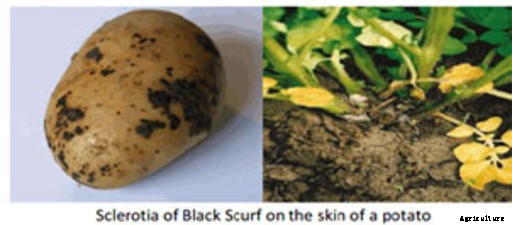
Black Scurf is a fungal disease of potatoes and is caused by Rhizoctonia solani. It is usually found as irregular, black, scab-like marks on the skin of the tubers. They are easily scraped off with a fingernail and this releases a distinctive ‘fungal’ smell. These black masses are the resting phase of the organism and are made up of compacted mycelia, called sclerotia. They do not spoil the flesh of the tubers and they are still edible; also the sclerotia do not become any larger during storage.
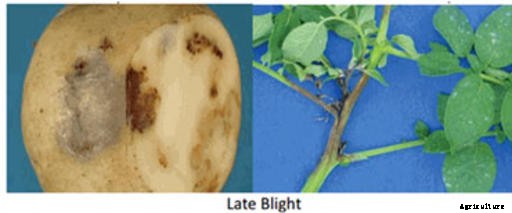
Late blight is caused by the fungus Phytophthora infestans. Unlike most pathogenic fungi, the late blight fungus cannot survive in soil or dead plant debris. It is a serious disease and found major yield limiting factor in high hills and is also a serious problem in plains; it may reduce the yield up to 70%. Usually no symptoms appear before the month of December.
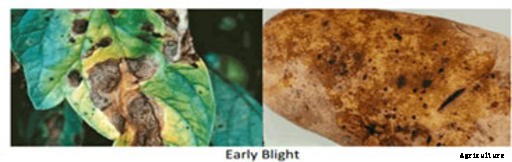
Early blight is caused by the fungus Alternaria solani, which survives in infected leaf or on stem tissues or in the soil. This fungus is universally present in fields where Potatoes and tomatoes have been grown. It can also be carried on tomato seed and in potato tubers.
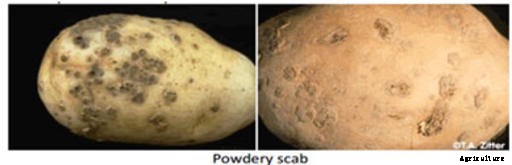
Powdery scab of potato is caused by Spongospora subterranea. Potato cultivars that are susceptible to the disease present sponge-like galls on the roots, stolons and scabby lesions on the tubers. Potato plants that are infected with the pathogen develop necrotic and deformed roots, which may affect plant vigor. The reduction of plant vigor can potentially influence the development of large tubers that are needed for processing.
Potato crop matures in 100 – 120 days. Drying of vines, hardening of potato skin and yellowing of leaves are the indications that the tubers have gained maximum size and weight. Potatoes are reaped either using a mechanical harvester or manually using spade for their digging. Tubers if kept under shade for 2 – 3 days harden their skin to avoid its removal during grading and packaging. Tubers are graded for separate packaging of superior grade to get high prices. Potato tubers which are uninjured, clean, dry and free from diseases are packed in clean, disinfected and unspoiled bags. Potatoes to be kept for seed purposes are stored at 3-4°C while the ones to be marketed after 2-3 months can be stored at 10 – 15°C.
Poor post-harvest handling, including transport and storage practices, causes unnecessary damage and losses and reduction of consumption quality. Sufficient cold store space is available in Pakistan. The handling of potatoes in storage is unsatisfactory and poorly managed. Finally, the farmers and consumers are faced with serve cyclical fluctuations in price, as production moves from glut to shortage, so preventing the farmers from enjoying a reliable income and inhibiting the consumer from including potato as a regular staple part in his diet.
The average yield of potato is 20-30 tons/ha, however it depends upon the variety, cultural practices, and location.


