
Welcome to Modern Agriculture!

Gram is a major Rabi pulse crop in Pakistan. It is grown in areas after rain and floods. It is a short duration crop and can be grown between September and November. The best time for sowing is the second week of October.
Being a leguminous crop it is well suited under dry tracks. It requires winter climate weather condition and is allergic to frost. In normal condition the gram matures within four months or a little later. After reaching maturity stage the gram plant cannot stand heavy rains or hail storm.
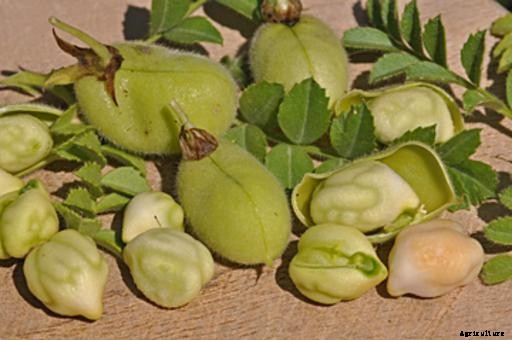
The crop demand rainy condition but it can be grown in less irrigated areas also. The crop is heat resistant and flourishes under good moisture condition. It can bear drought condition due to long taproot which allows using water from great depths than other pulse. It tolerates acidity but is sensitive to salinity and alkalinity. It has the ability to stick to 60-80 percent of its nitrogen requirement and excessive nitrogen fertilizer may delay maturity. In normal condition the gram matures within four months or a little later.
In Pakistan there are two kinds of gram crop namely desi and Kabuli. A good gram crop in case of desi (black varieties) gives an output of 15 to 20 quintals yield per hectare and in case of Kabuli varieties gives about 25 to 30 quintals yield per hectare.
Chickpea (gram) can be grown as one crop or combine with barely, linseed, mustard, peas, corn, coffee, safflower, potato, sweet potato, wheat or sorghum etc. In sequence it always follows rice, wheat and barley.
Chickpea (gram) crop is mostly grown in Punjab followed by Sindh and NWFP. Punjab contributes about 80 percent toward total production but the yield is highest in Sindh.
Chick peas are one of the oldest pulses known and cultivated from ancient times both in Asia and in Europe. It is assumed that gram is originated either from Himalayas or Mediterranean region. At present it is grown in Pakistan, India, Italy, Greece, Rumania, Russia, Egypt, North Africa and many other countries of world. Chickpea is valued for its nutritive seeds with high protein content, 25 – 28% after dehulling. Chickpea seeds are eaten fresh as green vegetables, parched, fried, roasted, and boiled; as snack food, sweet and condiments; seeds are ground and the flour can be used as soup and to make bread; prepared with pepper, salt and lemon it is served as a side dish as well as dal chana is very popular. There are two main types of chickpea, distinguished by seed size, shape and color. The first relatively small seeds is called desi and with large seed called Kabuli. Desi chickpea is cultivated mainly in the Indo-Pakistan subcontinent. Chickpeas are used both for human consumption and animal feeds in rural and urban areas.
Chickpea is grown in tropical, sub-tropical and temperate regions. Kabuli type is grown in temperate regions while the desi type chickpea is grown in the semi-arid tropics. Gram covers a major portion of rice area in winter season and is common Dubari crop of rice tract in Sindh. Khushab, Thal desert and Cholistan and Bahawalpur are main growing areas are in Punjab.
It is a small, much branched herbaceous plant rarely exceeding 60 centimeter height. The leaves are innately compound, usually with one terminal leaflet. The number as well as the size of the leaflet, however, varies in different types. There are 9 – 15 pairs of leaflets. The leaflets of the pinnate leaves are small, and have serrated edges. The leaves are covered with glandular hairs. The color of the leaves also varies; some being light green while other is green or dark green. Certain types possess leaflets with red margins. Flowers are of various colors from white to shades of pink or blue. Anthesis starts between 9 AM – 10AM and may continue up to 3 PM. The flowers remain open for two days, the flowering process being over early on the second day. Self-pollination is the rule, but cross pollination may occur to the extent of about 5 – 10% due to agency of insects. The pod is about 2 cm long and usually contains two seeds. A single plant produces about 50 to 150 pods. Chick pea has a well-developed root system. The roots usually include a central strong tap root, with numerous lateral branches that spread out in all directions in the upper layer of soils. There are numerous nodules on roots. The rhizobium bacteria present in these nodules fix up atmospheric nitrogen.
Two distinct types of chickpeas are recognized.
Chickpeas with colored and thick seed coat are called desi type. The common seed colors include various shades and combinations of brown, yellow, green and black. The seeds are generally small and angular with a rough surface. The flowers are generally pink and the plants show various degrees of anthocyanin pigmentation, although some desi types have white flowers and no anthocyanin pigmentation on the stem. The desi types account for 80-85% of chickpea area. The splits (dal) and flour (besan) are invariably made from desi type.
The Kabuli type chickpeas are characterized by white or beigecolored seed with ram’s head shape, thin seed coat, smooth seed surface, white flowers, and lack of anthocyanin pigmentation on the stem. As compared to desi types, the Kabuli types have higher levels of sucrose and lower levels of fiber. The Kabuli types generally have large sized seeds and receive higher market price than desi types. The price premium in Kabuli types generally increases as the seed size increases.
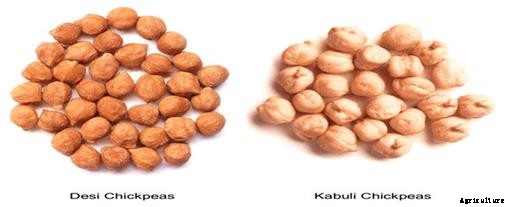
Chick peas are usually grown as a rainfed cool-weather crop or as a dry climate crop in semi-arid regions. Kabuli types are less tolerant than Desi types to dry conditions, as they require more moisture to achieve a satisfactory grain size and yield. Frost, hailstones, and excessive rains damage the crop. Relative humidity of 21 – 41% is optimum for seed setting.
Chickpea is grown on a wide range of soils in Pakistan. Gram is generally grown on moderately heavy soils, light soils, mostly sandy loams are preferred in Punjab i.e. Thal and Cholistan desert. Though gram is grown on all kinds of soils, sandy loam to clay loam is considered to be most suitable. The best type of soil for chickpea is one that is well drained and not too heavy. On dry and light soils, the plants remain short while on heavy soils having high water retention capacity, the vegetative growth is abundant, light becomes limiting and fruiting is retarded. The soil chosen for its cultivation should be free from excessive soluble salts and near neutral in reaction. However, it is not suited to soils having a pH higher than 8.5.
Chickpea is highly sensitive to soil aeration. This imposes a restriction for its cultivation on heavy soils and calls for special care in seedbed preparation. A rough seedbed is required for chick pea. In case the chickpea crop is taken after a kharif fellow, it would be desirable to go for a deep ploughing during the monsoon as the same would help in larger conservation of rain water in the soil profile for subsequent use by this crop. Very fine and compact seedbed is not good for chickpea but it requires a loose and well aerated seedbed.
Chickpeas are propagated from seeds. Sowing is usually done on conserved soil moisture. A pre-sowing irrigation may be needed, if the available soil moisture is not adequate for germination. Drilling is best sowing method of chick peas. Row x Row spacing 25 – 40 cm and plant x plant spacing 10 cm at the depth of 2 – 12 cm with soil well pressed down. Soil is worked into a rough tilth, clods broken and well leveled. Seed is sown from mid-September to mid-November and best time of sowing is 15th of October. Seeding rates vary from 30 – 40 kg per acre depending on the area and seed type. Chickpeas are also grown as a catch crop in sugarcane fields and often as a second crop after rice. Although usually considered a dry-land crop, chickpeas develop well on rice lands. In virgin sandy soils or for the first planting in heavier soils, inoculation is said to increase yield by 10 – 62%”.
In Pakistan there are two kinds of chickpeas are grown i.e. desi and Kabuli. A good gram crop in case of desi (black varieties) gives an output of 15 to 25 maunds yield per acre and in case of Kabuli varieties gives about 25 to 30 maunds yield per acre
.
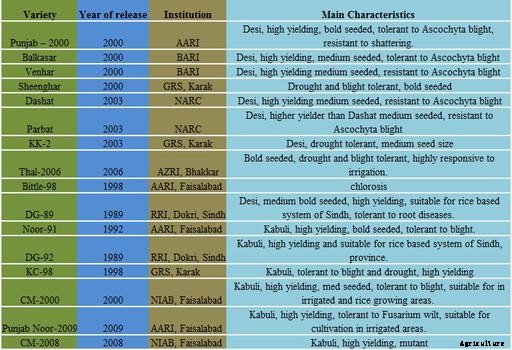
Chickpeas are poor competitors with weeds because of their slow emergence and growth during winter. Effective weed control is essential for good yields and to avoid the buildup of troublesome weeds in the rotation. Management for broad leaf weeds needs to begin in the preceding cereal year because there are few options for in-crop control. In particular vetch and other self-sown pulses can be problematic weeds.
Chickpea being a stature crop suffers severely by infestation of weeds. One hand weeding or inter culture with hand hoe or wheel hoe after 25 – 30 days and second if needed after 60 days of sowing may take care of weeds. Roundup herbicide can apply as pre-planting spray may be used as an effective herbicide. Hand weeding or inter culture with the help of hoe is always better than herbicides because inter culture operations improve aeration in the soil and root zone.
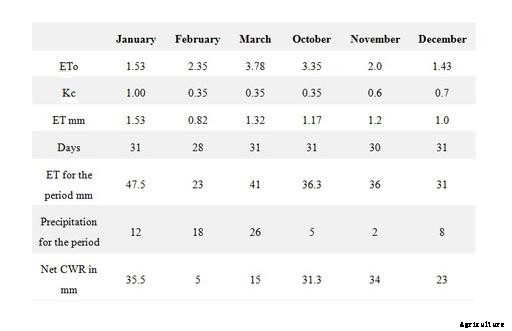
Chickpea is the most drought tolerant crop and thus suited well for light textured soils. Pre irrigation is essential to fulfill the soil profile to get proper germination. Total crop water requirement is vary from 150 – 250mm for different areas in Pakistan.
Water logging at flowering or poding can kill the crop or significantly reduce yield, especially at higher temperatures. Drainage must be excellent and watering time as short as possible, preferably less than 8 hours and definitely less than 24 hours (in heavy soil). Irrigation with Sprinkler system should be controlled to reduce the chances of disease because sprinkler irrigation can cause of foliar diseases like Botrytis grey mould.
Chickpea is a legume. It has nodulation capability which can fix atmospheric nitrogen into the soil, if seed is inoculated with bio-fertilizer using inoculants developed for nodulation of chickpeas. The bio-fertilizers for chickpeas are available with NARC and other establishments of PARC. 1.2 bags of inoculants are sufficient to treat the seed of one acre. High and effective nodulation on the roots of the chickpea is an important agronomic factor for enhanced productivity and fixation of atmospheric nitrogen into the soil. The genotypes are now available with high nodulation capacity and consequently with higher yields. One bag of DAP as phosphorous is recommended for one acre. Foliar application of liquid micro-nutrients (zinc and boron) is suggested based on the recommended dose for soils which are excessively exploited or low in fertility.
The plants start wilting and ultimately dry up at seedling and/or at flowering stage. The diseased plants are pulled out easily, due to the loss of rigidity. Sometimes, sudden drooping of leaves or only a few branches of a single plant is affected. The disease mostly spreads in patches, but entire field may also be affected in severe conditions. Severe damage has been reported during early pod filling.
The disease causing fungus may survive and carried over from year to year by sowing infected seed, while the diseased plant debris lying in the field or in the threshing area also helps the fungus to remain alive.
Cultivation of disease resistant variety is only the most easy, economical and safe method.
The disease starts from the base of the plant, which result in the death of the whole plant. The infected plants could not be differentiated in early stages from the distance. The affected plants may show partial or total drying, with purple to dark brown spots of different sizes on stems, branches, leafstalks and leaflets. These spots become brown to black lesions and affected plants or plant parts show burnt appearance. Primarily individual infected plants may be observed scattered but later on the disease appear in circular patches and ultimately the entire field come under attack, therefore, whole crop may be destroyed completely. The disease symptoms may also occur on the pods and seeds. The pods produce blackish spots while the seeds become shriveled.
The disease causing fungus is a soil borne and can remains viable for considerable periods. Seed may also help fungus to survive.
The control measures are same as suggested for wilt disease of gram.
The spots appear on leaves, gray to brown in color and circular to irregular in shape. These spots increase in number and size, which turn into lesions of a reddish brown margin. The size of pods and seed is reduced, hence yield decreased considerably.
The disease causing fungus is seed borne.
The control measures are same as recommended for the wilt of gram.
The disease is difficult to identify in initial stages. However, dark lesions are formed on the main stalk near soil level, forming localized dark green patches. The tissues of the affected portions become weak and shredded easily. If the plants will pull out, the basal stem and root may show dry rot symptoms.
The disease causing fungi are soil borne and remain viable for long period.
The control measures are same as recommended for the wilt of gram.
All the aerial parts of the plants are infected by the disease causing fungus. Initially, small spots appear in scattered manner but later on the coalesce, giving rise to broad lesions, which become dead. The spots are usually depressed with dark center and bright red or orange margins. Sometimes, such lesions are seen lenticular to circular sunken and tan to brown.
The disease is seed borne, but secondary spread takes place by air borne.
The disease could be controlled by spraying suitable fungicides, but the suggestions given for the control of gram wilt may also found fruitful.
Chickpeas mature in 3-7 months and the leaves turn brown/yellow during maturity. For dry seeds, the plants are harvested at maturity or slightly earlier by cutting them close to the ground or uprooting. The plants are stacked in the field for a few days to dry and later the crop is threshed by trampling or beating with wooden flails. The chaff is separated from the grain by winnowing. Tall cultivars are suitable for mechanized harvesting in which case combines can be used. Chickpeas are usually stored in bags, but are more subject to insect damage than when stored in bulk. Proper cleaning, drying, and aeration are necessary to control seed beetles. A thin coating with vegetable oil can reduce storage damage. Sometimes baskets, made from twisted rice straw, are used as storage containers.


